From the Editor.
Question the First
“The plan herein suggested assumes that since the Church is living in an order and world-spirit radically different from the past, it must change its method of approach to meet the new situation.”
What was Sheen’s watershed, the dividing line in his mind between past and present? Was it the French Revolution? The Industrial Revolution?
No, I think his dividing line was “the Great War” as culminating in the Russian Revolution. The following paragraph and others in the proposal will be seen to corroborate this judgment:
War, depression, economic chaos, the surrender of science to war, and a disappointed hedonism which turned to pessimism turning minds from a Philosophy of Progress to a Philosophy of Despair and a sense of human frustration and anticipated catastrophe. This modern despair unlike other despairing periods of history a) has no hint nor hope of a brighter future supplanting the evil present, b) nor does it look to the past. Its ideal is not retrospective, but anti-traditional.
Remember, he began his studies at Louvain in 1920, only six years after the German army had burned the university's library, destroying medieval manuscripts and over 200,000 volumes.

But Sheen is unusual in the array of problems he sees as arising specifically in this new era:
Birth control, living wage, family rights, sex, public morals, Totalitarianism, class conflict, racial snobbery are all so many problems issuing from the value of a human person.
His worldview (as is evident elsewhere in the proposal) is mainly European, not American. He still presumes that American culture will be determined by European culture. So his dividing line is drawn from European history, the Great War and the Russian Revolution, rather than from American history, say, the New Deal.
Question the Second
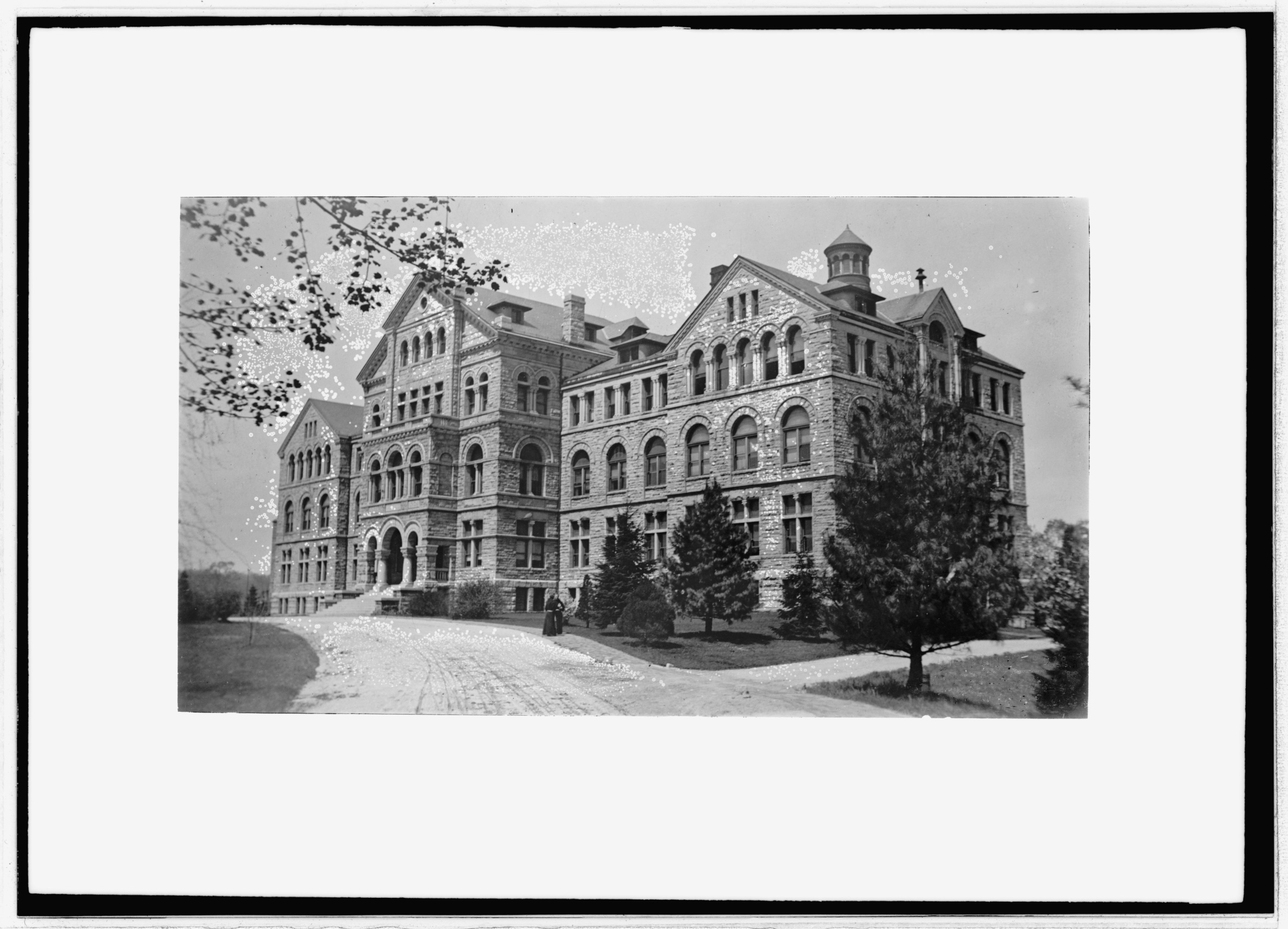
He refers to his Institute as “a university within a university.” He envisioned it as a unit within The Catholic University of America.
Even so, could his proposal be used as a blueprint for a freestanding university? Is the proposal his own “Idea of a University,” corresponding to Newman’s? Might we someday even see a “Blessed Fulton Sheen University” based on it?
No, I think not, but it could be used as a plan for a college teaching a core curriculum within a research university. I will explain why.
It is usual to say that the members of a research university have three duties:
first, to discover truth, which is “research”;
second, to pass on truth, which is “teaching”; and
third, to contribute to the common good in some way, of the university and of society, which is “service.”
Pope St. John Paul II uses this schema in Ex Corde Ecclesiae.
But Sheen is innovative for discerning, rightly, that there is a fourth duty, namely the “application” of truth:
There is not only much truth yet to be learned, but there is also much more acquired and revealed truth which has yet to be applied. Catholic education is not merely an exhortation to extend the frontiers of truth; it must also be primarily the announcement of salvation, not only for the individual soul but for society as well.
This work of “application” must be integrative. It would require that professors from different departments actually talk with one another, and also grow in their understanding of theology and philosophy, so that they can begin to represent within themselves the unity of faith and reason:
It would break down the assumption that religion is a department of life and restore its dignity as the soul of life. The present teaching of religion is that it is something to be learned; the Institute would add that it is something to be realized for Catholic Action is nothing but Catholic realism, or the remarriage of thought and action.
The modern research university ignores “application” in this sense completely. And, therefore, so does a Catholic university, if it models itself on a modern research university.
(Although Ex Corde Ecclesiae uses the three-duty schema, it speaks of the integration of knowledge, the dialogue of faith and reason, ethical concerns, and evangelization [nn. 15–20 and 48–49]. It contains Sheen's “application” in substance. Indeed, one might say that Sheen anticipated its most important themes.)
Newman uses the language of a “naked college” and a “naked university.” He disapproves of both.
A naked college is a residential college not placed in the broader community of a research university, which has professors who are leading experts, who can lecture with care on the most advanced topics in their disciplines.
A naked university is a research university with experts like that but with no residential college where students are formed in their character and, in the first instance, are intent on studying disciplines handed down from the past.
Sheen’s Institute is a remedy for a naked university but on its own would be a naked college.
His phrase “a university within a university” is misleading. He uses this language because he is thinking of the professors, who would have their own work to do within it. But from the point of view of the students, his Institute would be “a college within a university,” presenting an innovative core curriculum designed to equip Catholics for living effectively in the modern world.