


“To Meet the New Situation”
On Sheen’s Proposed Institute of Catholic Culture
(the second in a two-part series)
by Jonathan A. Buttaci
What is man that you are mindful of him,
and the son of man that you care for him?
After more than a decade of teaching—first in the School of Theology, later in the School of Philosophy—the then-Monsignor Sheen proposed a new Institute of Catholic Culture at Catholic University. In doing so, he sought to meet the new challenges presented by contemporary culture, while drawing on the University’s academic strengths—especially in philosophy and theology—and the Church’s perennial intellectual tradition.
His proposed Institute was to be integrated, operating across disciplinary boundaries as “a kind of university within the university.” Sheen was looking for a way to facilitate greater collaboration among traditional departments and schools, while respecting their proper boundaries and areas of expertise. He envisaged a “hierarchy or pyramid” of studies, “at the peak [of which] would be the superior sciences of theology and philosophy.” Even so, he insisted, these disciplines should not “impose their principles on [the social] sciences but rather utilize their findings.” He wished his Institute to supplement, and not replace, the academic work that the University was already pursuing.
In taking this approach, as in many others, Sheen proved to be well ahead of his time.
The Review will publish tomorrow the full text of his proposal. In this essay, as a guide to understanding the proposal and its significance, I shall explain his overall vision.
To start, someone might reasonably ask, “Apart from its having some niche historical interest, why should we—here, today—study an outline of a proposal for an academic cultural Institute from a very different time and academic culture, especially when Sheen’s Institute never came to be?”
In reply, I would draw attention to a common and important theme of his teaching. When discussing politics, both civil and ecclesial, and especially in view of proposals for social reform, Sheen would insist on the reform of the individual:
If we would remake the world, we must begin by remaking the individual man; then the institutions will be good enough, for they will resemble the good men who made them. (The Way to Happiness [1949], 189)
This provides the key to how Sheen himself would have wanted us to learn from him most deeply.
---
There are, of course, several obvious lessons. The first concerns strategy. Sheen’s Institute is intended, most centrally, to equip the Church to “meet the new situation” in which she finds herself:
The plan herein suggested assumes that since the Church is living in an order and a world-spirit radically different from the past, it must change its method of approach.
It is easy to underestimate how striking these words would have been in 1938.
Sheen identifies a number of changes that the Catholic academy needed to address. Some of these would have been familiar at the time: for example, the rise of outright unbelief and the shift away from Protestantism as the Church’s chief antagonist. But others would likely have seemed novel. He highlights a shift in modern culture from progressive optimism to despair. He describes how this shift is manifested in contemporary scientific and philosophical approaches, as well as in political and economic programs. And yet he also notes that modern culture, in abandoning its hope for progress on its own terms, has seen even science change:
Today Science has become idealistic and even mystical. It is now “too religious.” The new attack is not from the domain of science, but from the social order.
Here again his words prove prescient, and we find them no less true today.
His extended diagnosis of this “new situation” is worth reading, but it can be summed up as follows:
Since then the religious program of the Church in relation to the world must take cognizance of the errors of the time, and since the new errors are quite radically different from the past, it follows that the Church must present its eternal verities with a new emphasis.
What, then, will give the requisite unity to the proposed Institute’s approach? Sheen bases his remedy on his diagnosis:
The nature of the new approach will depend upon the fundamental and basic problem which underlies all other problems. It is the position of this paper that the basic problem is: – MAN.
Sheen then goes on to articulate, in a second section, the end or purpose of his strategy. He notes that ecclesial and scholarly authorities agree that the Church is uniquely situated to articulate “the fundamental doctrine of man” against “modern errors” that seek to dehumanize us. In this, Sheen anticipates an important teaching of the Second Vatican Council:
… the council wishes to speak to all men in order to shed light on the mystery of man and to cooperate in finding the solution to the outstanding problems of our time. … The truth is that only in the mystery of the incarnate Word does the mystery of man take on light. (Gaudium et Spes 10, 22)
This is why Sheen focuses not only on an integrated and comprehensive anthropology—including both philosophical principles and the work of social science—but also on theology and “Catholicity”:
The new program should take account of integral man, i.e. as natural and supernatural, personal and social. … It should integrate Catholicity (not merely the philosophy of man) with every sphere of human activity: political, economic, social, juridical, scientific, historical, etc., thus breaking down the assumption that religion is a department of life distinct from and often unrelated to other departments, valid only in its own sphere and with a principle of operations different from those in the secular sphere.
That is to say, nearly ninety years ago, Sheen was saying (as is commonly said today) that the contemporary problem is the problem of what it is to be human. Sheen once again sees further than most of his contemporaries, insisting not only that the Church is uniquely situated to speak prophetically about human nature, but also that the Church must not forget why she is so situated.
He concludes powerfully by quoting St. Thomas:
“All human activities are at the service of Divine Truth.”
There are many other insightful observations in Sheen’s proposal. Here are a few that are worth noting in brief:
(1) He takes the traditional task of apologetics to be too negative and reactive, and thus unsuitable for the present challenges. Sheen proposes that we move away from:
an approach which takes its form and content from the error to be answered rather than from the truth to be presented. … a philosophical ethics however valid it be is not the Catholic solution to all the problems discussed.
(2) Among other things, a more positive approach, he says, would be the greatest “protection of democracy against the invasion of all the ‘isms’ which impose a false ideology upon man,” securing “the restoration of the lost virtue of Patriotism as a form of Pietas.”
(3) Sheen emphasizes the cultivation of our nature, reminding us of the core meaning of culture:
The word “cultivation” in relation to nature means inciting nature by human labor to produce fruits which nature of and by itself is incapable of producing. Applied to man, culture means the unfolding of human possibilities through reason and grace, or the rational and spiritual development of the whole man.
Hence, presumably, his choice of the name, The Institute of Catholic Culture.
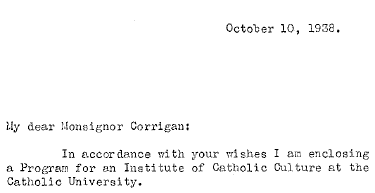
Finally, one cannot help noticing the practical urgency of Sheen’s tone throughout the proposal. In his brief cover letter to the Rector, then-Monsignor Corrigan, he wrote that the Church “must be put upon a new war-footing to meet the changed conditions.” Sheen is martial in his intensity, while also sober and clear-eyed in his strategic analysis. Although the Rector had apparently invited the proposal, Sheen’s own eagerness is revealed by his choice of closing in that letter: “With Christian impatience to serve you and the University, I remain, respectfully yours in Christ.”
Sheen insists on the need for “Catholic Action [which] is nothing but Catholic realism.” He sought real and practical effects from this proposal. He had no time for empty theorizing and endless deliberation.
In conclusion, think again about Sheen’s principle that all reform begins with reform of the individual. Taking that approach seriously, one wants to say: every teacher and professor, every parent, priest, and principal stands to gain from a personal reflection on the model of Christian cultural engagement in Sheen’s proposal. Perhaps most of all we can imitate his impulse to go beyond merely speaking out in criticism. It is also necessary to build, since, as he says, the Catholic religion is not only “something to be learned” but also “something to be realized,” “in the remarriage of thought and action.”
Some of us will enjoy having the resources and opportunity to reform old institutions or found new ones. But if Sheen is right, all of us—with Christian impatience—must embark upon a program of self-reflection and self-reform, by first “remaking the individual man.”
Jonathan A. Buttaci, an Associate Editor of this Review, is Associate Professor of Philosophy at The Catholic University of America and a Senior Fellow in the Gibbons Institute.
Photos courtesy of The American Catholic History Research Center and University Archives (ACUA), The Catholic University of America, Washington, DC.