



Catherine Ruth Pakaluk

Opening keynote, “AI and the Future of Work,” Leonum Institute for AI and Emerging Technologies, The Catholic University of America, September 25, 2026. Text as delivered, with sources added.
This is the second of two parts. Part I argued that the moral meaning of work, like that of having children, lies in the ranked goods to which it is ordered, and that the higher goods are learned by way of the lower.
4. Is There a Crisis of Work?
It would seem that there is not. Unemployment is relatively low. [1] Hours worked look pretty stable for the last forty years after a modest (7%) decline from 1960 to 1980. [2] Hours per person—including non-workers—actually rose as women entered the labor force through the 2000s. Email and devices have pulled work from the office into every corner of our lives: the commute and the hours after work. There was no major tech shift in work to correspond to the birth control pill, no work revolution to reflect the sexual revolution. Indeed, we professors still urgently assign Pieper to our students, as if the big problem were people working too much—the culture of “total work” that Pieper criticized in his day. [3]
On the contrary, there is a crisis of work that is still hidden, and we must take account of it before assessing AI and the future of work. I will give a summary account under three main headings: first, general work trends; second, the expansion of credit; and, third, the decline of marriage as a governing ideal.
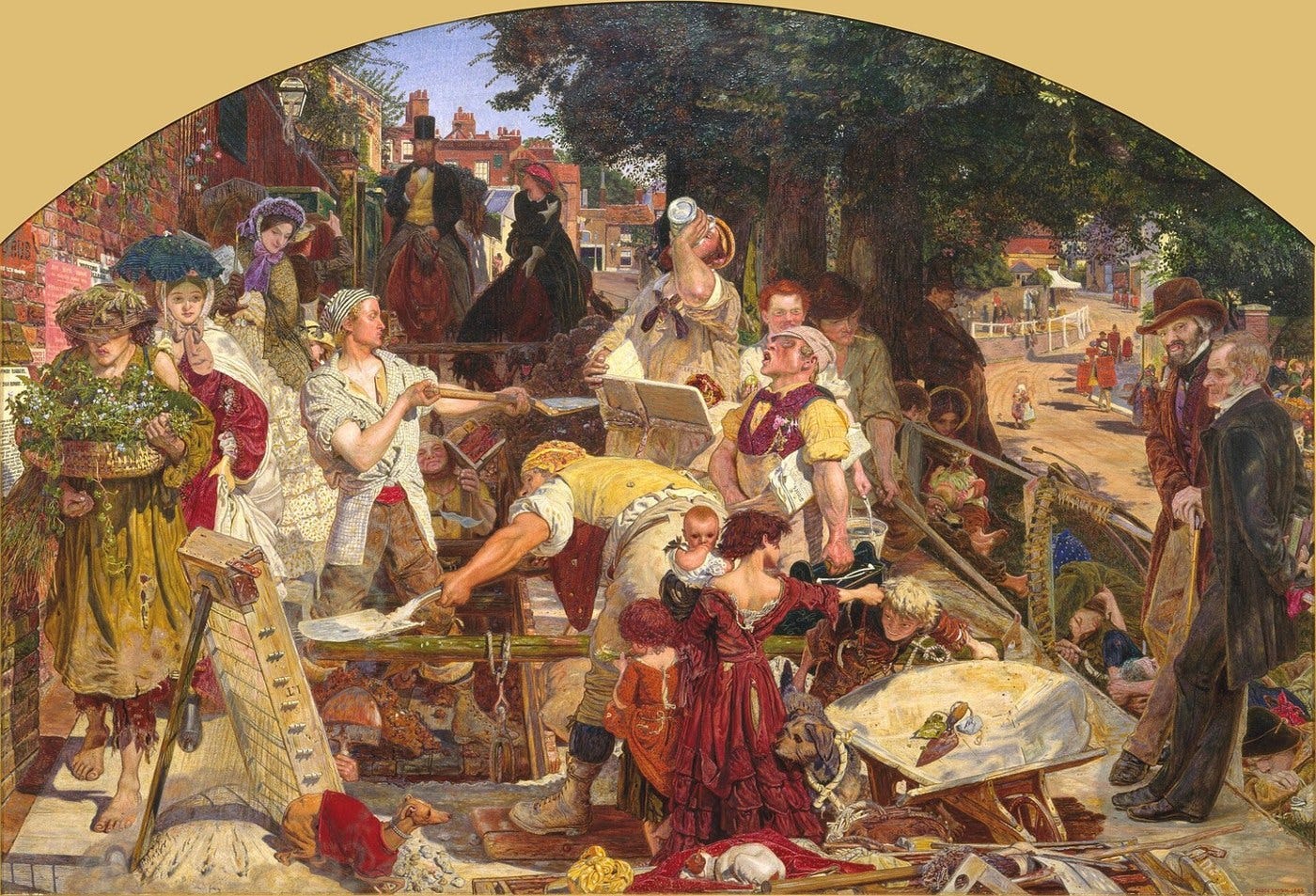
First, as regards general work trends—and bear with me as I cite data that document my point—from 1965 to 2003 men’s “market hours worked” fell about 12 hours per week, while women’s hours rose about 7. At the same time, working at home fell for women, and leisure rose by 4–8 hours per week for both sexes. In other words, men worked less, while women worked more, supplementing household income. As a result, over those nearly forty years, leisure at home rose by almost a fifth of a 40-hour workweek. [4]
This recent trend falls within a long-term downward trend in male labor force participation (“LFP”). In 1954 virtually all American men aged 25–54—98%—were working or looking for work. It was 96% in 1965; 94% in 1980; 92% in 1990; 91.5% in 2000; it reached a low of 88% in 2014. It has hovered around 89% since 2019. [5]
A decline of nine percentage points may sound small, but it means that about one in nine prime-age men is neither working nor looking for work, versus one in fifty in 1954.
To understand this long-term trend among men, consider the following points. (1) It’s not that men switched to unpaid care. Time-use data show that non-working prime-age men spend less time on housework and childcare than working men and more time on screens. [6] (2) The decline is not a matter of weak demand for labor; it is, rather, a long-term trend that has persisted through booms and busts. (3) The case of women, by contrast, sharpens the point about demand. Prime-age women went in the opposite direction, from 37% LFP in 1950 to about 78% today, [7] which means that there has been a strong demand for workers—but men are not filling it. The downward trend in male LFP is seen mainly in non-college-educated men, and yet there are millions of unfilled jobs available in the trades. [8]
The downward trend in LFP is seen in other age ranges as well. I’ve just considered “prime-age” male and female workers. What about younger people? “Pre-prime-age” trends run parallel: teen LFP peaked in 1979 at around 60%. It fell to around 34% in 2011. And the reason is not that these young people are in school, because the participation rate of teens enrolled in school fell from 42% in 2000 to 25% in 2015. [9] If work begets work (as I claimed earlier), then our work formation pipeline is looking rather thin.
What about people at the other end of their lives, nearing retirement or “post-prime age”? In this group we see a massive retirement expansion made possible in part by Social Security and Medicare: LFP for men 65 and older fell sharply from 45.8% in 1950 to 15.6% in 1993. [10] This trend reversed in the 1990s, with the change from defined-benefit to defined-contribution plans. This reversal fits the lower motive/higher motive thesis beautifully: remove the lower motive and men leave; restore it and they come back. Nobody is staying for the higher one.
In sum, general work trends do point to a crisis of work.
The second main heading under which I wish to make my case is the expansion of credit supplied by fiat money. Household debt relative to GDP was about 25% in the early 1950s. It crossed 50% in the 1980s, and peaked just under 100% in 2008. [11] The ratio of household debt to disposable income went from about 30% in 1950 to about 130% at the peak. Consumer credit (not counting mortgages) ballooned from $21 billion in 1950 to $5 trillion today. [12] About half of Americans with credit cards do not pay off their balances each month. [13] We all know the story of government debt—how we recently passed $40 trillion in national public debt with some fanfare. But Americans in general—as households and as a nation—live permanently and structurally beyond their means. That is to say, they consume what they have not produced. Alternatively, we may say that they consume what they have not (yet) worked for. That is very much a crisis of work. It is a matter of income without production—feigned income. I won’t dwell long on the point here, but ultimately our nation’s full transition to fiat money in 1971 was a sine qua non of this phenomenon of feigned income. Of itself it was perhaps not sufficient to get us to where we are now, but it was absolutely a necessary precondition.

This phenomenon of income without work has cultural manifestations as well: consider trends in betting and gambling, meme stocks, and trash crypto; also, the wider acceptance of UBIs and transfers, not only on the political left but now also on the political right. This is why the California billionaire tax has garnered such broad appeal. [14] Redistribution of wealth is simply expected as a general right owed to everyone: everyone assuming that someone, somewhere, is doing the work. And yet, in fact, we are not doing the work: we are borrowing from our children.
I have been engaged in examining a disputed question, as it were: “whether America is a country obsessed with an ideal of total work” (as someone might claim in the spirit of Pieper). I have been giving a sed contra of sorts, based on trends in labor force participation and borrowing. My third and last argument in this sed contra draws on a point made by Joseph Schumpeter in Capitalism, Socialism, and Democracy in 1942. In a chapter entitled “Decomposition,” Schumpeter argued that a reason to suppose that capitalism might undermine itself was that “the family and the family home used to be the mainspring of the typically bourgeois kind of profit motive,” the locus in life, that is, of “the man whose views and motives are shaped by such a home and who means to work and to save primarily for wife and children.” [15] Schumpeter observed: remove the family, and one of the great lower motives for work goes too. His argument should be read in its entirety: I have not the space or time to do it justice here. But in his view “capitalist inventiveness” would produce “contraceptive devices of ever-increasing efficiency,” implementing new tastes formed by capitalism’s “rationalization of everything in life.” He saw that “a sort of inarticulate system of cost accounting” would reach this most private domain and be applied to children. [16] As it did so, he recognized, so too would the incentive to work decline.
Arguably, the culture of the sexual revolution at its origin in the 1960s was anti-work. But while there was no immediate, society-wide “anti-work revolution” corresponding to “the sexual revolution,” nonetheless, non-marriage and non-childbearing have been silent killers of work. In 1960 about 72% of American adults were married; today about half are. [17]
The relevant consideration would be that, in the final analysis, it’s not that people stopped getting married and having children because “things got too expensive.” It is rather that men stopped working insanely hard because they were able to have fewer children and split the working hours with their wives. Without the “wolf at the door” that one man in my recent fieldwork described, or the “twist of the knife” that another mentioned, they lacked ordinary, powerful human motives to work hard.
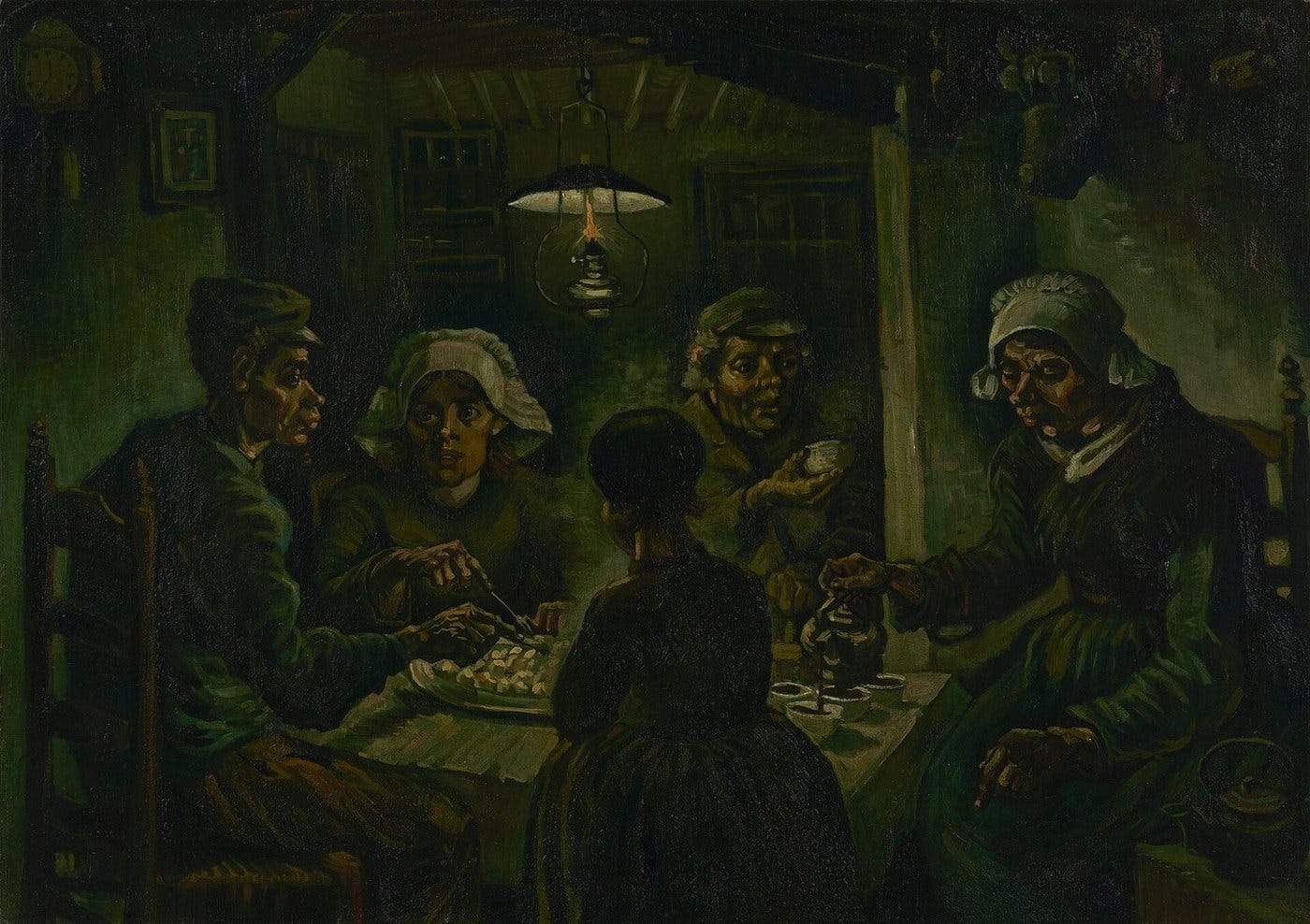
This final point is somewhat dark. It encourages us not to look only at what has happened (downward trends in work, wanting to consume outside of our work earnings) but also to imagine a counterfactual: what would have happened to male work and productivity if men had not stopped getting married and having kids at the same rates as in the past? The decline in LFP is mostly a decline among unmarried men plus a collapse in the share of men who are married. As the Bureau of Labor Statistics tells us, fathers of young children work the most, with a 95% LFP compared with 89% for all prime-age men. [18]
Let me deal briefly with a few objections you might want to raise. What about these households with more leisure? Isn’t that basically good, to have more leisure? Sure, in the abstract, leisure is good; but we are also flooded with memes and complaints about how the poverty line for a family of four might be reaching $140,000, [19] and about how a household cannot get by on one income as it could in the past. We are trying to square a circle: to praise the leisure effects of moving from one fully driven worker to two half-driven ones, while also complaining that the things households want seem increasingly out of reach.
You might also be concerned that I’m overstating the credit and fiat point: it’s one thing to object to debt, but quite another to accuse debtors of trying to get something for nothing. After all, they’re promising to pay it back with future work. There’s some truth to that, of course, as regards secured loans especially. I’ve paid off cars with my own work, and most of us hope to pay off a home with our own work. But with unsecured loans, it is a different story, and, in any case, structurally the point stands: household and public debt appears to have no “limiting” principle. We just “raise the debt ceiling” again and again.
The current tremors in the bond market have once again provoked astute commentators to worry about accumulating debt—the ten-year Treasury yield crossed 5% on September 14, 2026, and the man who coined the phrase “bond vigilantes” wrote on September 15 that he was starting to worry. [20] Is a debt crisis in our future? Maybe this year, maybe the next. I do not know. But I do know that living as we have lived since 1971—with no natural constraint on printing money or credit expansion—is a human experiment that has never before been tried. We are a little over fifty years into this experiment, which has much to do with how we see the meaning of work. I do not think the experiment will last, because natural law is against it. Money is a real thing that is merely the most tradable product of our work—not a notional one. We have behaved as if we could make it notional, and make it correspond by fiat to our consumption demands. But ideas have consequences, and if the products of our work are merely notional—not tied to any true purchasing power set by reality—then isn’t it easy to begin to see our work too as merely notional?
Finally, as regards Schumpeter’s point, you might argue that the family isn’t the only lower motive for work, since unmarried and childless men still work, and some of them work very, very hard. This is fair. I do not claim the family is the only mainspring of work. But historically it has been a mainspring that reached to every man, not just the ambitious. It has done so by nature, not by education or culture. What we see today, instead, is a concentration of work among the ambitious, whose hours have increased since the 1980s. It is difficult to estimate the magnitude of the counterfactual: what LFP and productivity would look like today if pre-1960s marriage and family formation patterns had held. To my knowledge, no one has attempted a full estimate; the causal identification would be formidable. But here is a back-of-the-envelope estimate: the six-point gap in LFP between fathers of young children and all prime-age men amounts to about 3.8 million workers. At perhaps $150,000 of GDP per employed worker, we get around $570 billion a year, which is about 2% of GDP before factoring in wage premiums, hours, and fertility effects on the size of the workforce (missing males). Adding in even 5% premiums on the remaining married-equivalent men would push the magnitude of the difference to over 3% of GDP. [21]
Getting those estimates more nearly right would make a great paper. Maybe AI can help me write it. But the gap is real, and it is hardly ever named. The point may be put in this way: we as a nation are less prosperous when men are less married.
Someone might say, looking over my three separate claims about a crisis of work, that in the end I have made only one: the change in marriage and fertility is the cause; the expansion in credit and fiat money is the means—and an accelerant. The fall in labor force participation is only the symptom, the part we can see.
5. In the Beginning
I have argued so far that (1) the moral meaning of work depends on the goods to which it is ordered; (2) the higher goods are learned by working for lower goods when this activity is illuminated by faith; and (3) there is a hidden crisis of work, which has been slowly generated by the crisis in the family.
I have also argued that the crisis in the family has arisen mainly through the erosion of the lower motives for marriage and having children. The result is that faith now correlates with robust family formation, because faith supplies the higher motives, and the higher ones are the only ones left. Putting this all together, one gets the conclusion: faith will increasingly correlate with the lived experience of work, the work that begets work, and faith will be increasingly vital to parsing the challenges presented by AI and the future of work.
I have often been asked: “Can we get the marriage and family ‘magic’ you describe in your book without the religion part?” I can’t say definitively “no.” I’ve interviewed some remarkable men and women who do what faith-inspired families do with apparently no faith. But they are rare, and they are outliers.
We have to be clear that living communities of people with faith help young people get married and have kids in several ways: (1) They name and define the eternal and transcendent value of the child against the false claims of a humanity constantly willing to sacrifice some human lives (the poor, minorities, the weak, or the young) in favor of the demands of other human lives. This is not new but a constant temptation of fallen humanity. (2) They present living models of marriage, including chastity and fidelity, to show that when we say “we believe in love” we mean that it is actually possible, that it is real. You can’t believe in love if everywhere around you are broken promises and failed covenants. (Then the devil whispers: you can’t.) (3) They dampen the sense of risk for young couples, since they say, in effect, “This community stands behind you. You will not fail. We will assist you.”
My prediction is that the same people who wonder today about the “magic” worked by faith for marriages will tomorrow ask about the “magic” worked by faith for a robust ethic of work. And I will say again: I cannot say definitively that nothing besides faith will work. However, in this domain as well, faith names the higher goods, presents models of hard work, and is the ultimate “I have your back” when the going looks risky. “God will provide,” we say—and here is a people who really believes it. That is the natural, hopeful, childlike outlook of people of faith, and it is our natural outlook at this university. Human work is ordered to prosperity, and prosperity is ordered to the growth of the human race, beginning with the growth of our families.
Now at last I can say this: the reason the analogy between children and work does its job, and the reason they both point back to the role of faith, in a time when lower goods give way to the higher, may be found in Genesis 1:28, where children and work arrive for the human race in one breath: “Be fruitful and multiply, and fill the earth and subdue it” (RSV-CE).

In Laborem Exercens John Paul II wrote:
The Church finds in the very first pages of the Book of Genesis the source of her conviction that work is a fundamental dimension of human existence on earth. … Even though these words do not refer directly and explicitly to work, beyond any doubt they indirectly indicate it as an activity for man to carry out in the world. [22]
I’ve had reason to wonder, lately, whether our age is the first age for which “be fruitful and multiply” seems truly binding—for ours is the first age in which reproduction became most fully a matter of choice or human will. Until 1800 the world population hardly budged. But since 1800—we’ve all seen the hockey-stick graphs—human population has exploded, and with it, material and intellectual prosperity.
When Pope Leo XIII wrote Rerum Novarum in 1891, barely a quarter of the world had escaped the grinding reality of the other three-quarters: hunger, poverty, and premature death. [23] This was “the social question,” as it was later called by Pius XI. [24] But today, in Pope Leo XIV’s time, thanks be to God, the proportions are nearly inverted. Fewer than one in ten still face material poverty of the type identified by Pope Leo XIII. [25] The “new social question,” if you will, was named by Mother Teresa, and by John Paul II in his turn: spiritual poverty. It is the same spiritual poverty that lies at the root of the crisis in fertility.
If the new poverty is spiritual, the remedy is not more work or less work, but more faith. And so: the future of work—and of greater progress on poverty and human development in all its forms—depends today as in no previous time upon the future of faith.
In the past, a stiff-necked people may have been fruitful for their own reasons; now, as we are still stiff-necked, we will be fruitful only for God’s reasons. The Commandments, from Genesis to the Decalogue, describe the order of reality. And they are a unity: loosen one and the others loosen with it, as the course of human history shows. Obey God. Honor your parents. Do not take innocent human life. Do not violate marriage or traffic in sex outside of marriage. Do not try to get something for nothing. Do not even think about trying to get something for nothing (the essence of “coveting”). From this vantage point, the commandment to “subdue the earth” through work takes a noble place in salvation history. As this is the first time we’ve been able not to multiply, is it any wonder that we are now tempted not to work?
Where do these remarks leave us on AI? That is not my job to decide, but it is ours to explore. At the very least, I hope we will avoid the hackneyed paths. AI will not replace human work any more than tractors replaced farming, though the number of farmers fell. It will change the nature of some work for some people. Likewise, AI will not free us from work—the Elon Musk–style vision—because AI cannot change the structure of reality given by Nature’s God. These are the fears and hopes of a people already in a crisis of work—already accustomed to getting something for nothing. As a consequence, they look upon AI with greedy eyes—maybe it is the diviner’s rod, or the Midas touch? And then we worry that it will conjure on its own. If you have worked with AI, you know that, of course, it must be guided, guarded, and judged. Human judgment will become even more important, not less so, because judgment is of a person. Nor can AI do work, for work is the domain of the person. “Only man is capable of work, and only man works,” John Paul II wrote in the opening lines of Laborem Exercens. [26]
Let me be clear about what I am not saying. I am not saying that AI erodes the lower motives for work, the way machines, pensions, and the pill eroded the lower motives for children. It is the erosion of the lower motives for family that has eroded the lower motives for work. AI is simply arriving at a strange moment—a moment when the motives for work are already reduced—and it arrives as a massive temptation to use it irresponsibly: the conjurer, the something-for-nothing. A patient assessment says otherwise: AI cannot replace the thinking and judgment that human work requires. So: in the hands of the diligent and the hard-working, AI is tremendously valuable. In the hands of the lazy or the greedy—I mean, with the structural laziness and greediness we see in our society—it is tremendously dangerous.
AI won’t challenge the meaning of work. And it won’t challenge what it means to be human, at least for those of us with the eyes of faith. Rather, it will call forth the gifts of the spirit of man—of whom Gaudium et Spes says: “by his interior qualities he outstrips the whole sum of mere things” [27]—and, we may now add, the whole sum of AI agents.
Notes
[1] U.S. Bureau of Labor Statistics (BLS), Current Population Survey.
[2] OECD; Penn World Table, annual hours per employed worker.
[3] Josef Pieper, Leisure: The Basis of Culture (1948).
[4] Mark Aguiar and Erik Hurst, “Measuring Trends in Leisure,” Quarterly Journal of Economics 122, no. 3 (2007).
[5] BLS, series LNS11300061; see Nicholas Eberstadt, Men Without Work (2016).
[6] Eberstadt, Men Without Work, drawing on the American Time Use Survey.
[7] BLS, series LNS11300062.
[8] BLS, Job Openings and Labor Turnover Survey.
[9] BLS, Current Population Survey, ages 16–19.
[10] BLS, labor force participation of men aged 65 and older.
[11] Federal Reserve; FRED series HDTGPDUSQ163N.
[12] Federal Reserve, Statistical Release G.19, Consumer Credit.
[13] Federal Reserve, Survey of Household Economics and Decisionmaking.
[14] California Proposition 40, November 2026 ballot.
[15] Joseph A. Schumpeter, Capitalism, Socialism, and Democracy (1942), ch. 14, p. 160.
[16] Cf. Schumpeter, Capitalism, Socialism, and Democracy, pp. 157–58.
[17] Pew Research Center.
[18] BLS, “Employment Characteristics of Families.”
[19] On the “$140,000 poverty line,” see Noahpinion.
[20] Ed Yardeni, as reported in Fortune, September 19, 2026; see also Bloomberg, September 13 and September 23, 2026.
[21] Author’s arithmetic: six points of roughly 63 million prime-age men ≈ 3.8 million; at about $150,000 of GDP per employed worker ≈ $570 billion, against a GDP of roughly $29 trillion.
[22] John Paul II, Laborem Exercens (1981), §4.
[23] Cf. Robert William Fogel, The Escape from Hunger and Premature Death, 1700–2100 (2004).
[24] Pius XI, Quadragesimo Anno (1931).
[25] Our World in Data, extreme-poverty series.
[26] John Paul II, Laborem Exercens, preface.
[27] Second Vatican Council, Gaudium et Spes (1965), §14.
Cover: Jean-François Millet, The Sower (1850), Museum of Fine Arts, Boston. Public domain, via Wikimedia Commons.