



From the Editor
This week the Review acts as the journal of record for American Catholic intellectual life, publishing two works that represent it at its best. Today and tomorrow, in two parts, we publish the opening keynote that Catherine Ruth Pakaluk, Director of the Gibbons Institute, gave last month at the Leonum Institute for AI and Emerging Technologies of The Catholic University of America. On Thursday we publish a lecture by David Gallagher on the ordo amoris, the “order of love,” in St. Thomas Aquinas. Dr. Gallagher, formerly Associate Professor of Philosophy at the same university, is a Thomist of the highest rank.
Demographic decline and the ordo amoris have been among the most discussed topics of recent public debate; readers will not want to miss these pieces.
The Moral Meaning of Work, Part I
by Catherine Ruth Pakaluk
Opening keynote, “AI and the Future of Work,” Leonum Institute for AI and Emerging Technologies, The Catholic University of America, September 25, 2026. Text as delivered, without the opening welcome, and with sources added.
1. The Wrong Invitation
I want to begin with a confession. I did not think the invitation to give this address was the correct one. Though I have followed AI with curiosity, it did not become personally useful to me for research and administrative work until this calendar year. I’m now an avid user of AI (hopefully responsibly), but I’ve made no specialty of writing or speaking on it. Rather, I’ve spent the last several years writing and speaking about the moral meaning of something else: children.
So when this invitation arrived it looked like a mismatch. Indeed, for a moment I wondered if they had meant it for that other Professor Pakaluk, the editor of the new American Catholic Quarterly Review, who addressed the Pontifical Academy of St. Thomas Aquinas in June on “Contradictions in Natural and Artificial Intelligence.”
After I confirmed that it was meant for me, one thing gave me pause before I declined: in helping my audiences to think more clearly about children, I’ve found it useful to draw a close analogy with work. A good analogy usually goes both ways. If familiarity with “why we work” can help us understand “why we have (or don’t have) children,” might familiarity with the “moral meaning of children” shed light on the “moral meaning of work”?
I hoped that it would be so. Let me explain.
2. Lower Motives and Higher Motives
The whole question about falling birth rates is a funny one: we are trying to understand why people do not do a thing. This is difficult, philosophically speaking!
Contrast this with other troubling trends: social media usage; drug addiction; divorce. In these we are trying to understand why people do a thing: addictive programming (social media); self-medicating for depression or anxiety; relief of suffering from living with a partner in disunity. Principles of human action suggest that we see in every “doing,” whether good or bad, the good that is sought: every action, as Aristotle says, aims at some good. [1] The first principle of moral life and of human action is that good is to be done (and evil avoided). [2] Thus, these actions have motives that can be understood—a good that is sought—even if we count the good as mistaken or harmful.
Let’s consider instead two possible “not doings” that might be troubling: not going to church; not breathing. Any departure from breathing is likely to be a real cause for concern: the person is gravely ill or impaired. However, not going to church we tend to analyze in a different way. We don’t say: “Goodness, people not going to church are gravely ill or impaired.” Rather, we say: well, why did people use to go to church? Why did they go in the past? We discover the reasons for “not doing” in the reasons “for doing.”
With not having children, the diagnosis depends on whether you think having kids is more like going to church, or more like breathing. A lot of the discourse seems to presuppose that having kids is like breathing. But of course, having kids is not like breathing at all: childbearing for a rational animal is (and is meant to be) a result of human decision in cooperation with the divine. We are no more compelled by nature to have children than we are compelled by nature to go to church, even though we would affirm that “having children is natural” just as going to church is natural.
So: Why do people have kids—or why did they have kids in the past? There are many types of reasons to have children: labor in an agricultural society; to ensure care in old age; for help around the home; as the fulfillment of sexual love; perhaps even because God says children are a blessing, and we believe Him. Each of these is a fine reason to have kids, but we would certainly want to rank them. Utilitarian reasons—labor, help—are what I call “lower motives.” To seek the end of a sexual union, “higher.” To seek the good (or blessing) of the child himself and give glory to God, perhaps “higher still.”
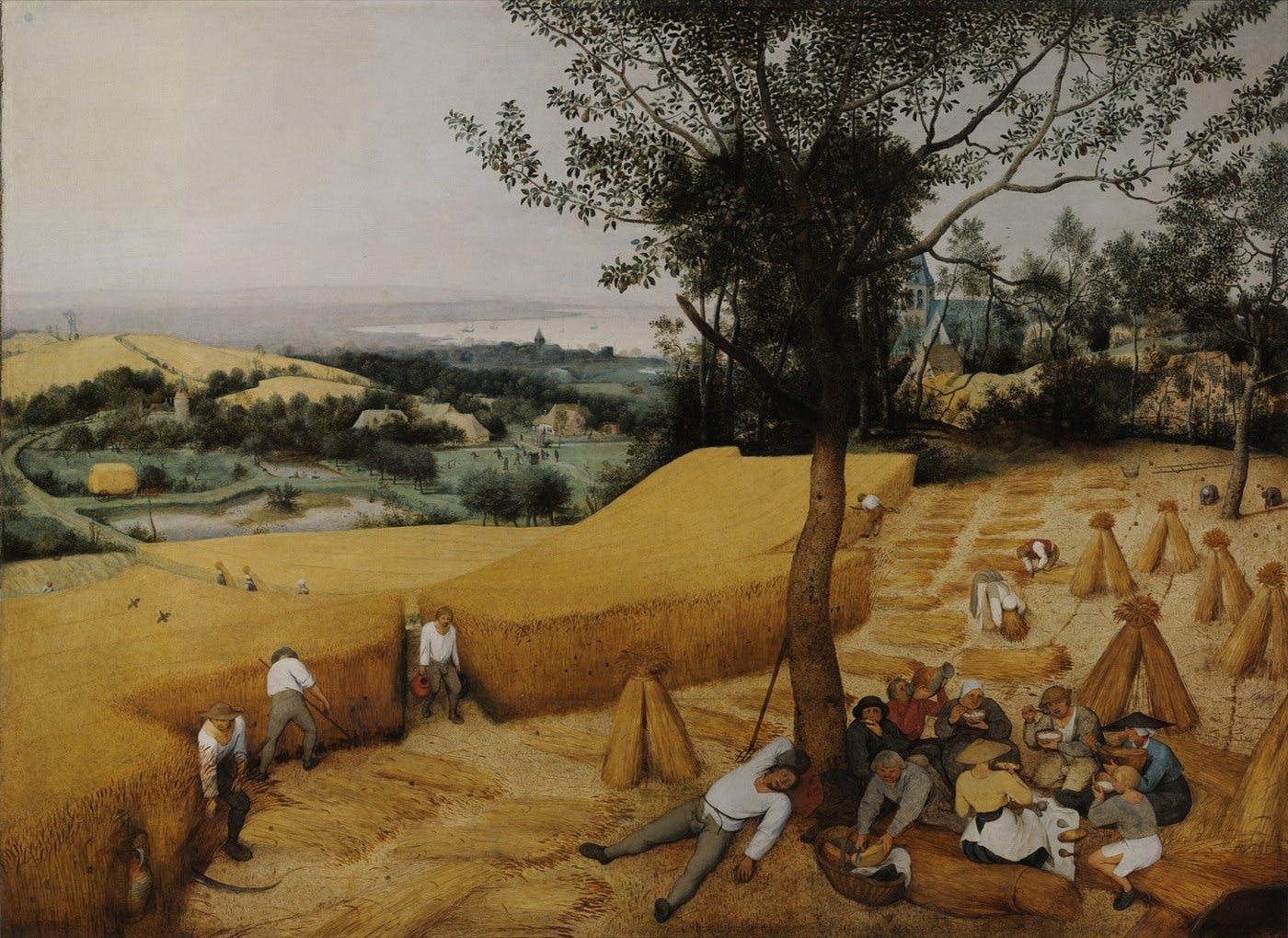
Let’s turn to: Why do people work? We might first do work as a child because someone tells us to do so—a parent. Or we might work as a child because we are rightly curious about nature, fascinated by how things go when we dig, build, and discover. Later, when we leave our home, we might work in order to make a living. However curious we are, or however much we love our work, every job has its tedium. What keeps us going is a drive to provide for ourselves and for others who depend upon us. But finally: we might work also to give glory to God, to cooperate with His ongoing creation, to submit ourselves to the toil and frustration that is our lot in this vale of tears, to become willing cooperators in God’s work of creating each of us anew, for man is the subject of work, as John Paul II says. [3] Here is a hierarchy of possible motives. Surely it is better to work for the supernatural motives above all, and to care less for the human ones. But we would rightly fault a man or woman for neglecting those good human motives, since God Himself intended them.
And for good reason! How many of us would work at all if the lower motives were not present? How many of us would come to know the higher motives? In fact, at first we work to eat (for ourselves); later we work to provide for other selves; and at last, with grace, we learn to work for God. That progression is ordinary, not a defect. A feature and not a bug. We become better by working; virtues and graces hang in the balance. We contribute our share to the common good, laying a foundation for greater abundance.
More goods turn out to be attached to working than merely making a living: almost like a divine trick. This is true for all work: for HVAC specialists, restaurateurs, bus drivers, and for any work assisted or enabled by AI. Work is an opportunity for transformation and sanctification because an eternal being is the subject: in the traditional sense, he who works is the subject doing the work; but he is also the object in a surprising sense, because he is himself made new when he applies his labor to the objects of his work. [4]
This is a critical insight of the Christian life, originating in the Gospels and found immediately in the Acts of the Apostles (Acts 18:3; 20:34–35); it is evidenced in the great religious orders—think of the Benedictine motto, ora et labora. But for us today it is exemplified best by that saint of ordinary work, St. Josemaría Escrivá. [5] All human work is God’s work.
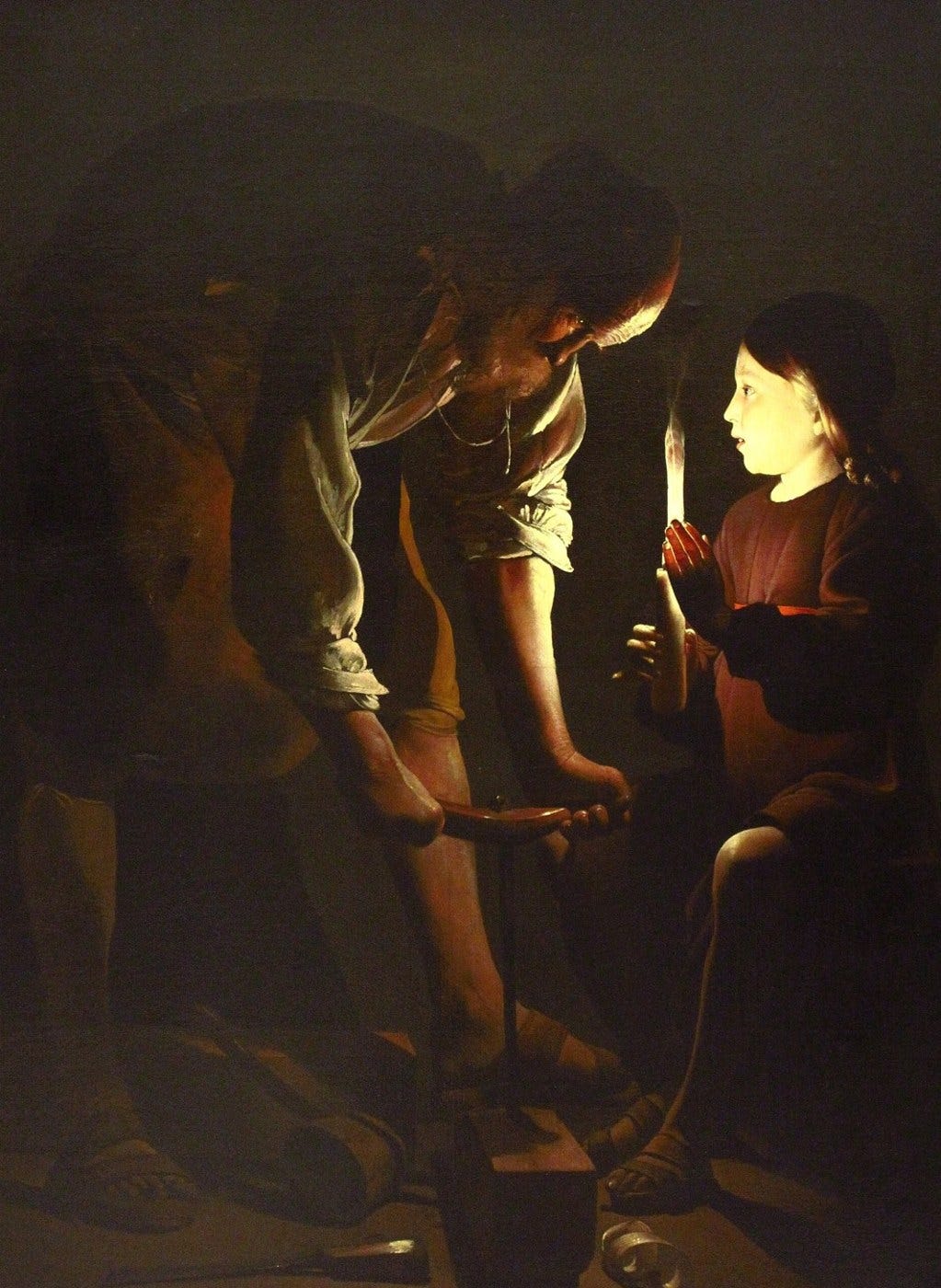
But woe to us if such lofty motives—to become transformed, to be sanctified—were a necessary starting point, for how many of us would pick up the work? Frankly, that doesn’t sound very appealing, does it? With work we must learn by doing: so the best preparation for work is work.
The point about children emerges more clearly now. If people have fewer children today, we should ask first about the motives: Why do people have kids? Or why did they have kids in the past? Perhaps the first mover, the motive, was originally the sexual love to which all men and women are drawn; perhaps also they willed and sought the more utilitarian goods: help at home, care in old age, the companionship of a family. But where nearly everyone has children because the lower motives make it so, as a rule, and with grace, society learns the wisdom of having children. The higher motives are slowly learned: that children really are a blessing from God, an expression of divine goodness, the purpose of marriage, and to be desired for their own sakes. The best preparation for having children is having children.
And why not? We are not angels. Most of us appear to need a nudge or a kick toward the path that is most noble. There is humility and realism in this. It’s not that men and women of the past were cold-hearted utilitarians. It’s rather that God’s design appears to draw us to higher purposes through lower ones.
With children the trouble is that the lower motives have been steadily eroded: economic growth and machines chip away at the need for labor; savings and pensions, the need for security; birth control and family planning, the identification of children as the fruit of sexual love. If, as an empirical fact in the modern world, only the most religious people have birth rates above replacement, that is because faith supplies the higher motives, and they are the only ones standing. [6]
3. From Motives to Meaning
How are motives related to meaning? The word motive comes from the Latin movere, “to move.” [7] Medieval Latin used motivum as a noun for “a moving cause, a reason.” [8] So a motive is a mover. Linguistically it is related to motion, and to e-motion (to move out or away). Aquinas’s term for what moves the will is motivum—a mover—in this sense. What we really mean, though, is what pulls or attracts: the subject is moved by the good that entices. [9]
The “reasons” or “moving causes” are simply the goods sought—what the will is after. Thus, if many goods are attached to one action, there are many possible motives, or moving causes. And, as the goods can be ranked or compared in value, so too the motives can be ranked or compared. They can also be assessed, against various standards, as right or proper.
The word meaning comes instead from Old English mænan, to intend, or to have in mind. [10] If a motive is the reason moving you toward a good, the meaning is the good that you intend to obtain. Motive and meaning are two sides of the same human action. In cases where many goods are attached to one action—such as work, or children—we can intend (or mean to achieve) only some of the goods, but we may get the others into the bargain. Or we can intend all of the goods attached to the action, which is more meritorious.
We can say that the meaning of an activity is the ranked set of goods to which the action is ordered. What does it mean to be ordered? Well, simply, that God intended those goods—or, if you prefer, Nature and the author of Nature. So the meaning of work is all the goods that God intended from my work; my own meaning is what I intend with my work. If I intend something disordered, then what the action means to me is different from what it means to God, or what it means “in reality.” But if I intend merely the lower ordered goods, God allows for that subjective meaning (or sense of purpose), and intends it; He may nevertheless bring about whatever higher goods He has willed. And thanks be to God for that!
So: the moral meaning of work includes the whole range of goods that God intended to come from our work. The word “moral” isn’t doing any extra work: every human activity has moral content. We can just as well say “the human meaning of work,” since the first principle of the moral law is that good is to be done and evil avoided. Work is a good for man (subject to all the necessary caveats for any particular work). So, to inquire about the “moral” meaning of work is to inquire about the right and proper goods that God attached to work, and how we appraise them (subjectively: aligning our purposes) and how we best seek them (objectively: fitting means to ends). (See in the word “means” exactly this meaning of mean.)
Likewise: the moral meaning of having children includes the whole range of goods that God intended to come from having children—including the children themselves, who are eternal beings.
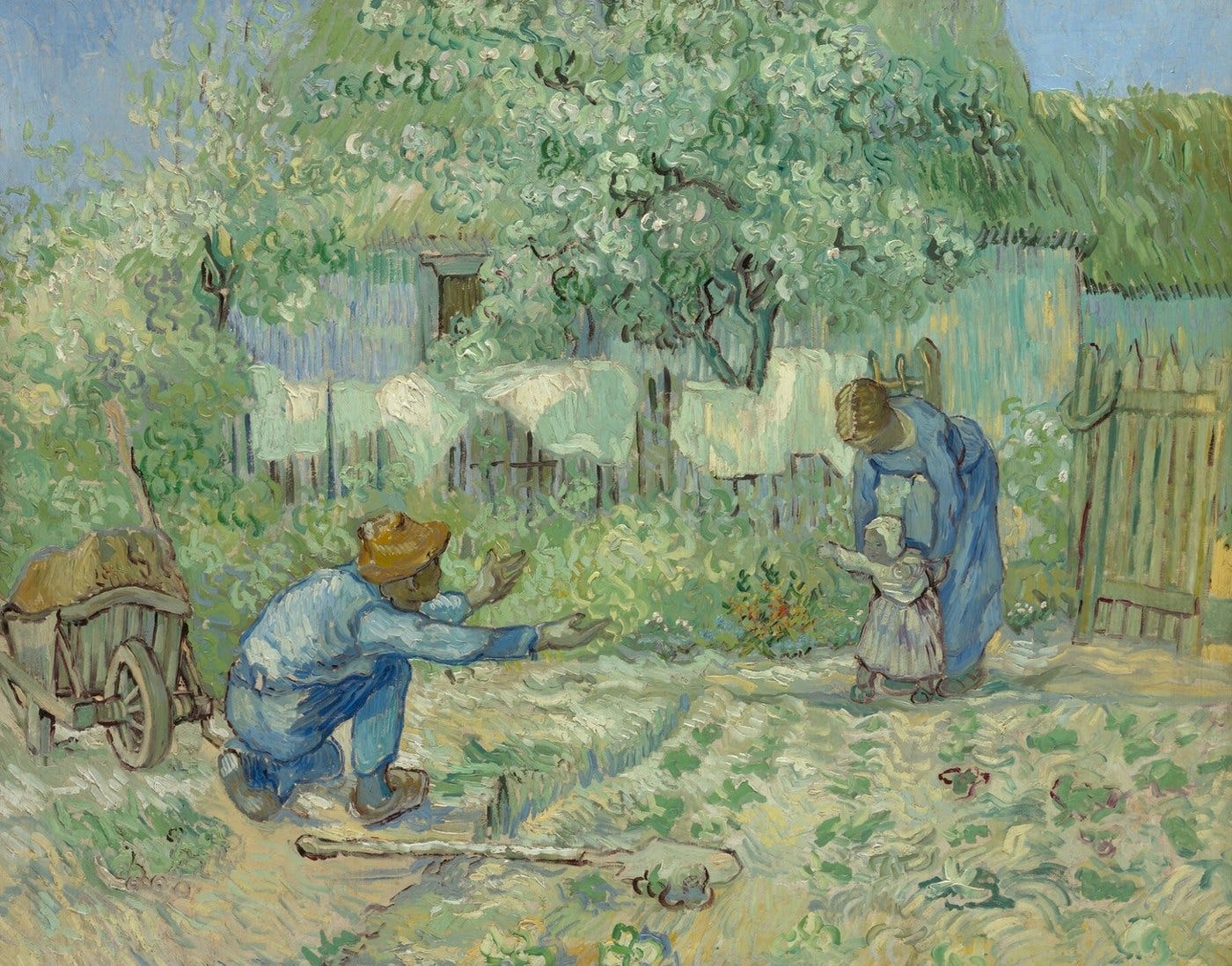
Removing a lower good from an action doesn’t strip it of its meaning; rather, it exposes the higher goods that were there all along. This is what has happened with children. The activity survives (though changed) in society only by virtue of the remaining (higher) goods. The moral meaning of children has not changed through the erosion of certain lower goods intended or tied to it by nature; what has changed is that childbearing survives differently in society, with the sustaining role of faith emerging for the first time in human history.
This poses a question: has something similar happened to work? Before asking what AI will do to work, let us assess our moment briefly, as we have done with children. Is there a global collapse of work to correspond to the (coming) global collapse of workers produced by demographic decline?
Part II follows tomorrow.
Notes
[1] Aristotle, Nicomachean Ethics I.1, 1094a1–3.
[2] Thomas Aquinas, Summa Theologiae I-II, q. 94, a. 2.
[3] John Paul II, Laborem Exercens (1981), §6.
[4] Cf. John Paul II, Laborem Exercens, §9; on being made new, cf. 2 Cor 5:17.
[5] Cf. Josemaría Escrivá, Friends of God, nos. 55–72.
[6] See Catherine Ruth Pakaluk, Hannah’s Children (2024); cf. Jesús Fernández-Villaverde and Patrick Norrick, “Terra Incognita: The Economics of a Shrinking World”, NBER Working Paper 35809 (2026).
[7] Oxford English Dictionary, s.v. “motive.”
[8] Du Cange, Glossarium mediae et infimae latinitatis, s.v. motivum.
[9] Aquinas, Summa Theologiae I-II, q. 9, a. 1.
[10] Oxford English Dictionary, s.v. “mean,” v.1.
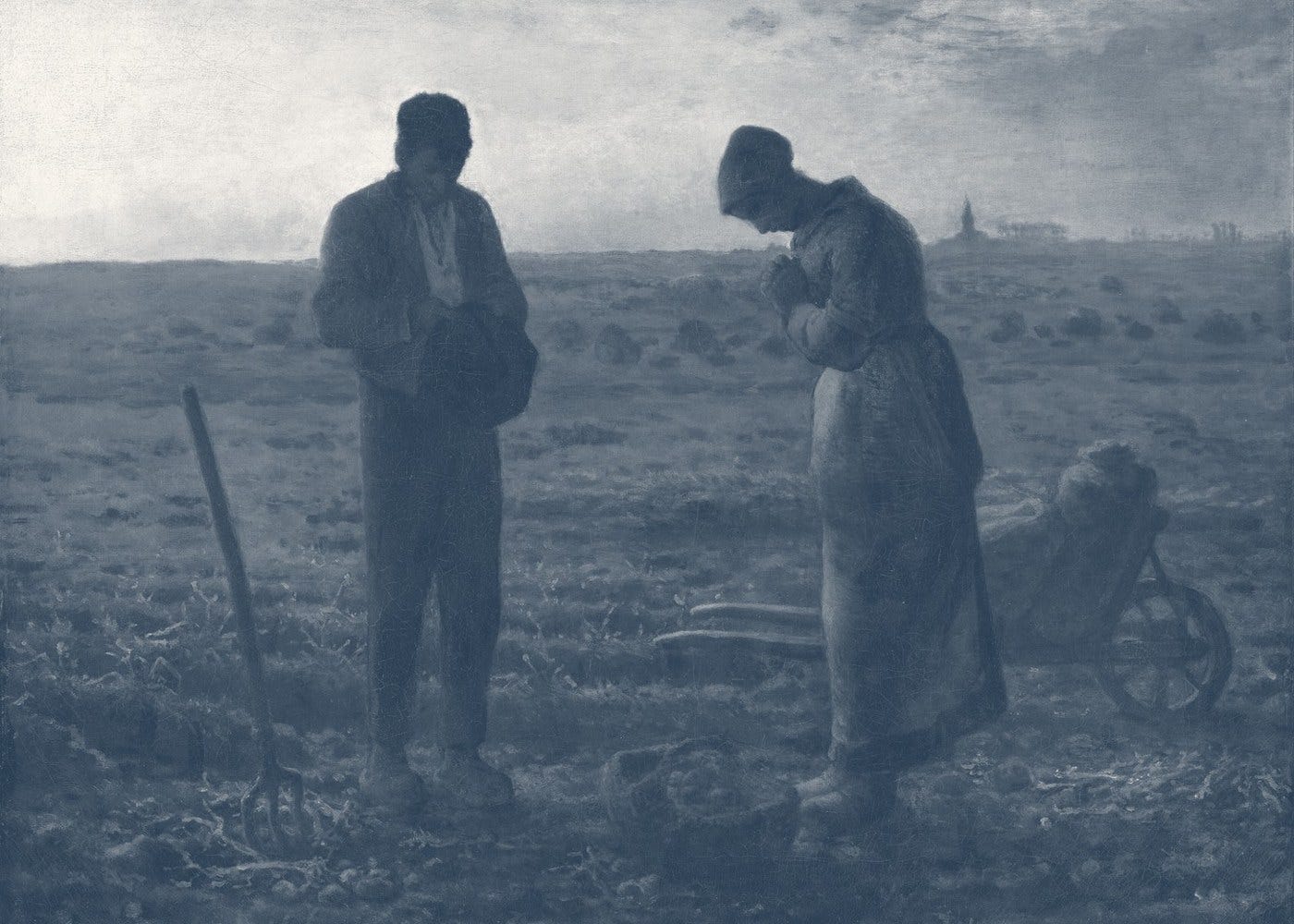
Cover: Jean-François Millet, The Angelus (1857–59), Musée d’Orsay, Paris. Public domain, via Wikimedia Commons.