


Arthur Waldon
This is the second and concluding part of Arthur Waldon’s essay from our number of January 1883; Part I appeared yesterday. Having sketched the poet and ascetic, Waldon now follows the stream of painters who came to Assisi to draw inspiration at the saint’s tomb. With it we close our week for St. Francis.
“Sanctitatis nova signa
Prodierunt laude digna
Mira valde et benigna
In Francisco credita,”
sings Brother Thomas à Celano, in his sequence of the Saint. In truth, the effects of that sanctity were at once wonderful and new. Still in the bloom of manhood, according to years, when he left the scene of his activity, his mark was there indelibly. And its impress only deepened and intensified by the shock which his sudden summons to heaven created among those who had felt dependent on him. If there was one thing more pronounced than another, in this influence, it was the fact of a new tendency towards the love of the beautiful as it is in nature, and of its dedication by a unanimous impulse to the highest ends of man. St. Francis was, as we have seen, a poet, and his poetry pervaded, impersonated everything, so that the very atmosphere of Assisi seemed sufficient to create and nourish the inspiration of Christian art.
Let us hear the Protestant Milman on the subject, who yet fails in his attempt to explain the singular phenomenon of this influence:
“Strange it might appear that the arts, the highest luxuries, if we may so speak, of religion, should be fostered, cultivated, cherished, and distributed by those who professed to reduce Christianity to more than its primitive simplicity, its nakedness of all adornment, its poverty. Strange that these should become the most munificent patrons of art, the most consummate artists; that their cloistered palaces should be the most sumptuous in architecture, and the most richly decorated by sculpture and painting; at once the workshops and the abodes of those who executed most admirably. Assisi, the birthplace of St. Francis, the poor, self-denying wanderer over the face of the earth, who hardly owned the cord which girt him, who possessed not a breviary of his own, who worshipped in the barren mountains, whose companions were the outcasts of human society,—Assisi becomes the capital, the young, gorgeous capital of Christian art.”[1]
He tells us, further on, that men who had an irresistible calling to be artists became Franciscans, because in that order they found those emotions which were to express themselves in art awakened, cherished, and strengthened. And no doubt, as the youth of Europe eager after science journeyed to Bologna, so that in a short time the two great bodies of the university, the Citramontani and the Ultramontani, counted among their hearers students from more than thirty different nationalities, so the youth that loved the arts came from afar to Assisi, there to gather inspiration and gain schooling. And in this concourse of the best geniuses a pious rivalry arose, giving an ever fresh impulse to the work that was going on. With noble generosity each left a monument of his achievements at the tomb of St. Francis as a token of gratitude to him to whom they felt that they owed all. Not a church or chapel, not a convent wall or ceiling in that favored city which is not sacred with the touch of some inspired brush. It is one vast academy, containing the noblest creations of human genius and piety; and though age has destroyed much of that which, after all, was but the faint expression of so much that is noble and admirable in the Christian’s soul, yet there remains enough to make that single town of Assisi, even at this day, the choicest collection of purely Christian art.
The disciples of St. Francis, who in his own day could be counted by thousands, who could be met with in every town and city throughout Italy, and even beyond the Alps and the sea, these perpetuated the spirit of their holy founder. It was not strange, then, that in the face of this new growth of feeling and devotion, the old mummy-like images of the Byzantine school were unable any longer to awaken a responsive echo in the soul of the Christian. Painting up to that time had been entirely in the hands of the Greeks. Their stiff, often grotesque forms, conventional coloring, and unnatural drapery had nothing in them of the ancient grace of their early masters. The new generation, growing up under the monastic discipline and general influence in all spheres of life of the Friars Minor, missed the freshness, the life, the something with a seraph touch in it at which their own hearts could catch fire.
But the young artist, the devout painter who drew the breath of inspiration from the hallowed Grotto of Alvernia, him they understood, and quickly his fame spread, and the builders and the guardians of God’s house sought him out, that he might breathe life into the walls, which were to instruct their people and at the same time fitly enshrine the holy of holies.
Some writers have dated the beginning of the mystic school from Gentile da Fabriano, perhaps because at that time it presents a more marked contrast to the Florentine and Bolognese schools, to which the anything but beneficial patronage of the Medici gave eventually so dangerous a direction that it actually undid much of the work of St. Francis by substituting the love of nature for its own sake in place of that love for God’s sake. Other writers place Oderisio Gubbio at the head of this school, whilst the honor of having been the first at least to abandon the manner of the Greeks is generally accorded to Cimabue. And yet such men as Giunta Pisano, Guido of Sienna, and others of the same day, unquestionably pointed the way to this departure. An old inscription, mentioned by P. Angeli, says of Giunta that he was the first Italian artist.[2]
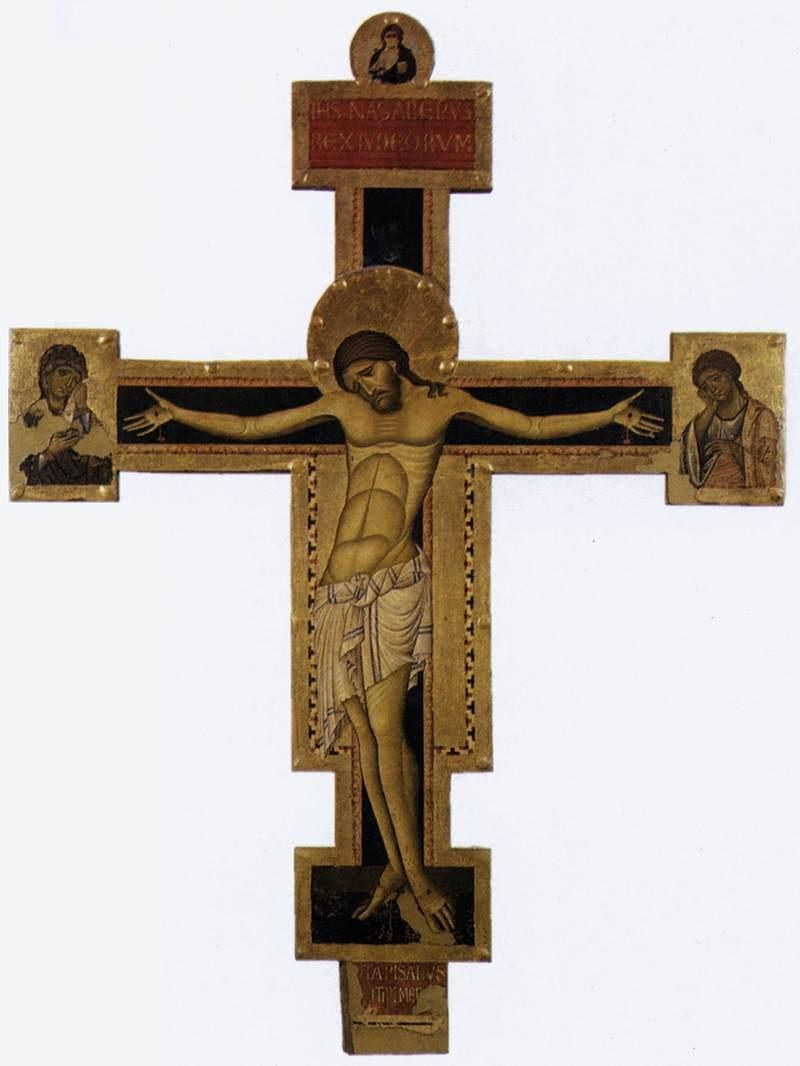
It is true that in the works of these early painters there is still a great deal of indecision. It could hardly be otherwise. Art is not in every stage of its life the complete expression of either the spirit or the time that produces it. The soul may be said to be breathed into the rough mass of solid stone in the very conception of the artist, but it wants time to assume shape and form and become the perfect reflection of the original mind. It is in the mature man’s face that we trace the peculiar character which is his, developed, indeed, in action, but there in all its peculiarity from the days of his babyhood. Thus these artists served as the connecting link between St. Francis and the most perfect exponents in art of his spirit. They gathered the seed and scattered it about the surrounding mountains and valleys, and it was some time before the new flowers grew up to perfume the air about with their sweet odors. As for Giunta, he was certainly under the direct influence of St. Francis. We know that he went to see him at Assisi, where, as we gather from Lanzi, he painted the first known portrait of the Saint. Soon after the death of the latter he returned to Assisi, and here has left us his best pictures. His paintings in the Church of the Angioli are far superior to the best efforts of the Byzantine school, both in truth to human expression and in disposition of the drapery. He also directed the paintings that were to honor St. Francis in his church at Pisa, which Cimabue and Giotto, it appears, afterwards completed. “These paintings may be ruder, but they are not less expressive than the floating forms of Guido or Murillo.”[3]
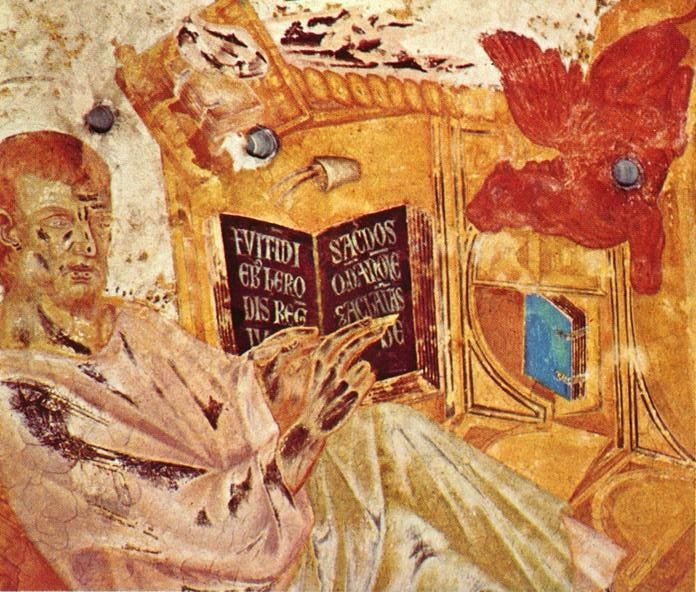
Next in order we have Cimabue. He also had learned his art from the Greeks, and his early manner strongly betrays their style. All at once, however, he seems to have come under the spell of St. Francis. There is a picture of the Saint and various little legends surrounding it in the Church of Santa Croce accredited to him, and bearing decided marks of Byzantine training. If it be authentic, which Lanzi doubts, it certainly indicates the direction which his genius took. It seems as if he had vowed henceforth to paint only for the glory of our Saint. In Pisa he completed an altar-piece for the Sons of St. Francis. He then went to Assisi. Here, as in the case of Giunta, we find his best productions. “None of his frescoes,” says Lanzi, “give so good an idea of Cimabue’s power as the truly magnificent paintings in the Church of Assisi.”
Here we see the evangelists and doctors of the Church instructing the monks of the Franciscan Order, executed with an originality of conception and arrangement altogether new in the light of contemporary works.
But Giotto still excels him. The paintings of both masters are side by side. Giotto too, true to the love that gave birth to his conceptions, chose for the principal subject of his brush the life of St. Francis. He became the model for generations throughout Tuscany. With him at the same fountain drank Dante. As in the days of Pericles, so there existed at this time a close resemblance of spirit between the art of poetry and that of painting. It was but natural, then, that there should likewise exist an intimate friendship between men of similar talent and like aims. Dante seems even at one time to have given his attention to painting under Giotto’s guidance. He certainly was a master in the art of drawing, and we have it on the authority of Benvenuto da Imola[4] and of Baldinucci, in his Life of Giotto, that the latter painted at Naples from designs drawn for him by Dante. We may here add the name of Oderisio da Gubbio, who painted with Giotto. Imagine the intercourse of these three men, great souls, inspired by the same noble motives, they pictured, each in his way, yet all in the same grand way, the glories of St. Francis. They have likewise immortalized each other. The undoubtedly most correct portrait of Dante which we have is from the hand of Giotto, whose praises in turn, together with those of Oderisio, are chanted in the melodious stanzas of the Divina Commedia.
Restless in his activity and zeal, we see Giotto, so like his holy patron, spreading the newly-learned gospel of his art in all the cities of Italy, from Naples to Lombardy, and beyond.
We must pass over a host of great painters, masters such as Orcagna, Gentile da Fabriano,—so truly the gentle, in name and in character,—the Bartolos, especially Taddeo, and that remarkable devotee of St. Francis, Margaritone of Arezzo, all in turn continuing and swelling the stream that had its source on Mount Alverno. Following the central line of the Apennines, we see it dividing, one branch with sportive and sounding current passing up into the Romagna, the other peacefully and gently flowing southward through Umbria and towards the Eternal City, both reaching out far into the next century, and inundating with their sweet fresh waters the charming valleys of Italy. And looking north, we meet an angel keeping guard over the waters. His white robe is that of the Sons of St. Dominic. With Fra Angelico the Dominicans take the lead in the field of Christian art. Did the angelic youth of Fiesole, so superior in his way, owe aught to St. Francis of Assisi? We shall see.
It is admitted on all hands that Fra Angelico studied Giotto’s manner of painting with great assiduity. His angels—and in these he excels—are imitations of the great master-disciple of Assisi, with only the difference that Angelico applied purer colors. This fact alone might be sufficient to convince us that the genius which St. Francis had diffused about him must likewise have touched the young Dominican. We have seen how the flame that issued from the seraphic patriarch had laid its hold even on St. Dominic, in spite of his totally different genius; how he had sought out St. Francis, sat at his feet to listen to his tales of divine love, and eagerly asked permission to be present at the general chapter of the Friars Minor. He wished to learn from men who had no other school than that of charity, no training but that of unlimited obedience in executing works of love, no doctrine but that of Christian poverty and humility. Whilst his was the lofty intellect appointed by God to gather the straying minds, to confound the heresy of the Albigenses, to crush the serpent’s head of a false philosophy, St. Francis was the heart overflowing with affectionate sympathy for his fallen brethren, at war with one another, and without peace in themselves. To him had been assigned the giant task to stay the tide of the lust of the eyes, the passions of the flesh, and to counteract the false asceticism which had taken form in the vagaries of the Waldenses. Yet if we may be permitted to judge the comparative strength of two such giants, so different in parts yet exercising a mutual attraction towards each other, we should incline to call St. Francis the stronger. Love informing the will exercises a greater strain than intellect, convincing and moving to action. And like his master must have felt the disciple, the pure, the simple-hearted Fra Angelico. How often he traversed, as we read in his life, the beautiful valley between Foligno and Assisi to where St. Francis lay entombed and his daughter in Christ, St. Clare; and there, before the masterpieces we have mentioned, he kindled his devotion and animated his genius, for both were one with him; the handling of his brush was but a prayer of the uplifted soul in contemplation. Looking at his own pictures, and there are comparatively few that remain, we find St. Francis introduced wherever the unity in the conception of his subject permitted it. In almost all his more remarkable pictures of the Blessed Virgin the seraphic saint figures prominently.
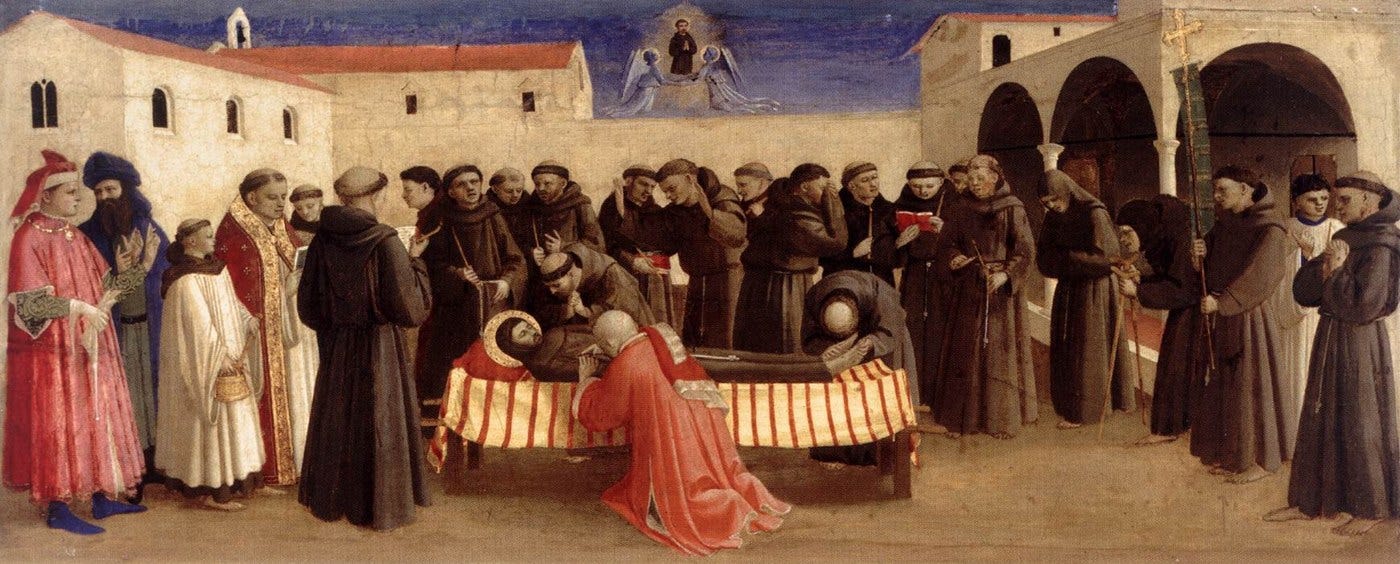
If the teacher ordinarily transmits his predilections and his zeal to his pupils, Benozzo Gozzoli, the cherished disciple of Fra Angelico, stands as another proof of the spirit which animated the holy friar of San Marco. “Gozzoli,” says Rio,[5] “is another star which contributed to the formation of the crown of glory by which the arts encircled the tomb of St. Francis.” His pictures are almost transparent in their chaste purity, singularly so those found in the Franciscan church at Montefalco. When he had to paint the portrait of St. Francis he frequently copied the picture at San Marco. Strange to say, when Benozzo left these pure mountain regions to go to Florence, he seemed to lose his inspiration. His works executed between 1464 and 1467 are said to rise scarcely above mediocrity. Yet the frescoes at Pisa, painted in the decline of his years, are simply marvels of what has been called the patriarchal style of Christian art.[6]
We might go on recounting painters, not only such as nourished their talents with the spirit communicated to them by men who had stood in direct relation to the Saint and his order, but such as were devoted to St. Francis as if he were still their only master; who learned nothing from those whom he had taught, but all from himself; artists who flocked to the place of his birth, to the principal scene of his activity and now his earthly resting-place, as if to invoke the aid of his spirit where they could be nearest to his remains—Pinturicchio and Perugino, whose art was so exquisite that it seemed altogether new—Perdita si fuerat pingendi hic retulit artem; si nusquam inventa est, hactenus ipse dedit;[7] Francia also, friend and rival of Raphael, with Giacomo his son and Giuglio his relative, who sought shelter even in death in the Church of St. Francis, where they are buried. Raphael himself, in his earlier works, has acknowledged the tribute he owed to St. Francis. And when the Renaissance had given a new turn to art, even then Assisi was still the place where best men sought inspiration, and St. Francis still remained the subject and his glory the object of their labors. There was always enough to allure the artist to that singular spot, independent of the devout memory he might entertain of the saint. The eleven or twelve communities of Franciscans, in devout procession moving to the tomb of the Saint, their solemn chants, above all, the stirring harmonies of the patriarchal choir, famous by the traditions of several ages, would attune the soul to the right appreciation of those marvellous frescoes that adorn the walls. Wherever the eye turns, from chancel to choir, naves all and dome, even the mosaiqued floors, are wrought by the hands of the Umbrian masters. Nay, the streets of the city itself are full of devout representations in painting, many of rare artistic merit, all breathing the love and spirit of St. Francis.
Even architecture contributes here in an altogether unique way to verify what we have said in the beginning, that the genius of St. Francis had impersonated everything. The architectural structure of the Grand Basilica in Assisi expresses perfectly the idea of the life of St. Francis. “An Italian writer,” says the Abbé Riche,[8] “sees in the creation of so wonderful a monument a supernatural effect of divine Providence. He finds himself unable to explain in any other way its appearance at an age when mankind appeared scarcely to awake from barbarism and ignorance.”
Roman architecture, such as it existed before this time, expressed on the whole the idea of rest, of strength. It was, as such, not unworthy as an expression of the Christian faith and the security which it had begotten. But lately, the times had become troubled, not, indeed, with the troubles of the early persecutions, when men felt safest as they approached the torture-block—no, these were other troubles. Darkness of pride and strifes and false lights had dimmed the air, and they that felt the stifling atmosphere looked up and sought the pure light of the noonday, and prayed with raised heart and eye, as we see St. Francis pray, in ecstatic longing for the light. The Gothic architecture expressed, so to say, the new feeling. It was a striving upwards. Its long slender columns supporting the pointed arch seemed to end in heaven, all pointed to the infinite that awaits man. But we see much more than this in the temple which enshrines the remains of St. Francis. There are here two churches,—we might say three,—one within the other. In them we have the twofold aspect of his life. His penitence, with its train of voluntary poverty, sacrifices, and suffering resignation, symbolized in the tomb of the saint, who lies there on the ground as he had desired to die, poor, with barely a shroud to cover him; and his monument, the little church of Portiuncula, built with his own hand and still untouched as he had left it. And high above it there tower in noble proportion the marble columns and Gothic dome, speaking to the beholder without his asking for the meaning of the symbol, of glorious and immortal transfiguration. Whilst the inner edifice pronounces the idea of humility, of sweet sadness, that plaintive, childlike hope which is at once full of diffidence in self and trust in the strength on which it leans; the other expresses that ineffable joy which knows no limits and no bounds, rising higher and higher until it touches immortality. It was a beautiful but difficult thought to express. Nowhere has it been more successfully done than in this epic in stone at Assisi.
How much more might be said to show how the spirit of St. Francis was the mainspring which produced not merely the enthusiasm and true love for the beautiful in art, but which gave to it at the same time subject, style, and artist, all, in fact, that made Christian art what it was in the Middle Ages.
And wherever the Sons of St. Francis went, whatever the name or garb or particular rule under which they perpetuated throughout long ages his teachings and his spirit, everywhere we see traces of that same enthusiasm for the arts. The convents and churches of the monks became the treasure-houses and nurseries of painting and sculpture. Raphael, Guido Reni, Domenichino, gave them the best of their pencils in Rome. The Church of St. Francis at Rimini became one of the wonders of the age, for here worked, next to Giotto, his most illustrious disciples, and Giorgio da Rimini, who loved to call himself Giorgio Francesco. But it is time that we conclude our sketch.
Perhaps the reader has, to some extent, realized what the love of God in a single individual is able to effect for the benefit of succeeding generations. Art is certainly a valuable element in the production of human happiness, and the very eagerness with which even its shadow and its counterfeit are sought, stands in confirmation of this truth. May we not hope for a chaster growth of true and elevated taste from the intercession of St. Francis? Our venerable Pontiff, Leo XIII., has seen opportune to recommend, with fatherly solicitude, devotion to the Saint as a powerful means of counteracting the existing evils of modern society. And whilst in reality the conditions of our present society are fundamentally different from those in the thirteenth century, when there was still a strong faith underlying all the vagaries of the human intellect and heart, yet the spirit of St. Francis, if we could revive it in its freshness, would heal many wounds, would undoubtedly diffuse a purer atmosphere round about the world of art. The humble monk out of the dark ages, he could bring light to us. May he vouchsafe to do so!
Notes
[1] Milman’s Latin Christianity, vol. viii., p. 477.
[2] Juncta Pisanus ruditer a Graecis instructus Primus ex Italis artem apprehendit circa, Ann. Sal., 1210.
[3] “Schools and Masters of Painting,” A. G. Radcliffe.
[4] “Comento al Canto XI. del Purg.,” cited from “Vita di Dante,” Leon. Aretino.
[5] “The Poetry of Christian Art,” p. 133.
[6] These have been restored lately, but, according to accounts, to their utter ruin.
[7] Inscription cited by Orsini.
[8] Fioretti, by Abbé Riche.
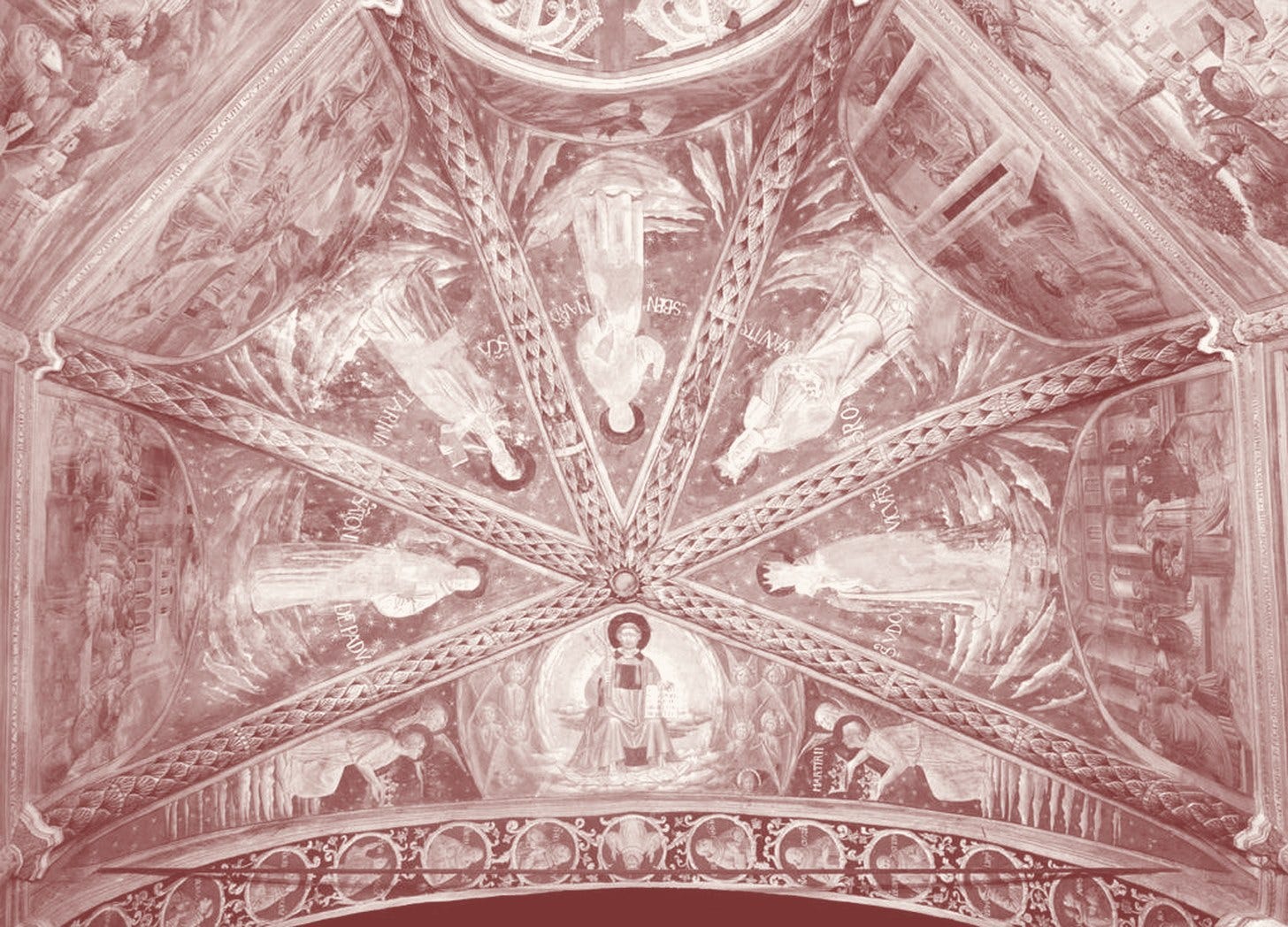
Cover: Benozzo Gozzoli, St. Francis in Glory and Saints (1452), apse vault, San Francesco, Montefalco.
From the American Catholic Quarterly Review, vol. 8, no. 29 (January 1883), pp. 43–58.