


The Influence of St. Francis of Assisi on Mediæval Art (I)
by Arthur Waldon
Arthur Waldon’s essay appeared in our number of January 1883, four months after Leo XIII, in the encyclical Auspicato Concessum of September 17, 1882, commended devotion to St. Francis on the seventh centenary of his birth; Waldon’s epigraph comes from that letter. His argument is that the love of God which made Francis a poet stands behind the whole revival of Italian painting, from Giunta Pisano and Cimabue through Giotto and Fra Angelico to the young Raphael. We print the essay in two parts, following the author’s own division, today and tomorrow. His spelling and punctuation are kept. Some of his attributions reflect the art history of his day.
Notice, by the way, the complexity of the sentences in this essay, and consider that it was written for a general readership; also, note that the author left Latin, French, German, and Italian largely untranslated.
“We owe to the mind of St. Francis that inspiration, nobler than human, which stirred the emulation of the greatest artists.”—Leo P. P. XIII., Encycl., 17 Sept., 1882.
At times convictions take possession of a human soul and develop therein with such astonishing power over and beyond all that surrounds it, assuming dimensions in their ultimate results which are out of all proportion with the source whence they appear to spring, that we are forced to look for their reason in some design of Providence bearing testimony to the unfailing truth on which they rest, and giving assurance of their predestined accomplishment. The Catholic Church is the soil on which such souls ordinarily grow. The fact of Calvary, of all human failures in an earthly point of view the most complete, yet with its prodigious effects, unaccountable unless in the light of a higher principle, has established a norm by which we may measure like phenomena. When St. Francis of Assisi suddenly departed from the common course of men about him, those who loved him best mourned, because, as they said, the beautiful youth had grown mad. But he had turned to follow a master, whom with less reason the enlightened world of old Rome had pointed out as a fool; and so he went on securely in his way, “ce fou sublime, dont la folie confondit la sagesse du monde.” [“this sublime fool, whose folly confounded the wisdom of the world'“] And when the few short years of his earthly life had come to their end, he had set into motion and given a lasting impulse to a revolution, which in due time overturned the political, social, and religious world from its existing state. Like the sun, which he affectionately calls his brother, and to which Dante aptly compares him, he, “when not yet much distant from his rising, began to bless the earth by his good influence.”[1] He illumined the darkness into which the world of those days was deeply merged, and created a new growth upon its face, breathing by the genial warmth of his spirit fresh life into the decaying members of society. Popes, emperors, nay, the obstinate princes of the East, who hated with a natural and religious hatred alike whatever bore the Christian name, bowed to his will and vied with one another in showering favors upon him to whom nothing was dearer than the contempt and poverty of Christ. Even St. Dominic, if we may believe the annalist of a past day [2], intimate and familiar friend of our saint, seemed for a moment to have lost confidence in his own distinct and stupendous mission, when he came within the circle of that radiant fire of seraphic love.
But it is not our purpose to measure the influence of St. Francis upon his own or later times except in so far as it caused the revival of the fine arts, which in point of time and place assumes definite form immediately after the death and at the tomb of the Saint. It were strange indeed if we could not trace the cause of this sudden change in the sphere of taste to the direct influence of him who from that time forth appeared for several generations at once the devout object and the patron of the fine arts. And no doubt it will be well to recall to mind the means which served to raise so admirable a structure as that which the school of Christian art presents to us in the 13th century, at a time when at least the outward conditions of society are much the same as they were then, with perhaps this difference in our favor, of a far more eager search after a high standard of taste.
In order to estimate correctly the influence of St. Francis upon the life of the fine arts for several centuries after his death, it will be necessary to cast a brief glance upon the character of the man, who, by the sole force of his personal endowments, without any assistance from without, was able to produce such gigantic effects. We shall next consider this influence in its further results.
I.
The most superficial reader of the life of St. Francis will be impressed with two features in the singular career of the Monk of Assisi: that peculiar asceticism, from which, as we know, arose the mystic school of thought, whose best exponent in theology became St. Bonaventure, and which found its truest illustration in the whole range of Christian schools of art, beginning in faint outlines with Giunta Pisano, the friend of St. Francis, and ending, at least for a considerable time, with Raphael, in his earlier works. The other trait, which aside from this strikes us, is the intense love of and sympathy with nature manifested by the Saint on every occasion.
Nature was, so to speak, poverty, whom he had chosen as his bride, in her fairest apparel. When he had relinquished all for Christ, he had gained all; the whole great world was now his own, and he felt this possession, and it made him happy beyond earthly happiness.
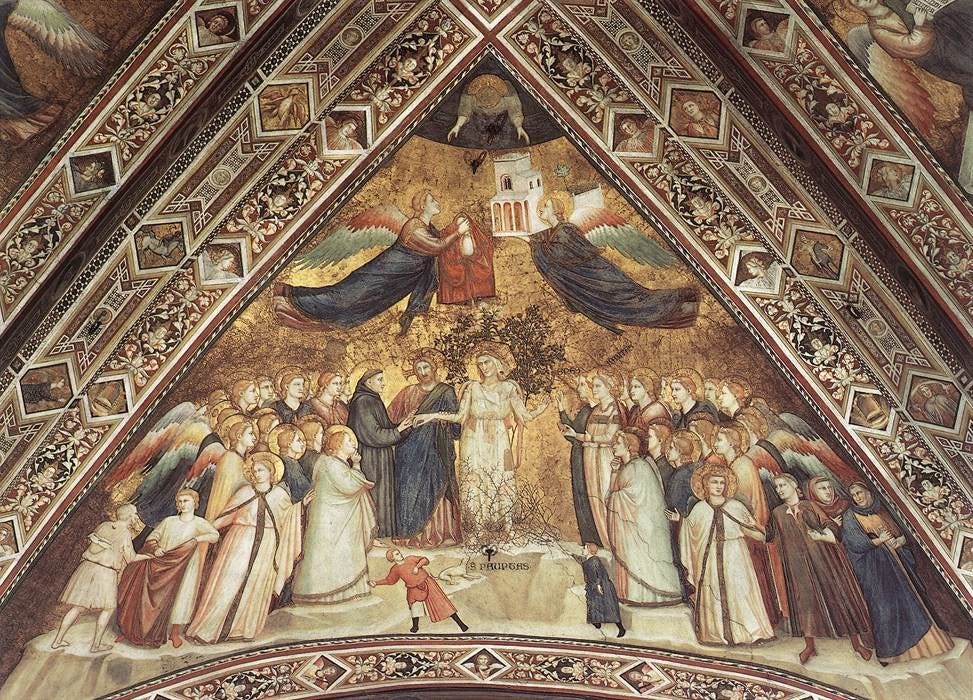
One day, before he had made his choice, when he was returning from a festival, his companions, seeing him strangely pensive and tarrying behind, asked him laughingly what could absorb the lighthearted Giovanni so profoundly at this time. “I was thinking,” said he, “of taking a spouse, but one so noble, so beautiful, that I know none like her on earth.” From that day the fair young Bernadone changed. “He is lovesick,” they said, and so he was. He had seen a glimpse of some beautiful being, a quick vision of some magnificent reality, and his heart went out to it; went out to God, that Beauty everlasting and surpassing all His creatures. And the Saint loved only the more these creatures, now that he recognized them as love-tokens of God’s munificent affection towards his humble spouse. He would cast aside the gilded deckings and don the wedding garment to please but his new choice. So by vigils and fasts, terrific stripes and crucifixions of his tender flesh, he called to heaven for a spotless robe, until the folly of a thoughtless boyhood had been wholly wiped out.
As sin disappears in man, its consequences vanish one after another, or lose their hold on him, and the former state of sinless happiness returns. In Paradise all nature had been subject to Adam. But once he rebelled against his Maker, creation declared enmity to its former master, man. Henceforth his life was one continued toil, and sorrow became as his daily companion. Then, as he bore the burden meekly, it lightened, or perhaps his strength increased, and he felt less of the old crushing weight. Nature grew more kind, the ground yielded more readily to the pressure of his spade, and it brought fruit and flower, which lighted up once more his aged care-worn features, and labor, duty, sacrifice, became a consolation. And when the end came they brought to the saintly patriarch the last born of his grandchildren that he might bless it. But he looked strangely out into the open field where stood the tree which he had planted, a twig of Eden’s sad tree of life. And in prophetic vision he discerned the fruit that was one day to grow thereon—arbor decora et fulgida! And he saw how the curse which he had brought upon his progeny was to depart by the strength of that fruit. It was a rapturous thought, and he loved the tree for its destiny, and the birds that nestled in it, and the flowers that grew beneath its shade; he loved all nature, for he saw in it expressed the ineffable love of his Maker. Then his dying hand blessed the babe with the strength of the expected Redeemer, and when with his last look he gazed into that blessed child’s eyes he saw there the joy which he had seen in Eve before the fall, the joy of innocence, like to no other joy on earth. How often has that process been repeated in the penitents, saints of the Catholic Church! It was in a manner the process which the soul of St. Francis experienced. He had become again a sinless child, in the baptism of penance, in the strength of his Redeemer’s Precious Blood. Nature spoke to him, and like a child he spoke to her, until both understood and loved each other as brother and sister of the same heavenly Father. See how it comes out, this love, in all its virginal freshness and innocence as we meet him in the byways around Assisi, sweetly caressing a rescued pair of turtle-doves: O sirocchie mie tortole, semplici, innocenti e caste—ora io vi voglio scampare da morte e farvi i nidi.[3] [“O my sisters, turtledoves, simple, innocent, and chaste… now I want to rescue you from death and make you nests.”] Or as we see him stooping to gather up the little worms from the road, lest they be crushed beneath the foot of some unthinking traveller; for he remembers how his Master had once said: I am a worm and not a man. Such was his tender love for the works of God’s hand, and like some magic spell it accompanied him wherever he journeyed, and where his shadow fell the ancient curse seemed forthwith to depart from the earth. The birds of the air, the beasts of the forest, came gladly at his call; the timid roe looked trustingly into that beautiful face and gathered its food from the hand that gave a blessing upon the dumb creature. All nature rejoiced when with him, and the lay “Laudate”[4] of the royal prophet seemed forever on his lips. Well could he write of “true and perfect joy,”[5] for it was always in his heart and round about him. But this intense love of nature, this perfect harmony between his inner being and the rest of God’s image in the outward creation, made St. Francis a poet, we might say an artist, in the truest sense of the word. Every artist is a poet. The history of the great masters amply illustrates this. We know how the genius of Giovanni Santi followed that of Petrarch and Dante, and how the father of the immortal Raphael was celebrated in his day alike for his verses and his paintings. Young Raphael himself was, as Lanzi informs us, a poet. Even Leonardo da Vinci, in spite of his practical turn of mind, has left us some verses. And most of the great painters of the early Italian school were enthusiastic students of Dante. On the other hand, there exists a close and necessary connection between true art and Religion. Indeed art is a species of religion, in which man pays homage to the divine Beauty. Such was the idea of art even among the Greeks in its best days. When high ideals in religion are united to most perfect natural forms, whether expressed in harmony of sound, or in painting, or in sculpture, we have art in its truest sense.[6] The mystic school of art had its source in the realization of the highest ideal of divine love expressed in the purest types of nature. If we trace the origin of the two most characteristic traits in the life of St. Francis, his asceticism and his love of nature, we shall find the one source an intense love, which made him identify everything about him with the motives of his Maker. This love terminates in a complete union with the divine will, and produces that harmony between the creature and his creator, identical in a manner with intuition, wherein the soul communes with God directly and faith yields to limited vision. No better argument than the fact of St. Francis can be brought against the assertion of Victor Cousin, that “he who pretends to commune with God in this mystic way, does thereby ignore Him in his manifestations in nature,” and that such communication “is a dream and an incredible rashness.”[7] Surely no one could have believed in God more essentially through “His manifestations in nature,” whilst few saints were more closely united to Him, receiving, as he did, almost all the important commissions regarding the institute of his order, like Moses, directly from God. With St. Francis self no longer existed. It was merged in God. And when he looked upon nature he saw it, too, acting in harmony with that sublime sentiment of entire unselfishness, so beautifully expressed in the lines of a German poet:
O welcher reine heil’ge Edelmuth
In der Natur und rings im All,
Wo Eins dem Andern, und wo Alles Allen
Mitwirkung, Hilfe, alle seine Kraft
Und Liebe, selbst sein eignes schoenes Dasein
Herzinnig treu, mit stiller Freudigkeit
Dahingibt, ohne je daran zu denken
Ob auch ein Stäubchen nur dadurch bezahlt sei.[O what a pure and holy nobleness
In Nature and in all the cosmos round,
Where each to other, and where all to all,
Its cooperation, help, its every strength
And love, its very own fair being, even,
With heart-deep faithfulness and quiet gladness
Gives over, never pausing once to think
Whether a single mote be thus repaid.]
In reality this spirit has always done more, for art as even for abstract science, than did brush, or chisel, or toiling brain. The most devout painters have been more successful as Christian artists than those who possessed the secrets of perfect technique or the most accurate knowledge of anatomy. We know[8] how Cardinal di Lugo, that giant mind, went in his subtle perplexities of theology to consult the boyish novice John Berchmans, that God might reveal to the prayers of the saint the science withheld from his own comprehensive intellect. Hence, when we come to judge of the effect of this asceticism upon art, we must lay aside the rules of the connoisseur. “Mysticism,” says Rio,[9] “is to painting what ecstasy is to psychology. It is necessary, in order to estimate it correctly, to associate ourselves by a strong and profound sympathy to certain religious ideas, with which this artist in his studio, or that monk in his cell have been more particularly preoccupied, and combine the results of this preoccupation with the corresponding sentiments in the minds of their fellow-citizens.”
As St. Francis worshipped beauty because it spoke to him of God, the eternal Beauty, reflected in nature, so he found himself drawn to rival nature, or to seek its choicest types, and to beautify, by his own hand, whatever was, in an especial manner, to image forth that heavenly splendor, or to enhance its appreciation among men.
The habitations of his monks were to be severely simple. “Habentes quocum tegamur his contenti sumus,” he said [“Having that wherewith we may be covered, with these we are content, 1 Timothy 6:8], with the apostle. We remember how, on one occasion, he became all aglow with holy indignation when, on one of his visitations, he found that the monks had, with much labor, built a magnificent convent; and how it took all the influence of Cardinal Hugolino, the then protector of the order, to pacify him. “Nostram hanc domum non agnosco,” he called out, “neque meos fratres reputo qui in illa permanserint.”[“I do not acknowledge this house as ours, nor do I count as my brothers any who remain in it.”][10] But when he reared altars and temples to the Most High, his zeal for their adornment knew no limit. He wanted to be poor, and no other saint in the Church has so entirely made that title of il povero di Dio his own. His patrimony he gave for the restoration of a church. Long before he had laid the foundation of the order of Friars Minors, he had devoted himself entirely to the reconstructing and beautifying of the house of God. He went from door to door begging alms; crying aloud in the market-place: “Come, help me to build the Church of St. Damian.” It was a passion with him, and people wondered what he meant. Yet he went on restoring. Church after church arose, newly adorned; St. Damian, St. Peter Apostle, and the Portiuncula, in his native city of Assisi. Cardinal Newman tells us somewhere that it was architecture which directed the thoughts of one of the most zealous priests[11] he ever knew towards the Catholic faith. Well, it was architecture which, though in another way, led our Saint to the reform of the spiritual edifice that was swaying to and fro amidst many conflicting elements. When, prostrate before the crucifix in the church, he had first heard the voice of his Lord, bidding him rise and uphold his tottering house, he applied the command as referring entirely to the material church. Yet God had meant it in another sense, and the saint was imperceptibly drifting towards the accomplishment of God’s will by beginning his task in this way. With his own hands he set in order and embellished whatever about God’s habitation was out of order, and when in after days he found a lovely spot, he would dedicate it to the special glory of the Most High, by raising there a chapel or an altar, or a niche in which to place the statue of some saint, so that it might remind the passing wanderer how good God is in giving us such beautiful things. In a lovely grove between Gemini and Porcaria he erected a church in honor of the Blessed Virgin, very like to the one of St. Maria de Angelis, in Portiuncula. We read, in his life, how, returning from Arezzo to Florence, he was compelled by sickness to stop a few days at Gangheretti. God had blessed the place by causing a fountain to spring up at the request of the languishing saint. As if to guard and beautify the spot where “God had been,” he employed the brief time of his convalescence in building a wall about and adorning it.
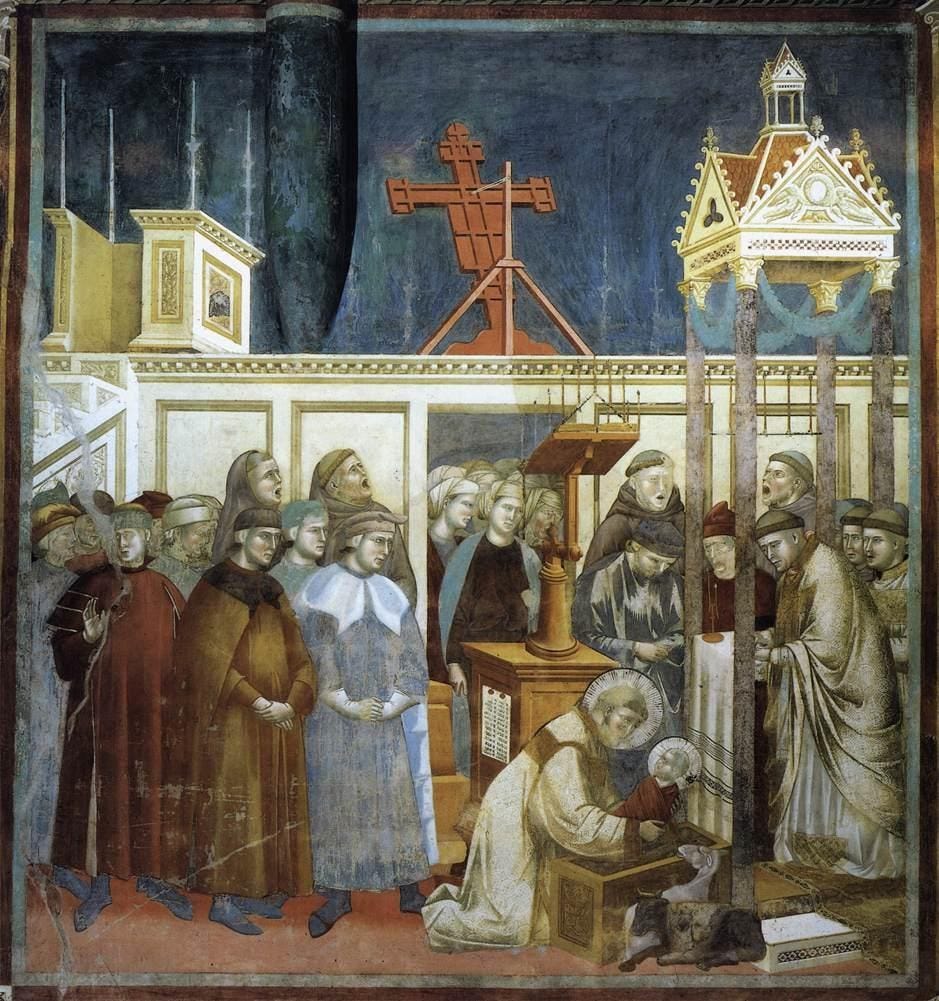
Thus his love made him happy, for he was ever in full harmony with all that surrounded him. We said above that St. Francis was a poet. In point of time he is one of the first of Italian poets; no less in point of true and deep inspiration. “He burned, all on fire with love,” says the author of the last life of St. Teresa,[12] “and that heavenly flame inspired simple but immortal verses.” What he has left us of his unquestioned compositions shows that he was not neglectful of form. Poetry in all ages has had two principal sources, one secular, the other religious. Thus, at the time of St. Francis, the Provençal minnesinger sang in glowing words of his lady-love, and the Oriental element imported by the returning crusaders had done nothing to change the existing tendency towards the creation of a voluptuous literature. On the other hand, we find in Italy a healthy element of Christian poetry, asserting its sway from Dante down to Tasso, and beyond. And the sources of this stream, says Brockhoff,[13] we find in St. Francis and his disciples. A celebrated troubadour, whose real name has not come down to us, but who passed among the people as the “king of poets” (rex versuum), went one day, in frivolous mood, to hear the strange Assisian preach. Then he laid down his gold-and-purple-trimmed mantle, and begged the garb of a Franciscan monk from our saint. No longer did Brother Pacifico delight the princes in their banquet halls, or the people at high harvest-time; yet we cannot doubt that he sang for the monks, or that he taught St. Francis to put into rhyme the hymns which the saint uttered in his wanderings, and which Brother Leo, who generally accompanied him, always noted down. St. Bonaventure tells us that amidst his frequent infirmities St. Francis often expressed a desire to hear music.[14] Wadding cites among his writings canticles in the vernacular and hymns for the use of the nuns of St. Clare. If we may judge from the few specimens yet remaining and accredited to him, they must have been exquisitely beautiful. There is a peculiar simplicity of style, a sweet flow of melody, in the Italian of that day. Anyone familiar with Latin will be able to enjoy the following prayer, which the saint is said to have used every day:
“O altissimo omnipotente glorioxo Idio,
Illumina le tenebre del core mio.
Doname te prego per tua gran bontade
Fede drita, speranza certa, con perfecta charitade.
E fame da mi havere perfecto cognoscimento
A ciò che sempre obserua el tuo sancto comandamento.”[15][O almighty, glorious God on high, enlighten the darkness of my heart. Grant me, I pray Thee, in Thy bounty, right faith, firm hope, and perfect charity. And let me plainly know myself, so that I may ever observe Thy holy laws.]
“His canticum solis (de lo frate sole) is unquestionably,” says Schlosser, in his translation of I Cantici di S. Francesco, “one of the finest productions of sacred poetry.” The hymns In foco amor mi mise, and Amor de caritade, found in the works of St. Bernardine of Siena, are, by the weighty authority of Ireneo Affo, attributed to Fra Jacopone, the worthy forerunner of Dante. Yet they breathe all the spirit of St. Francis. Thus sang the Saint. Like a prophecy, reminding us of holy Simeon at once and Zachary, are the last words, the song of the dying swan, when prostrate on the ground, blind, and too weak to reach his beloved Assisi, he turns towards the cherished city with these prophetic words:
“Benedicta tu civitas a Domino
Quia per te multæ animæ salvabuntur
Et in te multi servi altissimi habitabunt
Et de te multi eligentur ad regnum aeternum.”[16][Blessed art thou, O city, by the Lord, for through thee many souls shall be saved. In thee shall dwell many servants of the Most High, and out of thee many shall be chosen for eternal glory.]
How soon the blessing was verified. Less than forty years after, Assisi had sent out of her noviciate 200,000 monks, bearing the seeds of the spirit of St. Francis into every land on the globe.
During his lifetime the saint had exercised great power over men. As Irnerius drew disciples around him by the fame of his learning, so St. Francis had attracted them by the rumor of his sanctity. Once they had seen him he kept them spellbound by his lovely ways. He was a beautiful man. His broad, chaste brow, and finely-chiselled features, his eyes, with their deep-dreamy joy, catching a spark whenever holy zeal prompted his heart to light them, the grace of his manner, and yet withal, his humble readiness to serve as beast of burden to the first that chose to claim such service,—all these things charmed the men that approached him, and they learned to love the things he loved, they hardly knew why; but there seemed to be so much superior wisdom and happiness in his choice. Now that he was dead, men wandered to his tomb. Assisi became the centre of inspiration, the fountain-head whence
“Many rivulets have since been turned
Over the garden Catholic to lead
Their living waters, and have fed its plant.”[17]
Notes
[1] Paradiso, Cant. XI., 53.
[2] Vita S. Francisci, Bolland.
[3] My dear little sisters, sweet innocent doves,—yes, I am going to save you from death and build you little nests.
[4] Ps. 148.
[5] De vera et perfecta laetitia—cited by Wadding.
[6] Ruskin goes so far as to maintain that the realization of the divine presence in nature, and the love of nature which springs from and accompanies this consciousness are essential to and the only promise of true art.—Modern Painters, vol. iii., p. 313.
[7] Victor Cousin’s Lectures, Wright’s translation, p. 103.
[8] Essay on the interest and characteristics of the Lives of the Saints, by F. W. Faber.
[9] The Poetry of Christian Art, p. 122.
[10] Vita S. Francisci, Boll.
[11] The Rev. Hutchison, of the London Oratory.
[12] Cited in the Civiltà Cattolica, Quad. 774.
[13] Brockhoff, Die Klöster.
[14] Ad jucunditatem spiritus excitandam alicujus audiendi soni harmoniaci desiderium habuisset.—Vita S. Francisci. [“He had conceived a desire to hear some harmonious sound, to stir up gladness of spirit.”]
[15] “O almighty, glorious God on high, enlighten the darkness of my heart. Grant me, I pray Thee, in Thy bounty, right faith, firm hope, and perfect charity. And let me plainly know myself, so that I may ever observe Thy holy laws.”—This prayer appeared first in an ancient life of St. Clara, printed in Milan, 1492. It is not stated that St. Francis himself composed it, though there can hardly be a doubt of it.
[16] “Blessed art thou, O city, by the Lord, for through thee many souls shall be saved. In thee shall dwell many servants of the Most High, and out of thee many shall be chosen for eternal glory.”
[17] Paradiso, Cant. xii., 96.
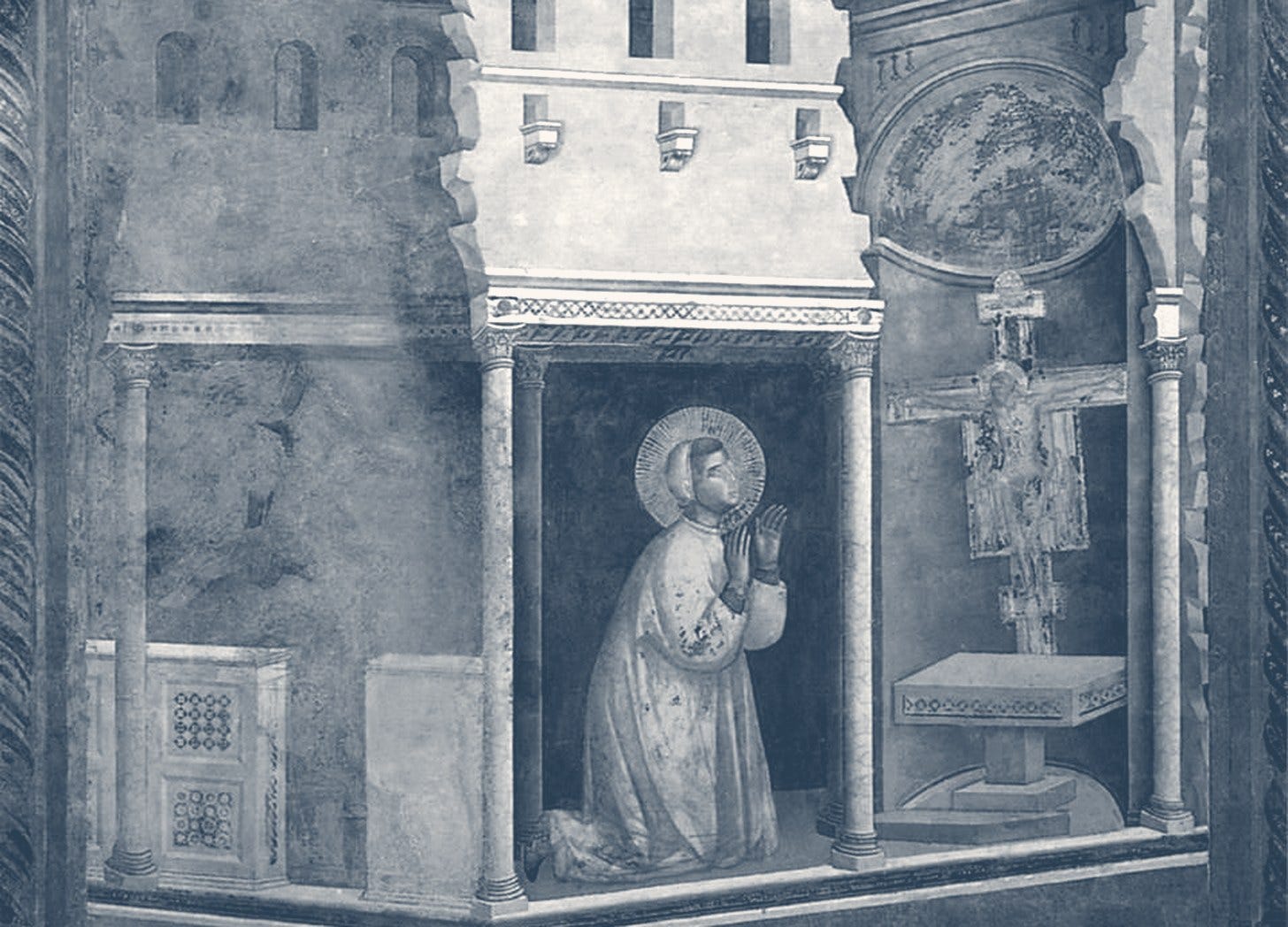
Cover: Giotto, Stigmatization of St. Francis (c. 1295–1300), Louvre, Paris (detail).
From the American Catholic Quarterly Review, vol. 8, no. 29 (January 1883), pp. 43–58. Part II follows tomorrow.