



Thomas Clemmons
In an earlier piece I discussed the relics of St. Justin of Annapolis. [1] Justin’s relics, under the protection of the Redemptorists, arrived in Annapolis in 1873, coming to rest ultimately at St. Mary’s parish. St. Justin’s relics were not transferred in isolation: the relics of two other early Roman martyrs, St. Sergius and St. Nazarius, were brought with Justin to the United States. A fourth Roman martyr, St. Datian, arrived twenty years later. What are the stories of the other three martyrs taken from the Roman catacombs? What can be known about their ancient martyrdoms, and what have been their fates on our shores?
In the nineteenth century the Redemptorists were remarkably active in the United States, especially in the Northeast. Founded by St. Alphonsus Liguori in 1732, the Congregation of the Most Holy Redeemer was given the charism of preaching to the people, especially to the urban and rural poor. [2] The first Redemptorists came to the United States in 1832; they reached Baltimore in 1840, New York in 1842, and other large American cities in the years immediately following. [3] In Philadelphia, St. John Neumann (1811–1860), a Redemptorist, became the fourth bishop of the city, where he founded the first diocesan school system in the United States. Under Neumann’s leadership, parochial schools in Philadelphia grew from two in 1852 to an astonishing one hundred or more by his death. He also greatly increased the number of parishes, churches and centers of education in his diocese, including laying the foundation for the Cathedral of Sts. Peter and Paul in Philadelphia and beginning a minor seminary for St. Charles Borromeo Seminary. [4] As St. John Neumann’s labors show, the Redemptorists were fervently and judiciously active throughout the East Coast.
The Redemptorists promoted the Forty Hours Devotion, which Neumann was the first American bishop to establish throughout his diocese, as well as, after Pius IX entrusted the icon to the order in 1865, the veneration of Our Mother of Perpetual Help. Two certified copies of the icon of Our Lady under this title were placed by the order: in 1868 at St. Mary’s of Annapolis (where St. Justin’s relics are found) and in Boston in 1878 at what is now the Basilica and Shrine of Our Lady of Perpetual Help (where St. Nazarius’s relics are found). Throughout these decades there was a prominent network of Redemptorists in Pittsburgh (both St. John Neumann and Blessed Francis Xavier Seelos were originally active at St. Philomena’s Church), Baltimore, Philadelphia, New York City and Boston—that is to say, the major urban centers of the eastern United States.
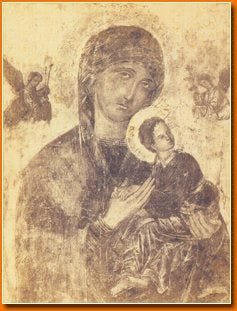
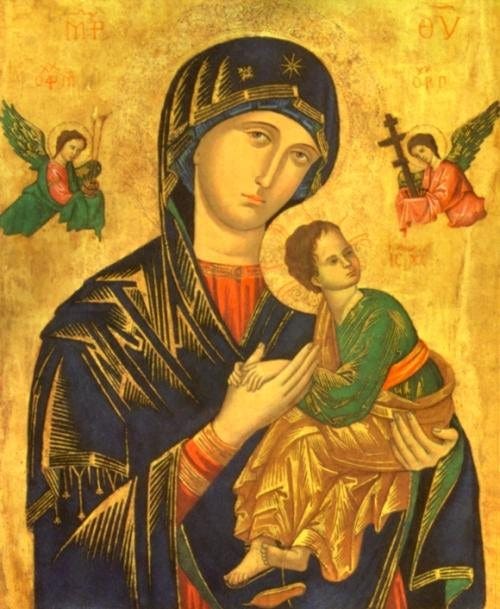
Above: Icon of Our Lady of Perpetual Help, prior to restoration (1866). Below: the icon restored, in St. Alphonsus Liguori Church, Rome (Wikipedia)
St. Sergius: Found and Lost
St. Sergius was taken from the Callixtus catacombs along with Justin and Nazarius in 1757. With these other two early martyrs, St. Sergius was kept in a private chapel in Perugia, before being moved to Subiaco Abbey and finally brought to the United States in September of 1873. A Redemptorist document describes Sergius as a martyr under the persecution of the emperor Julian the Apostate (361–63). [5] The reference to the persecution of the emperor Julian is interesting, as the Callixtus catacombs were more elaborately developed by this time, in line with the broader benefaction that the Roman church had received under the emperor Constantine, including the dedication of the large basilica of St. Lawrence. As concerns St. Sergius specifically, early references to the martyr are not extant. If Sergius was buried in the Callixtus catacombs as a native martyr of Rome, there are no clear contemporary accounts or references to him. This is not especially surprising, as early lists of Roman sites often only include the most famous saints and martyrs, who have shrines or churches for visitation and liturgical celebration.
The relics of the otherwise unknown St. Sergius were transferred to the setting of the bustling, yet relatively remote, Redemptorist House of Studies in Ilchester, Maryland. Ilchester was linked with Baltimore on the B&O railroad and by 1871 with Wheeling, West Virginia, and Pittsburgh. In these cities as well as the East Coast hubs of Philadelphia, New York City and Boston, the Redemptorists were very active. The Ilchester House of Studies was then both a remote place for formation and study (where some came to learn Bohemian, for example) and a reachable and connected nexus between Baltimore and the East Coast, and the more western reaches like Pittsburgh.
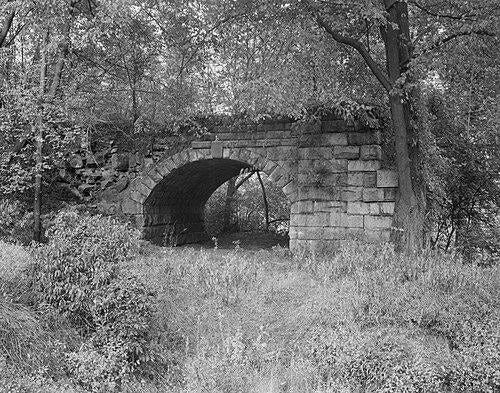
At this important center of Redemptorist formation, the relics of St. Sergius were placed under the altar, and remained there for the duration of the Ilchester House’s use. [6] The eventual division of the seminary program, with part of it moved to a residence on the Hudson in New York, diminished the Redemptorist presence at Ilchester. [7] In 1968 a fire destroyed the building. After the final class graduated in 1972, the Ilchester House was abandoned. It is unclear what happened to the relics of St. Sergius: whether they were moved and, if so, where. The remaining legacy of the Redemptorists at Ilchester is the parish of Our Lady of Perpetual Help in Ellicott City.
Boston’s Saint: Nazarius
Sergius was sparsely recorded, installed, then lost from view; St. Nazarius left a far more visible legacy in the United States. There is a very early reference to a Nazarius mentioned alongside a co-martyr, a certain Nabor. The feast of these two saints is listed as June 8 (later June 12), though their burial site is described as resting on the Via Aurelia, which is a little way from the Callixtus catacombs and the Via Appia. [8] It seems unlikely, then, that the Nazarius who is coupled with St. Nabor is the same Nazarius found thirteen hundred years later in the Callixtus catacombs with Justin, Sergius and Datian. The Redemptorists, for their part, preserve an account that Nazarius was martyred under Marcus Aurelius (161–80), an at times brutal persecutor of Christians (as the account of the martyrs of Lyons and Vienne attests). Beyond this, Nazarius’s biography is as obscure to later history as those of Sts. Sergius and Justin; however, a more enduring and public history awaited Nazarius in the United States.
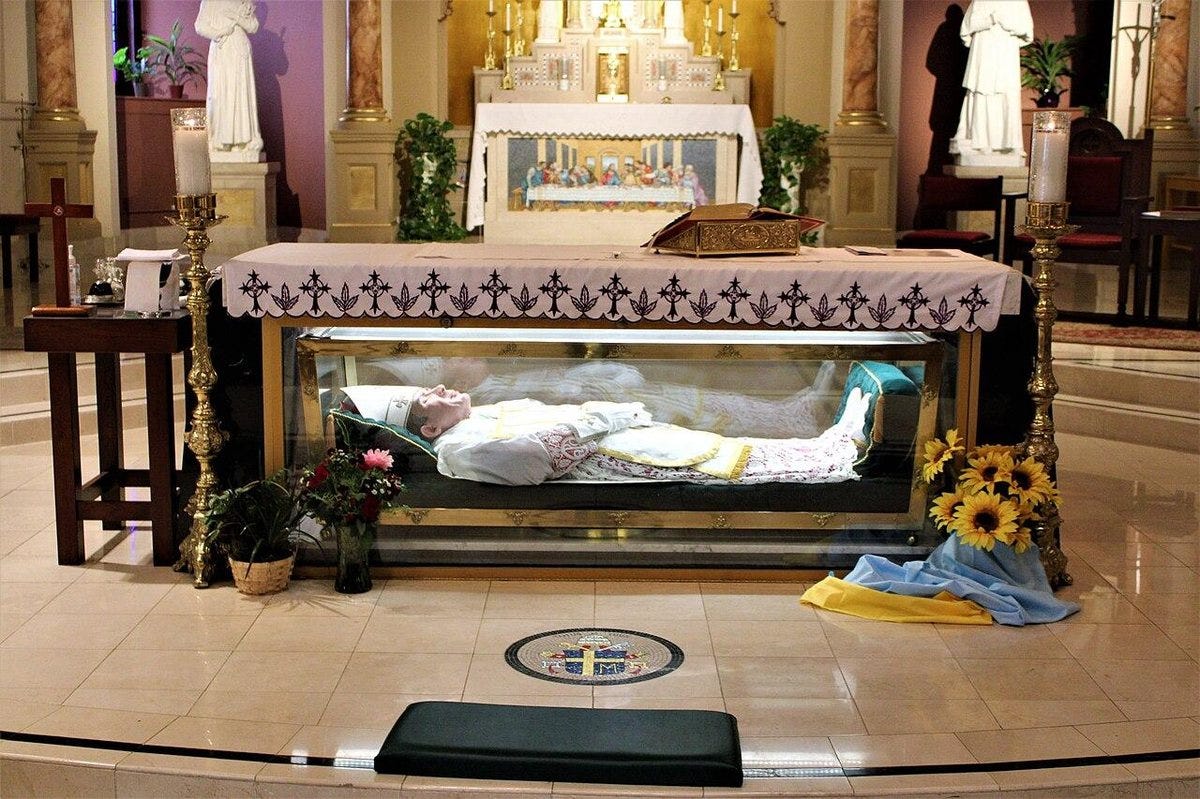
Unlike Sts. Justin and Sergius, whose relics went south, when the relics of St. Nazarius arrived in New York City, they were sent north to Boston. They arrived in the fall of 1873, and a ceremony for the historic “deposition” of the martyr’s relics was held on December 28, 1873. This ceremony received a write-up in the Boston Globe, with the bishop of Boston, John Joseph Williams, presiding, and the president of Boston College, Robert Fulton, SJ, as a celebrant, and Joseph Wissel of the Redemptorists as the homilist. [9] A Redemptorist account preserves a quote from an anonymous Boston parishioner, who remembered the event: “I was more impressed by the ceremonies attending the arrival of the relics of St. Nazarius than any other event in the history of the parish…there was a great deal of excitement over the idea of having the remains of a saint in the church.” [10]
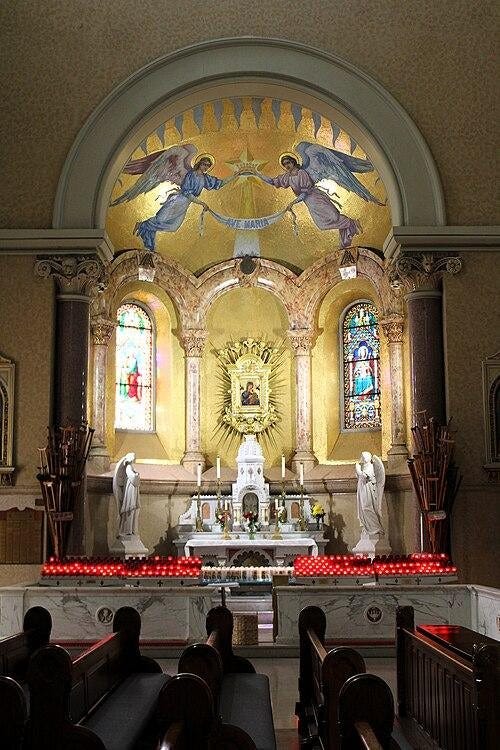
The relics of St. Nazarius were enclosed in a wax effigy and placed under the high altar of the church. In 1877, the relics were moved to the new mission church, which was dedicated to Our Lady of Perpetual Help. Here St. Nazarius remains, still encased in wax, beneath the altar; in 1954 the church was elevated to a basilica, the magnificent Basilica and Shrine of Our Lady of Perpetual Help (where, as noted above, a certified copy of the icon of the same name has been housed for nearly as long).
A Shrine in New York
The fourth martyr, St. Datian, is similar to St. Justin; he is said to have been martyred in Rome in the last years of the Great Persecution and buried in the Callixtus catacombs. Some identify him with Dacian, the Roman governor in Spain who sentenced St. Vincent of Saragossa to death in 304, and it is said that this governor was so moved by the witness of St. Vincent that he converted to Christianity and was himself martyred. The ancient accounts of Vincent’s passion, however, know nothing of such a conversion. It seems far more likely that, like St. Justin, the Datian of the Callixtus catacombs is a martyr obscure to later history. The Redemptorists mark his feast as October 30.
St. Datian did not come to the United States with Justin, Sergius and Nazarius. His relics, discovered separately in 1762, were kept in a different private chapel, not in Perugia, but in Rome. When this property risked confiscation, the relics were ultimately transferred to the Redemptorists for transit to the United States. The relics arrived in New York City on August 12, 1892, the port through which his companions from the catacombs had passed some twenty years before. St. Datian’s relics, however, stayed in New York. On January 26, 1894, the relics of St. Datian were installed in a wax effigy (like Nazarius) at the Church of the Most Holy Redeemer.
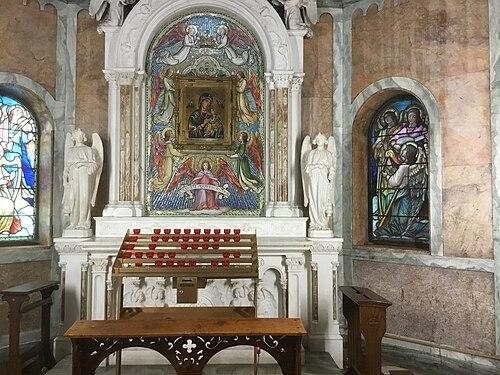
St. Datian’s relics marked the beginning of a great undertaking: the collecting of relics at the Church of the Most Holy Redeemer. Over the following century, the Redemptorists gathered many relics to supplement this shrine (152 in total!). [11] This remarkable historic church and relic shrine in New York’s East Village served as a parish until the fall of 2025, when regular Masses ended. In the past year, Most Holy Redeemer has been at risk of sale or even demolition. Though the church is now closed to the public, St. Datian, and the abundance of relics that surround him, remain in repose. [12]
Four Early Roman Martyrs in America
In examining these martyrs, we find many surprises but, as with St. Justin, no hagiography. Rather, we see that these four martyrs come from three very different periods of persecution in the early Church: Sts. Justin and Datian in the last years of the “Great Persecution” begun under Diocletian (circa 303–12), St. Nazarius under Marcus Aurelius (161–80), and St. Sergius under Julian the Apostate (361–63). Though these martyrs were buried in the Callixtus catacombs, which were certainly coming to greater attention by the late nineteenth century, given the work of the Papal Commission of Sacred Archaeology, these martyrs themselves were not famous. Nor were they a consequence of the Commission’s work; they had been removed from the catacombs nearly one hundred years earlier and kept for private veneration. The journey to the United States for these relics was, perhaps not surprisingly, overseen by one of the most active, and relatively new, religious orders, the Redemptorists. As custodians, they enshrined these four saints in significant places for the Redemptorist missions in the United States.
The long history of these relics is just as interesting. St. Sergius’s relics are, as best I can tell, in an unknown location. St. Justin rests peacefully, but not prominently, at St. Mary’s in Annapolis. In contrast, St. Nazarius remains in the magnificent Boston Basilica of Our Lady of Perpetual Help, where his very presence (wax effigy and all) may have aided in the church’s elevation to a basilica. St. Datian came to rest prominently at Most Holy Redeemer in New York City. His enshrinement initiated a process of gathering relics at that shrine, such that Most Holy Redeemer became one of the most prominent churches on the East Coast. Now, however, the church is closed to parish services and the relics within are effectively entombed. A strange history and an unexpected outcome for four unknown early Christian martyrs.
Thomas Clemmons is Associate Professor of Latin Patristics in the School of Theology and Religious Studies at The Catholic University of America and an Associate Editor of the American Catholic Quarterly Review.
Notes
[1] Thomas Clemmons, “St. Justin of Annapolis,” American Catholic Quarterly Review, September 28, 2026.
[2] See https://redemptorists.net/who-are-the-redemptorists.
[3] Joseph Wuest, “Redemptorists,” in C. Herbermann, E. Pace, C. Pallen, et al., The Catholic Encyclopedia, vol. 12 (New York: The Encyclopedia Press, 1913): 683–84.
[4] Joseph Wissel, “Ven. John Nepomucene Neumann,” in C. Herbermann, E. Pace, C. Pallen, et al., The Catholic Encyclopedia, vol. 10 (New York: The Encyclopedia Press, 1913): 773–74. See also Alvin Shuster, “Bishop Neumann Canonized; First Male Saint from U.S.: Bishop Neumann Becomes the First Male Saint from the United States,” Special to The New York Times, New York Times, June 20, 1977: 1, 3. See also John F. Byrne, “The Redemptorists in America: VIII. The Venerable Bishop Neumann,” Records of the American Catholic Historical Society of Philadelphia 43, no. 1 (1932): 34–61.
[5] Barnabas Hipkins, C.Ss.R., “When the Saints Came Marching Over…,” The Province Story: A Redemptorist Historical Review—Baltimore Province 1, no. 1 (November 1, 1974): 5.
[6] Hipkins, “When the Saints…,” 7. See also Michael J. Curley, C.Ss.R., The Provincial Story: A History of the Baltimore Province of the Congregation of the Most Holy Redeemer (New York: Redemptorist Fathers, Baltimore Province, 1963): 245–50.
[7] See Paul T. Stroh, C.Ss.R., Ilchester Memories, 1868–1957: To Commemorate the Golden Jubilee, 1907–1957, of the Redemptorist Novitiate at Ilchester, Maryland (Ilchester, MD: Redemptorist Fathers, 1957).
[8] See Martyrologium Hieronymianum in Michael Lapidge, The Roman Martyrs: Introduction, Translation, and Commentary (Oxford: Oxford University Press, 2018), 653.
[9] The Boston Daily Globe, December 29, 1873: 1–2; for Archbishop John Joseph Williams’ relationship to CUA, see The Catholic University Bulletin 14 (1908): 109.
[10] Hipkins, “When the Saints…,” 6.
[11] https://stbrigidstemeric.org/reliquary-chapel-of-st-datian
[12] https://www.amny.com/new-york/manhattan/east-village-rally-most-holy-redeemer-church/; see also https://www.otdowntown.com/news/most-holy-redeemer-church-in-limbo-locals-rally-archdiocese-mum-MA6165068
Cover: The Crypt of the Popes, Catacomb of Callixtus, Rome. Photograph by Dnalor 01, CC BY-SA 3.0, Wikimedia Commons.