


By the Right Rev. T. A. Becker, D.D.
From the Editor. This week we have been running “The Classical Education of the Day,” by the Right Rev. Thomas A. Becker, from our first number (January 1876). So far Becker has blamed the academies that prepare boys for college, the trade in easy-method textbooks, and students impatient to begin their professions. In this final part he turns to the colleges themselves: the boat race, the multitude of small colleges, and professors of Latin who could not speak it. He closes with a remedy.
THE CLASSICAL EDUCATION OF THE DAY
Right Rev. T. A. Becker, D.D.
American Catholic Quarterly Review, vol. 1, no. 1 (January 1876), pp. 33–50 (concluded)
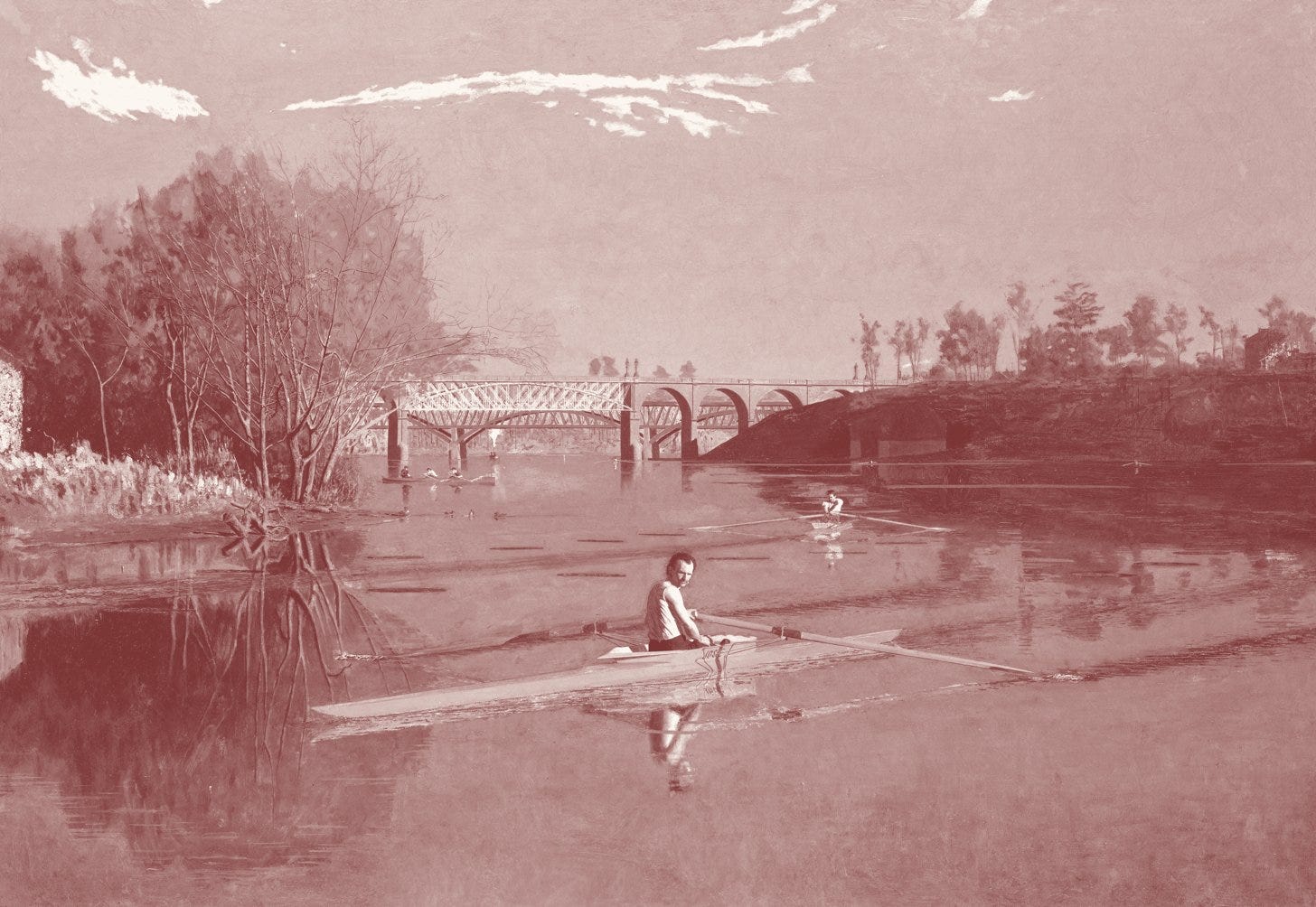
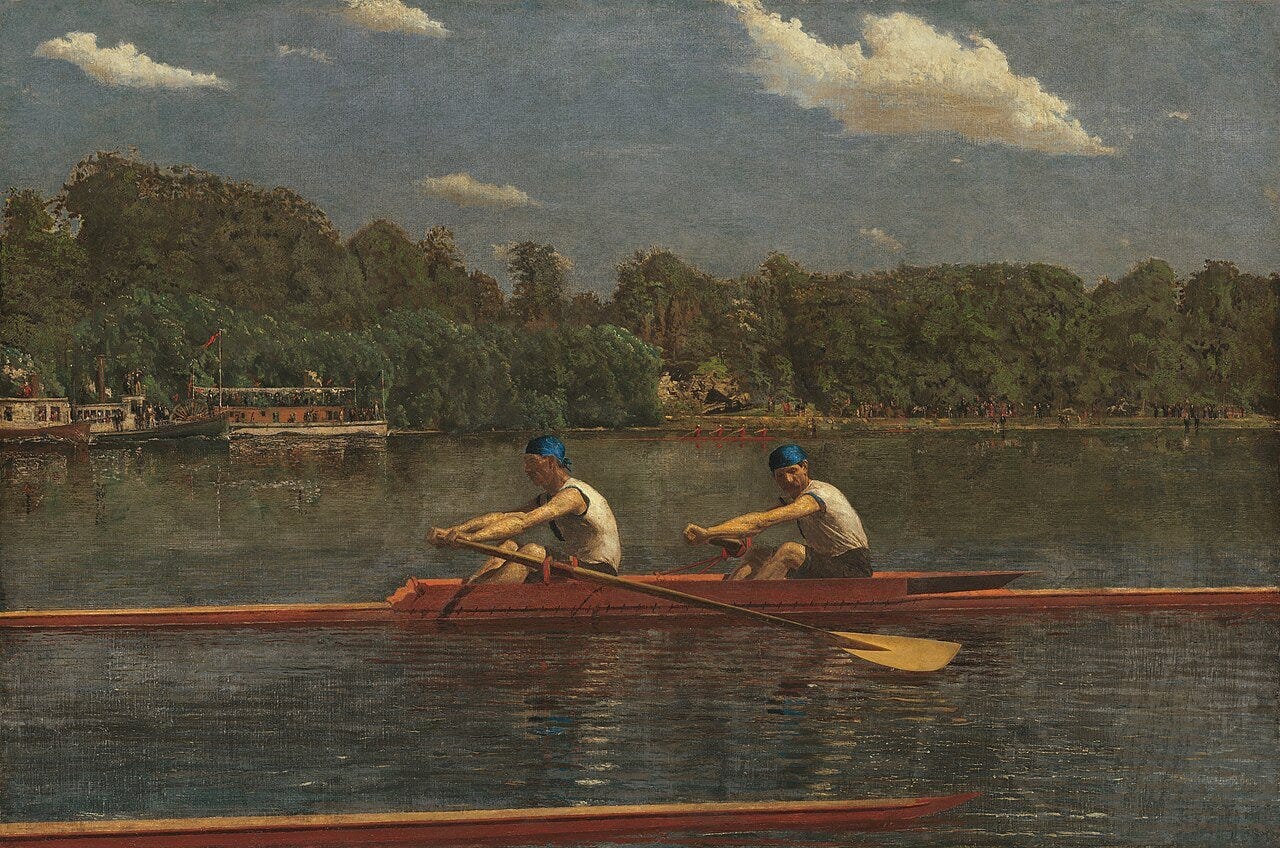
The colleges themselves, too, are in fault for not vigorously repressing the yachting, boating, base-balling and other practices and pursuits which have grown, in the principal institutions of the country, to such an extent that common sense would teach even a casual observer that very little of severe study can be there. The two things cannot coexist; and he who, during two or three months of his college year, itself consisting of but nine months, is busily occupied in training for a rowing match which is to be the great feature of the year, whose whole mind and being are agog on the subject for months beforehand and for weeks after, has no time and less inclination for such trifles as Latin and Greek. What is true of the boating nuisance holds equally good of all the other excitements with which the so-called students fritter away their time, destroy their chances of ever being scholars, and get their names into the trashy papers of the day for performances in which any fair coxswain or stroke-oarsman on board a man-of-war will far enough excel them, and that too on the munificent pay of $18 per month. Do parents and guardians send their sons and wards to college for this purpose? If they must be oarsmen, why not put them on board a vessel, with injunctions that they be of the crew of the gig, barge, cutter, launch, or dingy? It will not be so expensive, they will earn their board and clothes while at it, and there will be no false pretence of education connected therewith. If mere muscular power, or mere muscle, be the desideratum, they might at once be apprenticed to blacksmiths, and might attain at length a measurable proficiency in wielding the ponderous sledge to weld the flukes of a bower anchor. It would seem that students have been before this twitted with truth as having “rung in” (so it is called) professional base-ballers under the guise of students to gain the day. One becomes sad at the silliness, the deception and hollowness of the whole thing; yet newspapers are full of the accounts of such doings, college magnates glory in the success of their man, trustees doubtless applaud, and the parents of the victorious noodle or noodles are in ecstasies. The whole thing is wrong, misplaced, silly, and productive of the most mischievous consequences, and the utter ruin of all educational prospects.
Again, there are too many colleges, or rather institutions going amongst us by that name, which do not even deserve to be called good high schools. Sectarianism in most instances, local pride in others, and the same feeling that impels our villages ofttimes to apply for a charter, to have a mayor and city council, prompts every school of sixty or seventy pupils throughout the country to get a charter, have a faculty, dun the public for aid, confer degrees by wholesale on all the local or denominational small fry who would like to have them. This is absurd. A primary school is not made an academy merely by calling it so, nor can an academy, by any legislation, be turned into a college; neither, if possible, would it be at all desirable. There are too many of them already of their kind, and their members are largely though not entirely in fault for their being what they are, viz: puny, meagre and inefficient attempts at doing on small outlay of brain and means, and with scant numbers, apparatus and other appliances, what can only be done effectively by an able faculty, full libraries, ample chemical and philosophical appliances, the esprit du corps arising from large numbers, and the independence and manliness fostered by fixedness of position through scholarships and proportionate ample pay to the members of the faculty. But above all things, care should be taken in the first place to see that no man is put into a position to teach what he does not know! Let it not be in the power of a board of trustees, whose knowledge (if ever possessed) has been obliterated by time and disuse, to appoint men to so important a post as that of professor of Greek or of Latin, who are not competent in either — do not actually know either: and this is unfortunately a thing that has often been done in our country, and even in colleges that rank with the best. It may be thought that such precaution is unnecessary; but let us examine the matter quietly, and see what a professor should be, slightly glancing by the way at what a great many, aye a majority, are. What is said will be proposed in no captious or cynical spirit, but (if the writer knows himself) solely with regard to the truth and the benefit of the rising generation of youth. We use the word professor here in its proper acceptation of an instructor in a special branch, at an institution of a high or of the highest grade of its kind. But it will bear in this connection the vulgar and peculiarly American usage, by which any one is a professor who teaches anything, from Sanskrit down to the alphabet; and the remarks made, while primarily intended for collegiate teachers, and especially for those of the classical branches, will apply “mutatis mutandis” to the teachers in all schools and academies where classical studies are ostensibly a prominent object of acquirement.
He who … is busily occupied in training for a rowing match which is to be the great feature of the year … has no time and less inclination for such trifles as Latin and Greek.
It may here be stated once for all that what is said is in no respect intended to derogate from the moral character of the class referred to, of those who appoint them, of the community that patronizes them. Probably, nay assuredly, there is no country in the world so little likely to tolerate any deflection from the moral law, or from propriety of demeanor in a teacher, as the United States.
Men are professors in Europe who, on account of grossness of life, of indecorum of personal habits, could not teach in the United States for one week, had they the talents of an archangel. But they are thoroughly learned, they have mastered their branches; so far as anything human can be perfect, they thoroughly know what they teach, how to present it in fresh, interesting and attractive lights; are competent to answer, and promptly and fully respond to and clear up, any question in their branch that may be presented, or difficulty that may be put.
What we need is to have fewer colleges (one say for forty that we have,) and just such professors; retaining always the American desideratum of good character and gentlemanly habits. We want men filling classical chairs who have made those studies a specialty; who have prepared themselves at all points in regard to the niceties of grammar and idiom, the peculiarities of thought and diction, the habits and manners, the constitution, geography, laws, history, antiquities and mythology of Greece and Rome; men not only able to write correctly and with idiomatical accuracy of expression, but competent to converse fluently, and by consequence to think, in the languages they profess to teach. In reality no person without this thoroughness can with any degree of propriety be said to understand a language in such form as to be justifiable in occupying the position referred to in a genuine institution of learning. Such men are even now to be found, we presume, in scanty numbers, in our own country; and they will soon be found in greater numbers under the regime we propose. Under them students will receive an impetus in their studies; what they do will be done well; and the influence of such a teacher, even though his branch be not the favorite one of the student (for every student will have a bias or predilection for a particular study) will last through life.

But what is the fact? Our professors are appointed by family, class, or denominational influences. A prominent preacher, a lawyer not successful at the bar, a physician upon whom patients do not call in paying numbers, an editor of a religious journal, or a compiler of one of the before-mentioned text-books, is chosen; and who would hurt the feelings of gentlemen of such eminence by proposing an examination? Who would be able to do the work of examination, if proposed? Rarely or never those in whose hands the appointment lies: and it is much handier and every way more simple to take for granted that the candidate, who has already been a professional man, and who probably graduated somewhere, knows what he should know, than either to intimate the possibility of doubt, or expose our own ignorance on an actual test.
We know now professors of Latin … who could no more carry on a conversation in Latin than they could fly in the air.
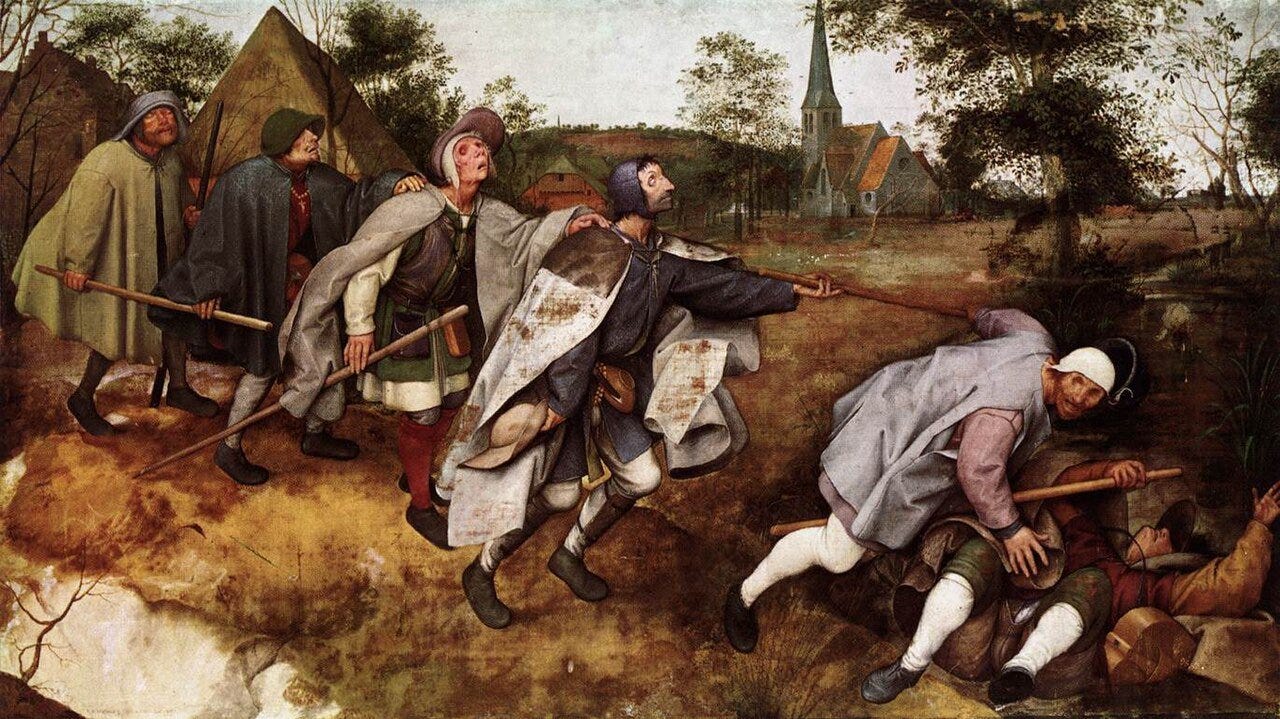
Ah, gentlemen! here is the great cause of our inferiority in classics (it may be, too, in other things) to the nations of Europe. The subordinate, or rather the primary instructors in classics, are with us either self-constituted (as are the principals of our academies and boarding schools), or when appointed, the power of appointment is lodged in the hands of men incapable of appreciating the subjects to be taught, and the requirements for teaching them. The head master wants not the most thorough and profound teacher, but the cheapest man, and the latter takes the place as a dernier resort until he can do better at some other and more lucrative business. It were better that the high-toned feelings of any number of plausible and sleek candidates for professorships were wounded, and that both they should see themselves, and the community should see them, in their true light, than that this persistent sham under the auspices of our colleges and the aegis of their Board of Trustees should go on any longer, fraught as it is with ruin to the best temporal interests of the youth entrusted to their care by an over-confiding, a credulous, and, in this regard, an ignorant community. We know now professors of Latin, and those too of long standing as well as of late appointment, who could no more carry on a conversation in Latin than they could fly in the air; who cannot discern and read with quantity and rhythm a line of Terence, or a prologue of Plautus; nay, who cannot distinguish, if I print in this article five lines of Latin poetry of the simplest measure, whether it be prose or poetry, unless taken from the common college curriculum, and the lines themselves indicate to them the verse. Such a thing as translating currenti calamo [with a running pen] into Latin the leader that may appear in some of our best papers, is to them as thoroughly impossible as it would be for a Digger Indian with a slight tincture of frontier English, to understand the same; and in short, their whole knowledge of the tongue is lame, defective, feeble and inaccurate. In a conversation gravely held with one of them, a few months since, he expressed the opinion that “he did not believe that anybody now-a-days could speak Latin,” and insinuated, rather than expressed openly, a doubt whether it had ever been done since the time when, as he expressed it, “Latin became a dead language!” What is to be done with such a man? He has not a sufficient substratum after all these years of teaching Sallust, Virgil, and the few orations of Cicero supposed to be necessary, even to appreciate an argument on the subject, or to have a glimmering conception of his own ignorance. Scripture tells what the result is when the blind lead the blind; and this cæcus cæcorum ductor [blind leader of the blind] has held forth for many years with great acceptance as professor of Latin! Nor is he alone: he is but a pronounced type of a large class, we fully believe of a majority, if not of college professors, certainly of academical instructors throughout our country. We would in charity hope that it arises from ignorantia invincibilis, and would just as soon argue with the hedge schoolmaster (you may possibly have seen the type), who knows usually so little that he supposes that he knows everything, and that wisdom will die with him.
And yet what is it but a fraud? These men pocket, year by year, salaries or fees from the community, for teaching what they do not know, for imparting a knowledge of what they themselves do not understand. If a man sells me an unsound horse at the price of a sound one; if he gets from me money on a check returned “no funds;” if he sells me goods not up to the sample or damaged, I have a remedy at law. Why should I have no remedy in this single case? It may be said that these people who teach languages which they do not know, i. e., can neither write nor speak, act in good faith. I answer that there are means of knowing, and it is their business to know the quality of the article in which they deal, and for which they take my money, and I cannot accept these excuses. There are numbers of men (it is useless to say what proportion of all) teaching classics and making money at it, who if they had their deserts would sit in prison under sentence of false pretense. This may seem a harsh showing, but the proofs might readily be furnished; and no wonder that the cause of classical literature is at a low ebb throughout our country.
If, as those conversant with the subject will fully admit, the best graduates of our most noted colleges are inferior in actual knowledge to a student who passes his examination at a German gymnasium; if an Eton or Rugby boy will shame them in writing Latin or Greek verse; if the students of the various colleges (in the French sense, i. e., high schools) are fully their masters in those studies, surely something ought to be done, some action taken in the premises, or else we had better yield at once. Under the circumstances, and considering the almost entire nullity of the classical knowledge imparted in our country, it is not to be wondered at that men shrewd in other respects, but either entirely wanting classically, or possessing that smattering which is usually imparted and which they feel to be almost utterly useless, have been successful in superseding the study of classics, by substituting what are called “Scientific courses,” in many of our foremost colleges; and that really educated Americans traveling or residing in Europe, are obliged to feel ashamed for their country, when the subject of classics is on the tapis among literary men. A remedy ought to be found; the talent exists in our youth; some professors can even now be found thoroughly educated to the requirements of the chairs of classics in our colleges; others will soon be educated to that point under their auspices; the system of appointment on general principles and without examination must be done away with, and no one should be allowed to teach in an academy who has not passed, then and there, an examination at the hands of competent men, on the branches he professes to teach; the number of pseudo-colleges should be largely reduced; boating, yachting, etc. — in short, all the wide-spread occupation of our present muscular-literary aspirants — should either entirely be done away or confined within reasonable limits; which regulation might with great propriety be extended to the whole absurd system of honorary degrees, which are a delusion, and tend to diminish the respect which a degree rightfully taken deserves. The diploma or “sheepskin,” as our friends term it, would mean something which it has long since ceased to do in any eyes but those of the illiterate, or the still more stupid class, the half-learned. The evil is one of great gravity, threatening to make total shipwreck of the cause of genuine erudition in our country; and while the writer is well aware that it is the truth which hurts, and that he has said too much for many, he is equally sure that he has with him the sentiments of the really learned, and he knows better than to expect the suffrages of the sciolists and shams who disgrace our country, no difference what their position, if they be ignorant and pretentious, and sail under false colors.
Many more points might be made, many more instances and narratives given, of the fraudulent and false nature of our system of classical education, even among ourselves; and we might be induced to make an introspection of our own colleges, which would not be entirely flattering. For the present, this paper is long already; enough has been said to indicate some of the prominent defects pertaining thereto; and in the hope that this defective sketch may stimulate other minds to thought upon the subject and to the devising of efficacious remedies against its evils, we may speak of our own seminaries, and their aspirants, and their defects, in the future.
T. A. Becker.
✠