



From the Editor
“Therefore every scribe who has been trained for the kingdom of heaven is like a householder who brings out of his treasure what is new and what is old” (Matthew 13:52)
We follow this principle at the American Catholic Quarterly Review. In the brief four weeks since our relaunch, we’ve brought out things old—the last essay of Orestes Brownson, the 1938 proposal by an American Blessed for an Institute of Catholic Culture—yet also things new, such as a reflection on how we grow in virtue, and, today, the remarkable story, told engagingly by brilliant Gibbons Fellow Thomas Clemmons, of how the mortal remains of an early Roman martyr found their way to Annapolis, Maryland.
Indeed, if you live in the Washington, DC, area, you can make a pilgrimage to the relics of an early Christian martyr just as easily as if you lived in Rome.
In the weeks to come, we will publish recent lectures and talks by prominent Catholic intellectuals, more treasures from our archives, and continuing contributions by our able group of editors—all in our quest to become “the journal of record” for American Catholic intellectual life.
Enjoy today’s essay—and, if you'd like to support our work, please consider becoming a paid subscriber.
Michael Pakaluk
St. Justin of Annapolis
by Thomas Clemmons
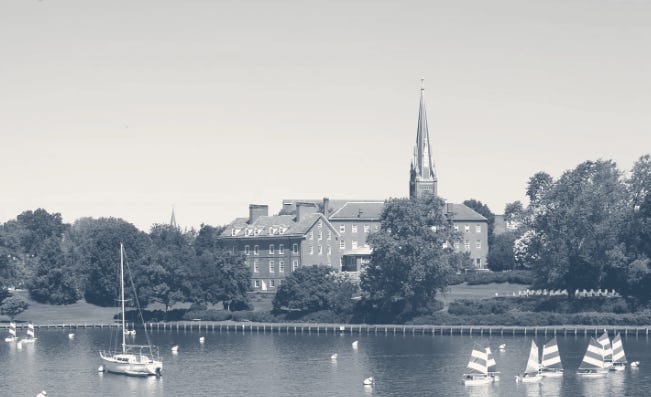
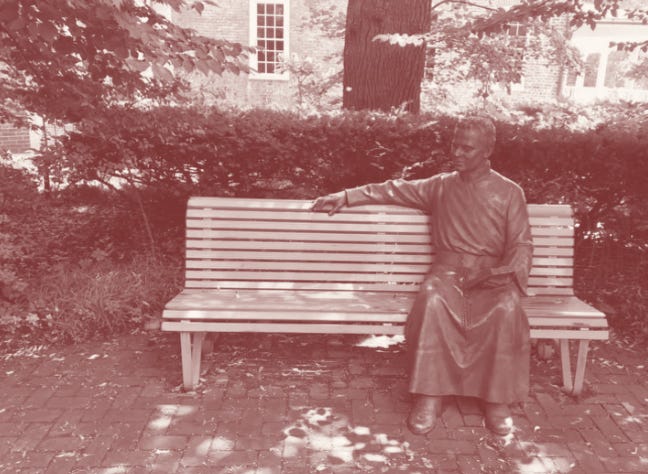
In Annapolis, Maryland, in the quiet cemetery of St. Mary’s Church, is a tombstone marking the resting place of “St. Justin the Martyr.”
As a professor of Patristics, I have been told on a few occasions that a short distance from Washington, D.C., lie the remains of the famous second-century saint Justin Martyr (c. 95–165).[1] Is it possible that the relics of St. Justin Martyr, author of the two Apologies and the Dialogue with Trypho, were at some recent point moved, or translated, to the United States?
A little investigation shows that the relics of St. Justin Martyr are all said to rest in Italy, though in three different churches: Santa Maria della Concezione and St. Lawrence Outside the Walls, both in Rome; and Saints John the Baptist and Blaise in Sacrofano. It quickly becomes clear that the relics in Annapolis are not those of Justin Martyr, the well-known second-century martyr. Who, then, is this Roman-era martyr buried at St. Mary’s in Annapolis?
A century after the execution of Justin Martyr there lived a second Roman martyr named Justin. This Justin was a priest in the city of Rome before and during the Valerian persecution (257–260). According to tradition, he arranged the funerals and burials of many murdered Christians, including several famous martyrs such as Pope Sixtus II, St. Hippolytus, and St. Lawrence. This “second” Justin was himself arrested and probably executed under Claudius II in 269.[2] Like many of those he buried, he was laid to rest in the Catacomb of Cyriaca. His relics, however, did not remain in Rome (nor did they go to Annapolis); in the ninth century they were taken to Freising, where they remain in the Cathedral of Sts. Mary and Corbinian.
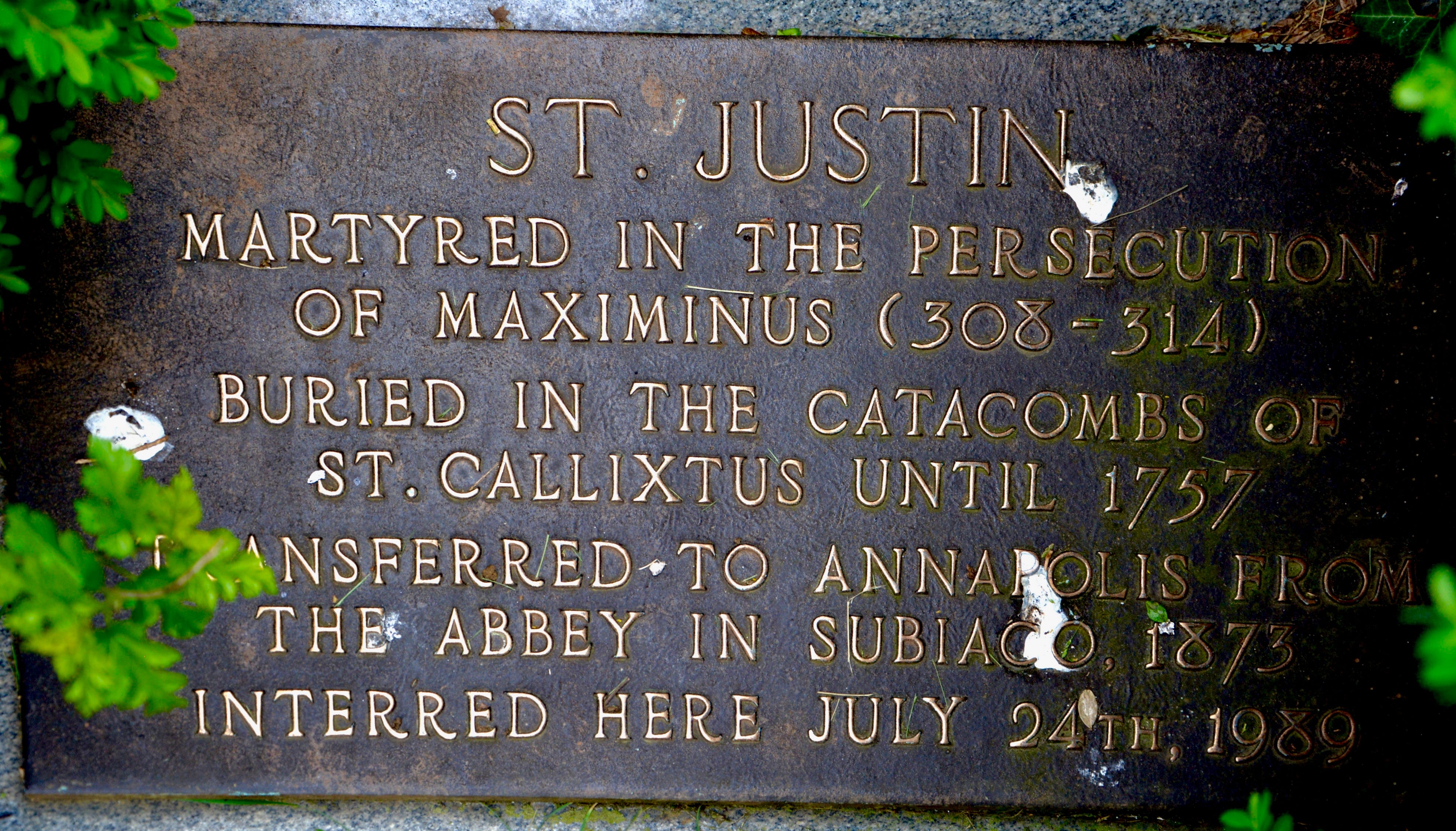
Neither of these two famous Roman martyrs of the second and third centuries is the St. Justin of Rome now in Annapolis. Rather, our St. Justin of Annapolis was a martyr of the severe and widespread Diocletianic persecution of the early fourth century. It is likely that he was martyred in Rome under Maxentius, sometime between 306 and 312. The plaque at St. Mary’s over his resting place, however, reads: “Martyred in the persecution of Maximinus (308–314)[,] buried in the catacombs of St. Callixtus until 1757[,] transferred to Annapolis from the abbey in Subiaco, 1873[,] interred here July 24th, 1989.”[3]
Who, then, is this St. Justin the Martyr of Rome? Is there an extant passio, acta, or vita of him? Is he found in an older martyrology?
Our St. Justin was unknown, it seems, to much of posterity. There is no extant, or even known, account of his life or martyrdom. The oldest martyrologies do not mention him. Even the Roman Martyrology of Pope Benedict XIV, first published in 1749, near the time Justin’s relics were discovered, does not mention this Roman martyr.[4] Our Justin, buried in the fourth century, was known only through his discovery in the Catacombs of Callixtus. Indeed, his namesake, martyred under Claudius II some forty years earlier, had labored in these very catacombs, where Pope Sixtus II was laid to rest and where this more posthumously obscure Justin would come to rest.
This is a remarkable point: St. Justin, who came to rest in Annapolis, was an early martyr, buried and venerated in the Roman catacombs, but not remembered in literary history. He would be “found” again only in more recent times.
In modern scholarship it has become a superficial commonplace that the accounts of the early martyrs are often fictitious literary productions, multiplied and elaborated over time. The Bollandists have labored for centuries to apply a scientific approach to adjudicating the veracity of these accounts, both martyrial and hagiographical. But whatever one makes of such judgments (and one may rightly be suspicious of them, since their principles of exclusion are flexible at best), our St. Justin of Rome presents a different consideration: a martyr preserved within the Catacombs of Callixtus, lost in many ways to history, until rediscovered in the eighteenth century. The sole points of reference are his resting place and his very bones.
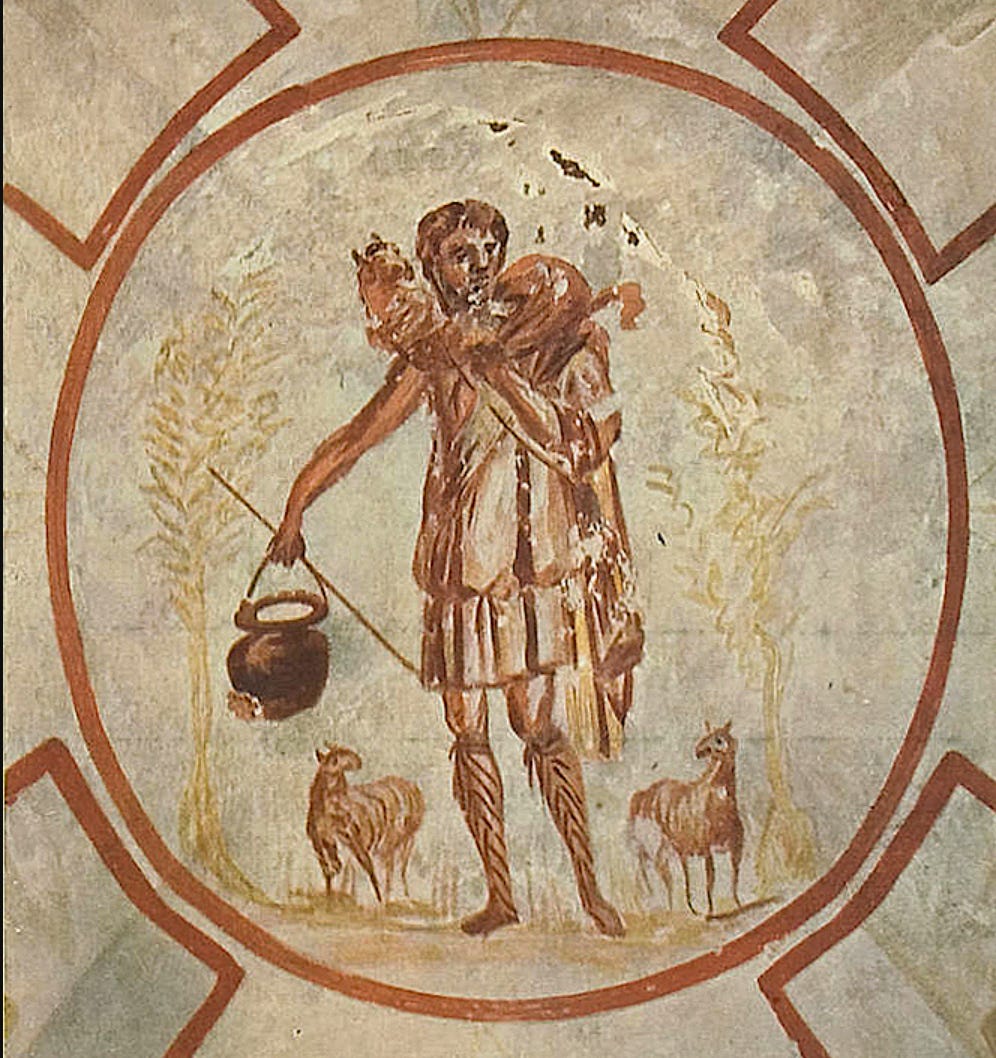
The catacombs of Rome were well known to the early Christians, and they were in various ways developed, preserved, and supported by the Roman Church. The earliest periods of Christian use have left graceful ornamentation, such as the famous frescoes of the Good Shepherd and of the Bread and Fish. By the fourth century, proper shrines, altars, and even churches had been established in the catacombs. Christians continued to visit the catacombs and to venerate the martyrs there even after the Edict of Milan (313). St. Jerome recounts his youthful visits to the catacombs while he was a student in Rome. Popes throughout the fourth and fifth centuries were devoted custodians of the catacombs, the resting place of so many Roman martyrs.
With the long decline of the city of Rome, many of the catacombs were no longer frequented by the ninth century. By the fourteenth century, their entrances could no longer even be found. Only in the sixteenth century, more than a thousand years after our St. Justin’s interment, did occasional excursions into the catacombs begin (it has been argued that controversies between Catholics and various Protestant groups over the veneration of relics prompted these expeditions). Focused study and excavation began only in the nineteenth century, with the founding of the Commission of Sacred Archaeology by Pope Pius IX in 1851. In this period the wonders of the Catacombs of Callixtus, including the tomb of St. Cecilia and the Crypt of the Popes, were discovered by Giovanni Battista de Rossi.[5]
It was in these Catacombs of Callixtus that Justin the Martyr (of Annapolis) was discovered, not, however, during the nineteenth-century excavations, but during the occasional excursions of the century before. The plaque above St. Justin’s resting place gives the date 1757,[6] which places his removal from the Catacombs of Callixtus before the period of organized study and preservation. This early removal also explains how his relics, together with those of two other early martyrs, Nazarius and Sergius, came to be housed in the private chapel of a noble family in Perugia, where they remained for nearly a century.
At some point in the 1860s, perhaps because of social, political, or even personal hardships during the tumultuous unification of Italy, the relics were removed for safekeeping by the Bishop of Città della Pieve. In 1869 they were entrusted to the Benedictines of Subiaco Abbey. According to a Redemptorist history, the “sacrilegious outrages” committed by those seizing the Papal States prompted the prior of Subiaco Abbey, Fr. Raphael Wissel, O.S.B., to offer, with the proper permissions, the relics of these three early Roman martyrs (Justin, Nazarius, and Sergius) to his brother, Fr. Joseph Wissel, a Redemptorist priest and rector of St. Alphonsus in Baltimore. The American Redemptorists accepted, and the Baltimore Province received the relics in September 1873.
The Redemptorist account preserves a telling remark by one of the U.S. Customs inspectors who examined the relics upon their entry into the country. The relics were allowed to remain sealed upon arrival. Redemptorist priests met them at the point of entry and, with the inspectors in tow, escorted them to the rectory of Most Holy Redeemer on East Third Street in Manhattan (the church that would later house the relics of St. Datian). There, under the custodianship of the Redemptorists, the three sealed containers were opened and inspected by U.S. Customs. One of the inspectors observed, “What a strange religion this must be to pay all of these import charges for three boxes of bones!”[7]
This (notably perennial) response does in a way sum up something of Catholicism. Early pagans often remarked on how Christians buried and revered their holy dead. The catacombs of Rome testify to the elaborate care and veneration that Christians gave their dead, especially the martyrs, who were often brutally and publicly executed. Indeed, the “second” St. Justin mentioned above caught the attention of Roman officials precisely because of the funerary services and care for the dead that he offered to martyrs such as St. Lawrence. Our St. Justin, as unknown as he has been, received a noble burial in the Catacombs of Callixtus. Once removed, he was venerated in a private chapel and ultimately, at some cost and with great care, sent far from the land of his martyrdom to a place and a people enlivened by the Redemptorist missions.
I will discuss in a future essay how these three other early Christian martyrs, Sergius, Nazarius, and Datian, were at the center, or perhaps in the thick of things, during the prominent Redemptorist missions in the East Coast metropolises. By contrast, St. Justin, now of Annapolis, moved ultimately to a small plot in the parish cemetery, points to the witness of the martyrs: at times obscure, yet powerfully perduring.
It is no small thing that Justin, a martyr of the most protracted persecution of the early Church, now rests beside the ordinary faithful of St. Mary’s in Annapolis. There is no need for elaboration, just the witness of bones.*
Thomas Clemmons is Associate Professor of Church History at The Catholic University of America and Associate Editor of this Review.
[1] For a recent discussion, see George Matysek, November 10, 2023, Catholic Review, https://catholicreview.org/saint-in-the-graveyard-how-did-the-bones-of-st-justin-wind-up-in-annapolis/.
[2] See Martyrologium Romanum Gregorii XIII: editio novissima Benedicto XIV (Venice: Francisci ex N. Pezzana, 1784), 183. His feast is celebrated on September 17th. See references to this St. Justin in the Passions of Saints Polychronius and Parmenius, Abdon and Sennen, Pope Sixtus II, Lawrence and Hippolytus. This may be the same Justin commemorated with Crescentius on August 4th in the Martyrologium Hieronymianum. For evidence of the arrests of Christians, see Papyrus Oxyrhynchus 3035.
[3] The plaque reads “Maximinus”; more likely he was martyred under Maxentius, who was in control of Italy from 306 to 312.
[4] See Martyrologium Romanum Gregorii XIII, “Index” (Venice: Francisci ex N. Pezzana, 1784), 19.
[5] See V. Fiocchi Nicolai, F. Bisconti, and D. Mazzoleni, The Christian Catacombs of Rome: History, Images, Inscriptions (Regensburg: Schnell & Steiner, 2025), esp. 9–13.
[6] An internal Redemptorist publication by Barnabas Hipkins, C.Ss.R., “When the Saints Came Marching Over…,” pp. 5–8, gives the precise date of April 18, 1757. St. Justin’s relics were found along with those of St. Nazarius and St. Sergius. St. Nazarius’s relics ended up in Boston, and St. Sergius in the Redemptorist formation house in Ilchester, MD. A fourth saint, Datian, was discovered in 1762, and by a different route his relics came to rest in New York City.
[7] Hipkins, “When the Saints Came Marching Over…,” 6.
—
*I sincerely thank Dr. Patrick Hayes, Archivist for the Baltimore Province of the Redemptorists, and my colleague Dr. Maria Cecilia Ulrickson.