


Father Cuthbert, O.S.F.C.
This is the third and concluding part of Father Cuthbert’s essay from our number of October 1900. Having traced the conversion of Francis, he turns to the love of Christ that made the saint at home again in creation, and to its meaning for the Church of Cuthbert’s own day. Himself a builder, Cuthbert writes: “The Church of the future has its own work to do; it cannot afford to lose sight of the work already accomplished.” The Italian verses in the notes are from the poem “Amor de Caritate,” attributed to Jacopone da Todi, and are given as the 1900 printing has them.
(While we would not endorse all of Father Cuthbert’s characterization of Protestants—such as his charge of their “worship of the Bible”—there is much truth in what he says, and in any case the Review reprints his essay as a document of its time.)
When this inward call made itself manifest, Francis was once more happy. He no longer went aside from his friends and groaned for the solitude of his soul. In surrendering himself to Christ he had again found the joy of life, only now it was a deeper joy—the joy born of an extended vision and of a deep personal love. He was once more at home in creation; but creation had now a larger aspect and a deeper significance. The vision of truth which was within his soul cast itself upon the vision of beauty without, and mingled in inexpressible delight. There were shadows there, wrought by man’s sin, especially by luxury and selfishness. But the vision of earth which Francis now saw was one of essential delight. And with all this Christ had put him into immediate relationship, because Christ was the centre of it all. It was Christ’s own kingdom. The glory of the earth was Christ’s glory; the sorrow of the earth, too, was Christ’s. Love of Christ therefore meant love of all creation, especially of all mankind.
The intuitive apprehension of this truth is the explanation of Francis’ subsequent career and of that widespread movement which for a period brought back to earth the primitive spirit and conditions of Christianity when men forsook all for Christ and learned from Christ how to love one another. This evangelical revival, which realized the yearnings and hopes of all the best spirits of the later middle ages, was remarkable chiefly in that it reconciled the religious spirit of the age with all that was best in the secular spirit. The reconciliation was brought about by a fuller appreciation of that central mystery of the Gospel, the Incarnation, and its influence upon life in general. In the Incarnation Francis saw the reconciliation of the world with God, a reconciliation which implies that of the secular spirit with the religious, of temporal interests with the eternal. But in Christ he also saw how this reconciliation is brought about only by suffering and renouncement. This is the cost man has to pay for making an idol of the Present and Visible and separating it from its proper relationship with the Unseen and Future. Not until Francis became impressed with the reality of the other world had Christ any real significance to him as the Reconciler of this world with the Father. At the same time the Incarnation taught him to give the visible creation a positive value, fraught as it is with eternal verities. With Francis renunciation was but the stepping-stone to a larger life; it gave him freedom to satisfy his spiritual aspiration and it likened him more closely to his Master, Christ. His renunciation of wealth and comfort had in it none of the Puritan’s belief in the wickedness of nature. Even to the last he could appreciate the spirit in which ordinary mortals make merry at the dinner board over the meeting with a friend. He would order the knight Orlando to go and entertain his guests, when the knight himself thought it becoming to converse on spiritual matters with the saint. His religious songs were couched in the style and phrase of the troubadour. He saw nothing improper in applying the titles and style of chivalry to his own disciples. The friars were on his lips, “God’s Knights of the Table Round”; St. Clara and her companions were “fair ladies of Poverty”; he himself was “the herald of the Great King.” He was, then, no hater of the world; he loved the world for what was good in it; he pitied it with a gentle sorrow for what was evil. The evils of the world were the thorns which tore the bleeding feet of God’s fair creation. This generous sympathy with all creatures it is which makes Francis so like unto Christ. Others have renounced the world for Christ’s sake as completely as did Francis; others have preached to the world and ministered to its wants, spiritual and temporal; but few have so utterly appreciated and sympathized with the world as Francis did. In this he is almost unique. Not more truly did the impression of the five stigmata on his body mark him out as Christ’s special follower than did his Christlike love of the world.
In his passionate love of Christ Francis again realized in the highest degree the aspiration of mediæval piety, which, as Harnack has pointed out,[1] found its first great expositor in St. Bernard of Clairvaux, and its complete expression in the Poor Man of Assisi. To attach oneself to Christ and to follow Him in all the humble estate of His earthly life—this was the ideal of the middle ages, especially of the twelfth and thirteenth centuries. It was an ideal which appealed at once to the imagination and the heart; and the secret of all great moral movements lies in the appeal to the imagination and the heart.
As I have already said, it is well for us Catholics in the midst of the evolution of modern life and its necessary influence upon the life of the Church to keep in mind the heroic figures of the past.
I doubt whether people brought up outside the Catholic Church can appreciate what such personal devotion to Christ meant to those mediæval revivalists. To them Christ was an ever-present Reality, without Whom there was no reality, but only vanity and disappointment. He was the unifying principle of creation; everything visible received a permanent value only in so far as it proclaimed the beauty and truth and love of Christ’s spiritual kingdom. Hence they sought for vestiges of Christ’s presence everywhere, and every discovery increased their joy because it bore witness to the fact of Christ’s presence among them. Thus Christ was the bond which united them to all external objects. Now Protestantism, whilst professing to be an evangelical reform, effectually severed this bond of direct spiritual relationship with Christ which was alike the secret of primitive Christianity and of mediæval Catholicism. The Reformers declared that the Catholic Church with its sacraments and dogmas had come between the soul and Christ; but they themselves created a barrier which experience has shown to be impassable in their worship of the Bible. They at once reduced Christianity to the servile observance of a moral code in place of that personal attachment to Christ, spiritually conceived by the believer, which mediæval Catholicism in its best representatives endeavored to foster. The influence of the rationalizing party among the Schoolmen undoubtedly tended to base Catholicism exclusively upon an intellectual assent to certain formulæ. And, too, there were the mediæval ritualists who in their multiplication of ceremonies tended to forget the significance of the symbol and to reduce religion to mere externalism. Oftentimes they put the jeweled cope in place of the clean heart, and sang psalms when they should have been teaching the poor. These were the abuses of the mediæval Church against which many a reforming spirit had protested long before Luther. But the constant teaching of the leading lights of the middle ages—of such men as SS. Bernard, Bonaventure and Aquinas—was that true religion depended upon communion with Christ as a present spiritual Personality. Only a few might attain to this intimate communion in any high degree; but all were urged to strive after it. To them the Bible was of value only in as far as it gave them some glimpse of the life of Christ, either in His earthly career or in His spiritual working, as the Divine Word, in the hearts of His chosen people. What they sought was, in a word, the Personality of Christ, that they might conform themselves thereto. The Reformers, on the other hand, did as many modern nations which have taken to themselves a written Constitution, and govern by conforming to the letter of the law rather than by fidelity to the national ideal. Hence to the mind steeped in sixteenth century Protestantism, the religious life of St. Francis and his mediæval compeers is as unintelligible as is the English ideal of free government to the peoples of the Latin race.
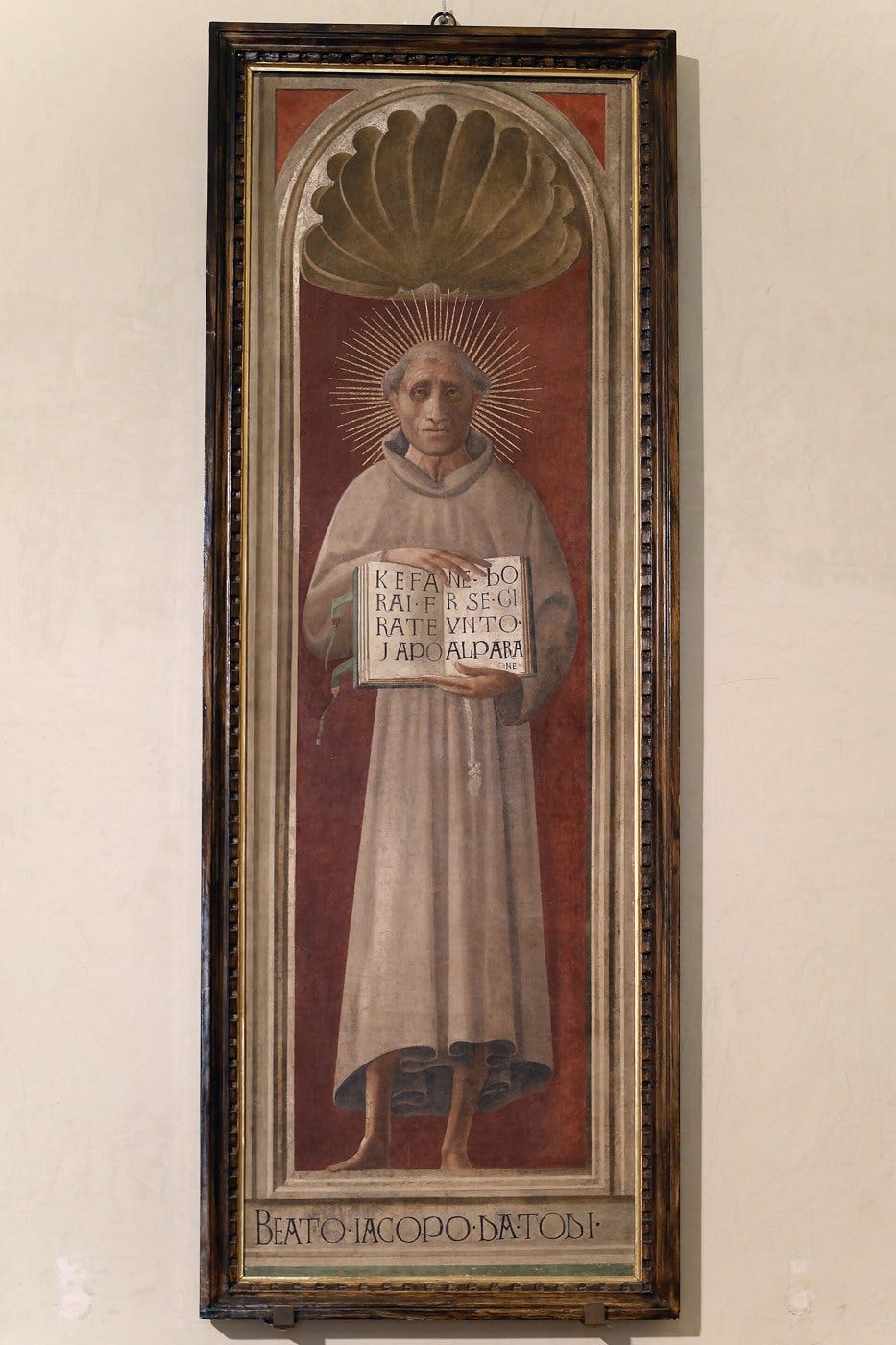
Perhaps nowhere is the character of the mediæval devotion to Christ more vividly expressed than in the dramatic poem, “Amor de Caritate,” sometimes, but erroneously, ascribed to St. Francis,[2] and more generally supposed to have been written by the friar-poet, Jacopone da Todi. The poem describes the surrender of the soul to Christ and gives utterance in the unrestrained style of a decadent period to the idea of mediæval devotion:
“I asked, not knowing, when I prayed,
For love of Christ; it seemed so sweet.
Methought in peace I should have stayed.”[3]
But the soul finds the love of Christ a consuming fire. It can find no peace now in mere creaturely delights. Heaven and earth do but cast the soul back upon itself with the sharp admonition:
“With all thy heart love thou the love
Which has created us that we
Might draw thy spirit heavenward
To love Him Who hath so loved thee.”[4]
And so the soul finds no peace except in entire self-surrender. Then
“Transformed by Christ, with Him made one,”[5]
the soul gains a new life and joy. It
“. . . . . . . is made
The likeness of its Lord to bear;”[6]
and in its new life [finds] indeed no soul-peace but the soothing ardors of a great love.
“In Christ I’m newly born again—
The old man dead, the new restored;
And whilst my heart is cleft in twain,
Transfixed by love as by a sword,
My spirit, all on fire, would fain
Behold the beauty of its Lord.”[7]
This beholding of the beauty of the Lord, or more correctly, of Christ all beautiful was the supreme ideal of the mediæval religious spirits. The beauty of Christ was the dream of their life, and it must be added that the sorrow of their life—a sorrow which finds expression nowhere more pathetically than in the life of Francis—was that the beauty of Christ was marred by the world’s sin and misery. Sin to those mediæval disciples was no mere disfigurement of a passing world; it was rather a gaping wound in the body of Christ. As Christ is spiritually united with the whole world in intimate relationship of joy and sorrow, so the world’s evolution was to their mind an extended drama of the life of Christ. Christ Himself was glorified in the pure heart, in the patient and in the just and in all the extension of His moral kingdom. He was also crucified again in the world’s suffering. The stricken leper, the hungry beggar, even the broken flower, were incidents in the mystery of Calvary. Hence to the mind of Francis suffering had a peculiarly religious significance. To him it was the price of the world’s redemption. Through suffering only could man attain to the perfect state; whoever would be of Christ must suffer with Christ the penalty of the world’s sin. Like Christ Himself, Francis would willingly have borne, had it been possible, the world’s burden upon his own shoulders; have suffered its pain and endured its varied wretchedness. As it was, his soul melted with compassion for his fellow-mortals. He welcomed all his personal pain because it identified him more and more with the suffering Christ and his suffering fellow-creatures. Days and nights he spent in prayer beseeching the Divine mercy to pardon a sinful world. He himself became an apostle, and willed that his friars should become apostles, to spread abroad the knowledge of God’s love to comfort the sorrowful and to preach repentance for sin that Christ’s passion might not be in vain nor the world’s suffering misery unending. In sin he saw the source of all suffering; in penance and reformation of life, the remedy. With this conviction he put aside the idea of living a hermit’s life and became a religious and a social reformer. “The world’s suffering, and Christ is still crucified in the world. Let us go forth and preach the Gospel of Divine Love and Eternal Life, that men may be stirred to put aside selfishness, hate and luxury, which are the cause of the people’s misery.” Such was in effect the precept he gave his disciples on the memorable day when he sent them forth to be evangelists, “to preach to the poor and heal the broken heart.”
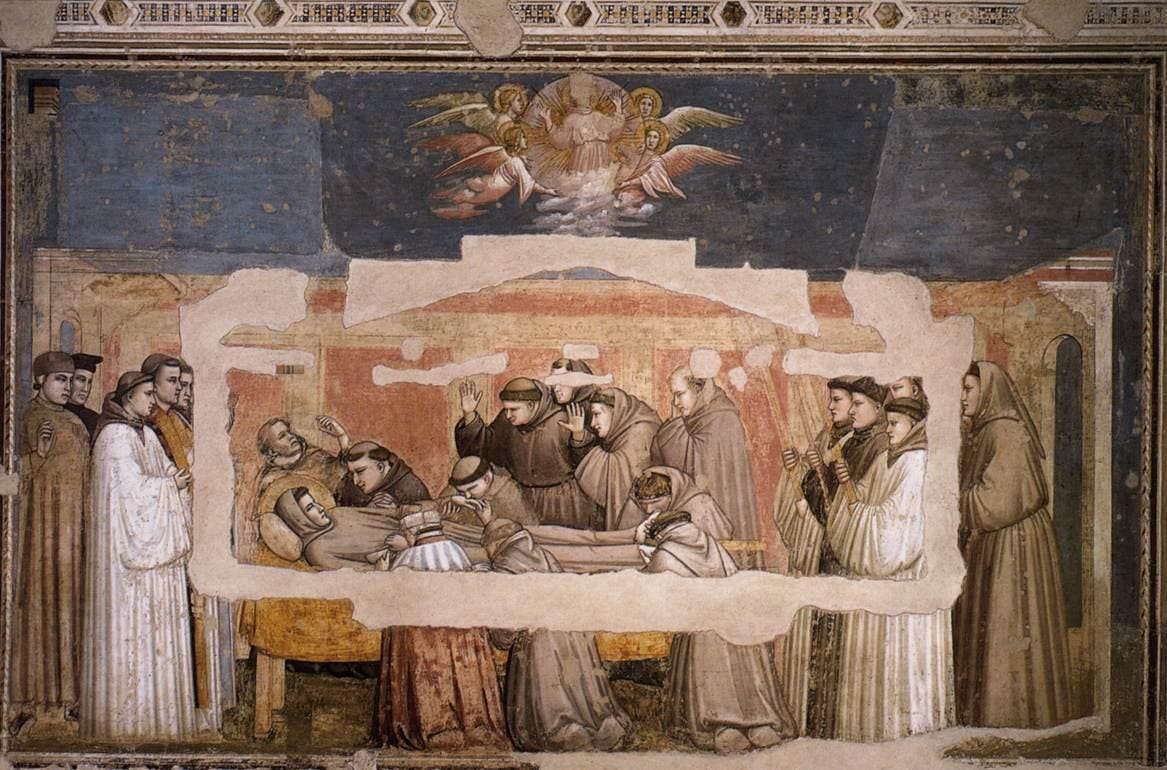
Such then was Francis of Assisi, the most Christlike of saints, and such was the character of the evangelical revival associated with his name. Rightly to appreciate him, one must, as we have already pointed out, view him in connection with his own time. He was typically mediæval, of the thirteenth century. Yet in the circumstances created by his own time he solved the question that has puzzled many souls in every age, and not least in our own. He discovered in religion a unity and perfection of life, a harmony of life’s varied realities, such as the present world with its long tradition of Manichean duality is hungering for. It was said that he who would find heaven must leave the earth to the devil; that to take delight in the world that is, is to forfeit the heaven that is to be. For a time men tried to live by this doctrine with consequences sometimes heroic, sometimes hideous, according to the temperament of the individual and his circumstances. The doctrine produced a Cromwell and his hearts of iron—no mean advantage to a demoralized nation such as the England of the seventeenth century—but it also gave us the prime hypocrite and the soul-stricken gospeler of a later time. The revolt against so sore a heresy was sure to come in time. When it came there was danger of the Present and Visible being idolized and put in place of God Himself. Yet if Christianity teaches any truth at all it is that man is to look forward to another life and another world. Other-worldliness is the essence of Christianity. At the same time it has consistently fostered an appreciation of the Present and Visible, differing from that of ancient Greek and modern Pagan, because it teaches us to look through the Visible to the Invisible, through the Present to the Future. This world is the step to eternity. We are not to sit down and make ourselves comfortable on the step, but to pass over and enter in.
This beholding of the beauty of the Lord, or more correctly, of Christ all beautiful was the supreme ideal of the mediæval religious spirits.
Francis of Assisi explains the problem on the mediæval background of his. He does not give us a direct solution of the problem in its modern details, but he gives us a key wherewith to work out the solution for ourselves. This key is a realization of and a personal devotion to Christ in His relationship with the world, and a Christlike love of the world. I say Christlike love, because there is another love which has for its patrons Epicurus and the leaders of the Pagan Renaissance, and in these days of catch phrases it is well to mark the significance of one’s words. The evangelists of the thirteenth century, inspired by the life of Francis, would have had little to say that was pleasant to such love as this. Not Epicurus, but Christ, was their ideal; and how their endeavor to give effect to their belief brought to the world for a while something of the glow of undiluted Christianity can be known by the perusal of those early “legends” written by St. Francis’ personal disciples and now once more published to the world.
As I have already said, it is well for us Catholics in the midst of the evolution of modern life and its necessary influence upon the life of the Church to keep in mind the heroic figures of the past. They have many a lesson to teach us which will be of value to us in these days, and save us perhaps much trouble and waste of energy. The Church of the future has its own work to do; it cannot afford to lose sight of the work already accomplished. A neglect of the history of the past would only entail greater labor in the days to come.
Notes
[1] History of Dogma, Vol. VI., chap. 2.
[2] The style of the poem is evidently of a somewhat later date than the opening of the thirteenth century.
[3]Inanzi ch’io provasse, domandava
Amor a Christo pensando pur dolzura;
In pace di dolzezza star pensava.
[4]Che celo e terra grida et semper clama,
Et tutte cose ch’io dibbia amara,
Lascuna dice: Cun tutto core ama,
L’amore che n’ha fatto briga d’abbrazzare;
Che quel amore perzo che te brama,
Tutto nui hà fatte per ti à se trare.
[5]In Christo transformata quasi e Christo
Cum Dio unita tutta stà divina.
[6]De Christo se retrova figurato.
[7]In Christo e nata nova creatura,
Spogliata homo vecchio, e fato novello;
Ma tanto l’amore monta cum ardura,
Lo cor par che se fenda cum coltello,
Mente cum senno tolle tal calura;
Christo se me tra tutto tanto bello.
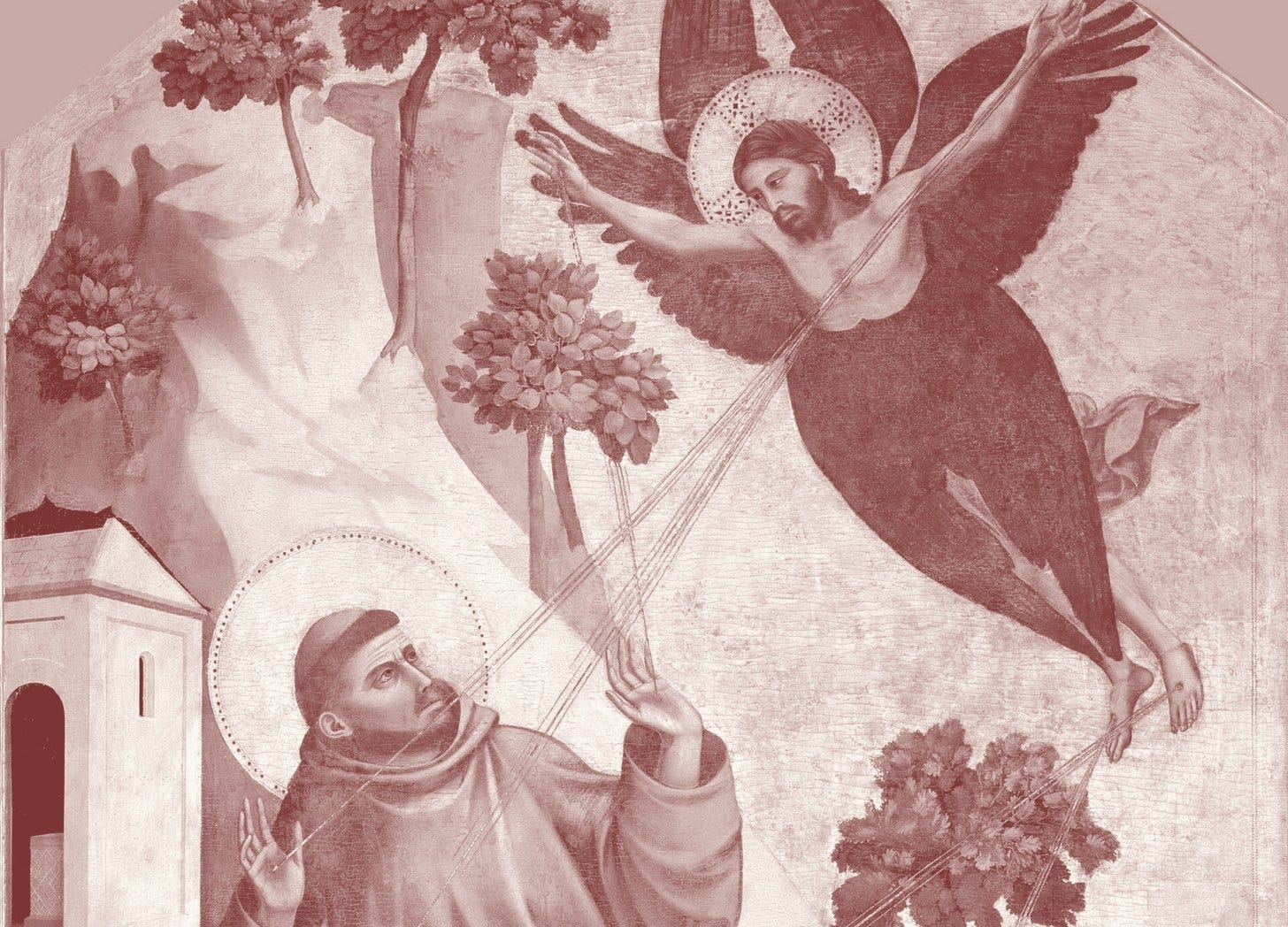
Cover: Giotto, Stigmatization of St. Francis (c. 1295–1300), Louvre, Paris (detail).
From the American Catholic Quarterly Review, vol. 25, no. 100 (October 1900), pp. 657–674.