


St. Francis of Assisi and the Religious Revival in the Thirteenth Century (II)
Nature and grace, and the conversion of Francis. From our number of October 1900.
Father Cuthbert, O.S.F.C.
This is the second of three parts of Father Cuthbert's essay from our number of October 1900; Part I appeared yesterday. Having set the primitive "legends" before us, he now states his thesis: that Francis resolved in his own life the apparent duality of nature and grace, of the temporal and the eternal. He then follows this thesis into the story of Francis's conversion.
Renan, in whose mind truth jostled so intimately against error, had long ago singled out St. Francis as one whose personality has a religious message for the present age; and in his brilliant critique of Karl Hase’s “Franz von Assisi” puts his finger upon the secret of the saint’s influence, both in his own age and in the present. “Francis of Assisi,” he wrote, “possesses for religious criticism an interest beyond expression. After Jesus, no other man has been endowed with a clearer conscience, more absolute ingenuousness, a more lively sentiment of his filial relation to the Heavenly Father. God was in very truth his beginning and his end.” Then after pointing out how the life and character of Francis transcends our ordinary conception of life so far as to be almost incredible, and that nevertheless we have incontestable documentary evidence to prove it, he proceeds: “Francis of Assisi has always been one of the strongest reasons which has made us believe that Jesus was nearly all that the Synoptic Gospels have painted Him to be.” In this last sentence we believe Renan has expressed in somewhat pedantic fashion the weightiest argument for Francis’ popularity. Francis is a unique witness of the Person of Christ. The study of his life makes one realize the beauty of the perfect Christian life and its possibility; for here in a mortal man like ourselves, without any claim to divinity, we have a character so supremely Christlike, that the Gospel itself, in the light of his history, becomes an actual palpitating truth, convincing beyond any argument drawn from speculative reason. After all the most persuasive argument for Christianity is the living Christian. Yet even when we have admitted this, we can hardly be said to have given a satisfactory answer as to the secret of Francis’ influence in the Christian world both in the Church and outside; nor can we be said to have given any sufficient reason for assigning to him, as many do assign to him, a special influence upon the further development of spiritual life in the Church of the future. Conformity to Christ is always the lever of spiritual power in the Church; but this conformity must not be merely of external life, but of the interior spirit. The real Christian embodies in himself the Truth of Christ, not simply the outward action; and it is in the degree that he helps us to realize truly and understand the very life and thought of the Sacred Humanity of Jesus that he is a permanent factor in the development of the Christian life.
Now we believe that the most potent claim of St. Francis to the reverence of the Church is that he in great measure solved in his own actual life the difficulty which has always faced, and still faces, earnest souls as to the apparent duality of life. From the very beginning, at least since men began to look into their own souls, human nature has seemed to be the battleground of two irreconcilable forces, each of which seems to claim the proper allegiance of man, and each of which seems necessary in opposition to the other. So that man’s nature has seemed to be an essential contradiction, and the only way to obtain interior peace has seemed to lie in sacrificing one element to the other. Yet, on the other hand, the instinct of the Church has been opposed to this view. She admits the apparent contradiction, yet points to a further development of man’s being in which the contradiction shall exist no more, and yet the apparently opposing elements shall be retained. How to harmonize the natural and supernatural, the temporal and the eternal, has always been the crux of philosophers; Christianity has given the only satisfactory solution. Yet how few Christians realize it! In St. Francis of Assisi, however, it has been realized in a notable degree, and it is in this fact that his power lies. In him religion and all that was best in the world-life of his time met and intermingled in a rich harmony; in him it may be said with truth the world-spirit of the middle ages took flesh and blood and was indissolubly allied to religion.
It has been sometimes urged against mediæval Christianity that it retained a great measure of paganism in its spontaneous delight in the visible world and in its worship of the palpable Present, whilst at the same time religion was held to represent something apart from the Visible and the Present. So that, it is urged, the life of the middle ages was a dualism; Sense and Spirit being the two poles of a perpetual antagonism. We must, however, admit that if our mediæval forefathers were conscious of this dualism, they had also an idea, more or less vague, that this dualism could be resolved into a deeper unity, as is evident from the manner in which they were able to bring their delight in the sensuous into the religious liturgy. In doing so they manifested a belief that harmony between the spiritual and the temporal is possible, however dimly they may have realized this harmony in actual life. They might not be able to reconcile the two terms of life; but they believed reconciliation possible. Their healthy instinct preserved them from that subtle form of Manichean heresy which has been so prevalent since the middle ages. Puritanism in all its forms (and we must bear in mind that Puritanism went beyond the Puritans) banned nature from the realms of grace, as an evil spirit is banned from heaven. But nature when thus banned is apt to become a troublesome enemy. The joy of life is not found in outcasting one of life’s constituent elements. Mediæval Christianity recognized all the elements of human nature, from an instinctive belief in their essential harmony; and this instinctive belief was vindicated by Francis in his own personality. He was, in fact, the hoped-for Messiah in whom the promise of the mediæval spirit was realized. The patient belief that life’s apparent dualism (represented in scholastic phrase as nature and [grace]) did but hide a deeper essential unity (also represented in scholastic phrase as regenerate nature) was realized in Francis. He was a manifest embodiment of regenerate nature. Others beside him realized this belief in their own inner life, as any one acquainted with mediæval biography knows; but Francis did so on a larger and more generous scale.
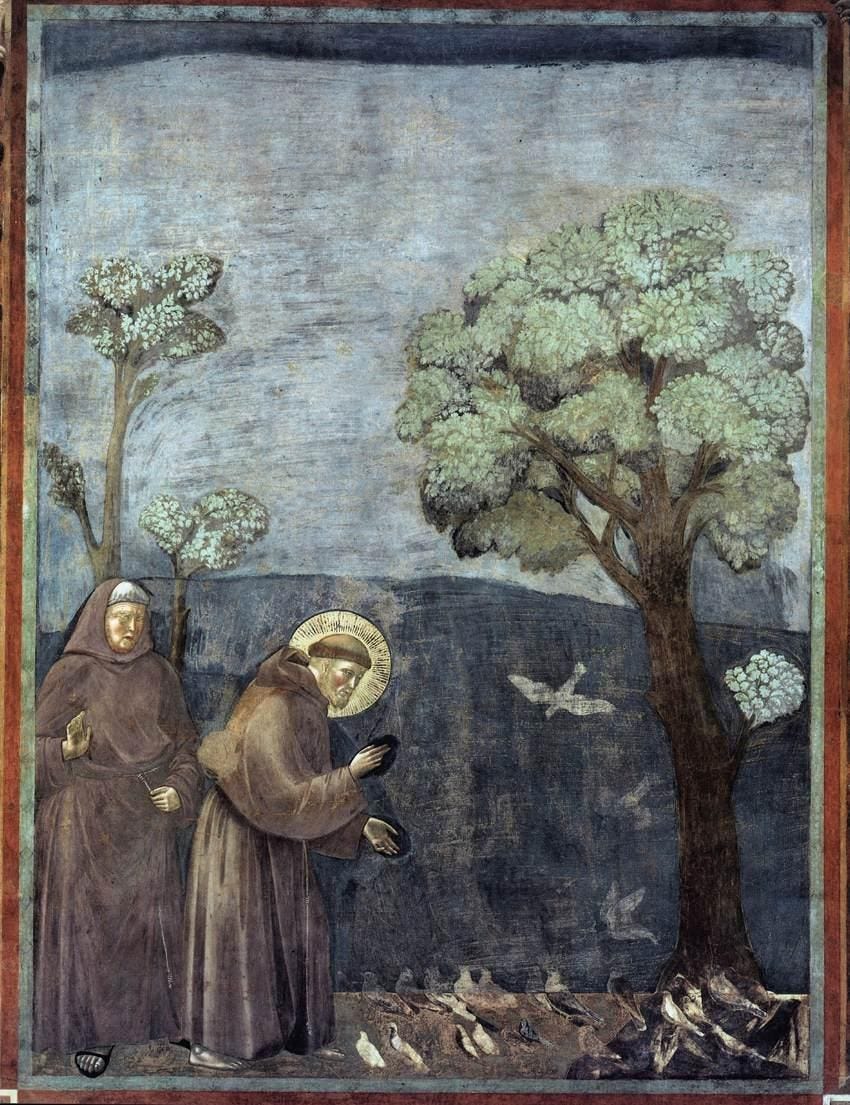
He had indeed the natural genius which enabled him to do this. Of a poetic temperament he was quick to take note of the beauty of all created forms and to recognize a universal kinship between himself and all creatures, whether man or beast, or the very elements. He lived, so to speak, in them, and their life was part of his. The flower of the field and the running brook sent him into an ecstasy of delight; he seemed to understand the mute language of the beasts; he would sing for very joy because of the mysterious beauty of the sun and stars. His soul moved in all the grand elemental forces of nature as the soul of the musician delights in the complex harmonies of the symphony. He was a poet, with a poet’s largeness of heart vision and intimate sympathy. But he was more. He was of that rare order of men to whom a right intellectual concept or an intuition is a moral conviction. Such men do not so much sing of truth or beauty as act it. They are themselves embodiments of the beauty and truth which they behold in the world outside themselves; in them the best that the world can give is mirrored and expressed. Such men are not merely artists: they themselves are an inspiration of art, and the value of their inspiration is in proportion to the generosity of their sympathy. Francis’ sympathy with the world outside himself was indeed great and generous, as any one can learn who will but open the “legends” of the saint—now easily accessible to all—or the Fioretti, that wonderful supplement to the historical narratives, embodying the traditions and impressions of a somewhat later age.[1]
Now this sympathy with nature in its various creations was the very groundwork of Francis’ religious life. With his poetic intuition he could never have acknowledged that nature was the work of the devil. In him the mediæval belief was strong that God and nature are allied, and that to love nature is to worship the Creator. He had an intuitive conviction of the great Catholic truth that the Divine is revealed in the Creaturely. “The earth is the Lord’s, and the fulness thereof; the world and they that dwell therein”—such was the song that the heart of Francis perpetually sang. It was the chant of his worship both before and after his “conversion.”
It was towards the end of his life that he composed his “Song of the Sun,” an unmetrical string of verses in which he praised the Creator for the beauties of the creation. But this was only a more conscious rendering of the religious sentiment of his youth.[2]
Francis’ conversion was, of course, the leading incident in his life, both historically and from the point of subjective analysis. He was in his twenty-fifth year and full of the ambition of youth when he fell sick of a fever. He was only just released by the Perugians, having been taken prisoner in a battle fought between the “patriots” of Assisi and the robber-nobility, who were assisted by the neighboring republic of Perugia. As soon as he was convalescent he longed once more for the freedom of the fields and the hills. But to his vast disappointment when he went forth the country had lost its charm, and he returned home with a chilled and stricken heart. Again he mingled in the civic revelries and led the light-hearted youth of the city as had been his custom; but the sunshine had gone out of it all, and in the midst of the fun Francis was sad and listless. The fact was that during his sickness he had been brought face to face with the thought of eternity; and the thought had taken hold of his soul and given him a new vision of life, or rather it had clouded the simplicity of his former view of life as a present enjoyment, and he could not yet grasp the mystery that had taken its place. He felt lonely in the midst of his former life; its joys had fled when the reality of eternity had first dawned upon his mind. Slowly and with much anguish of spirit which at times caused him to go out of the city to some solitary cave, and there cry aloud for very pain, Francis came to see the truth. He had now become conscious that there is a duality in life; that the temporal and the eternal, the secular and the spiritual, are two actualities. Hitherto he had professed this belief, and now he realized it. This realization it is which precedes any spiritual conversion. One must perceive life as a contradiction before one can attain to any perception of the deeper spiritual unity. It is the way in which the human mind is accustomed to work.
To such a man as Francis, so sensitive to the beauty and joy of life, the perception of any essential, or apparently essential, contradiction between the temporal and eternal, must be the acutest pain. He was ever too much alive to allow himself to be comforted by the belief, generally adopted by men of less spiritual energy, that things will right themselves somehow. For him to live, was to live in the full consciousness of the realities around him. Life might be a contradiction; then he must drink the cup of contradiction to the very dregs. Or beyond the contradiction of life there might be a higher truth and more essential unity; if so, such a man as Francis will discover it. It was the same problem as presents itself in the fascinating legend of the founder of Buddhism; but in Francis how differently it worked out. The solution as it came to Francis may be stated thus: “The eternal begins in the temporal; time is the seed of eternity. What you see to-day with your eyes is not wholly true, neither is it wholly false. Nature in so far as it is not spoiled by man, is the germ of heaven; the beauty you delight in to-day is the promise of a greater beauty hereafter.” Thus was Francis reconciled again with the visible world, from which the consciousness of eternity had for a time separated him. But the reconciliation was not yet complete. The visible world had gained with him a new reality; it had become part of the eternal; at least there was in the visible world the beginnings of eternity, mixed up with much that was a mere perversion of the original creation. Something was yet necessary to bring Francis into actual touch with the realities of his new spiritual vision, so that he might not be a mere stranger wandering through the Father’s Kingdom.
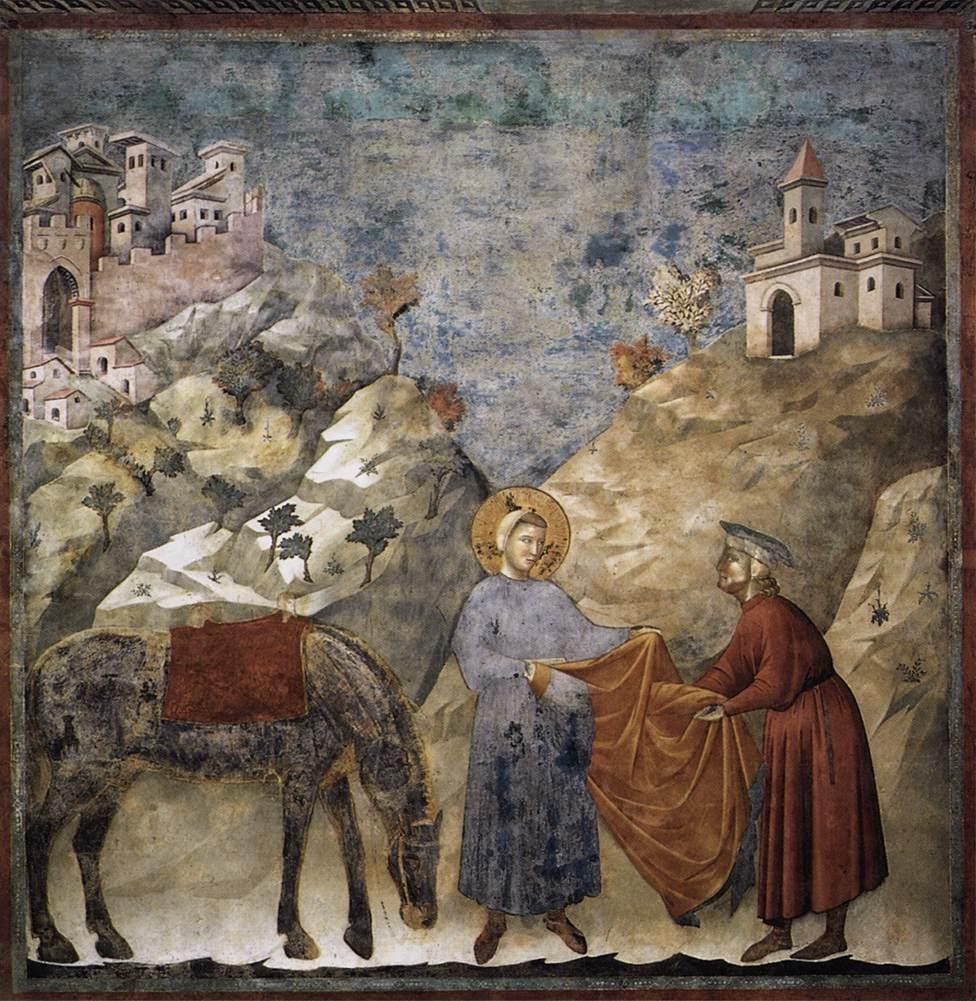
Never, as far as we know, had Francis felt the need of total self-surrender. He had enjoyed life with the irresponsible enjoyment of youth. This was no longer possible. Had he been other than he was, or had his realization of the eternal been less intense, it might have been possible for him to regain touch with the facts and duties of life by taking to himself a wife or attaching himself to some great leader of men. Some such surrender of oneself to a personality other than one’s own is necessary to every man who would live in actual spiritual contact with the world around him. Such is the law of human life. But no ordinary love was able to bring Francis into touch with the greater world now opened out to him. He must surrender himself to Christ only and for Christ’s sake renounce those lesser ties which bind lesser men to the realities of life. He must renounce all for Christ, as under other circumstances he might have had to renounce all for some chosen woman’s sake.
Notes
[1] See especially the twelfth part of The Mirror of Perfection, which treats of “His love towards creatures.”
[2] This song is supposed to be one of the earliest efforts in Italian literature. Generally St. Francis composed his songs in the language of the Provençal troubadours. The “Song of the Sun” takes its name from the verse coming immediately after the stately prologue. It begins:
Laudato sia Dio mia Signore contute le creature,
Specialmente messer lo frate sole.
From the American Catholic Quarterly Review, vol. 25, no. 100 (October 1900), pp. 657–674. Part III follows tomorrow.