


St. Francis of Assisi and the Religious Revival in the Thirteenth Century (I)
The primitive legends, and the first friars.
Father Cuthbert, O.S.F.C.
We close our week for the eight-hundredth anniversary of the death of St. Francis with two essays from the Review’s own archive. The first appeared in our number of October 1900; we republish it here in three parts. Its author, Father Cuthbert, O.S.F.C. (born Lawrence Anthony Hess, 1866–1939), was an English Capuchin writing from Crawley in Sussex. He later published a fuller work, a Life of St. Francis of Assisi (1912), and became head of the Capuchin Historical Institute in Assisi and editor of its journal, Collectanea Franciscana.
This essay was written six years after Paul Sabatier’s biography had made Francis a hero of the modern imagination. While Father Cuthbert admires Sabatier, faulting only his distorted view of the Papacy, he holds that the real gain of the new Franciscan scholarship is the recovery of the primitive “legends,” the memoirs written by the saint's own companions. In them, he argues, we have the real Francis, more Christlike than in any later biography.
An article more than a century old? Start reading and see if you can put it down.
At a time like the present, when the Church is in the throe of a new development in history, and when with the dawn of the twentieth century she has to face a new world of ideas in life, social, intellectual and political, it is instructive to look back over her past history and seek an intelligent guidance from the lives of those who have already contributed to the Church’s greatness. “It is only a fool who learns from his own experience; a wise man learns from the experience of others,” is a reported saying of the German Bismarck. The study of the lives of the men who have made a people great is a wise precaution, especially at periods of quick development and necessary unrest such as we live in to-day. The movements which in the past have shaken the Church and finally brought to her new life, leave an indelible mark upon Catholic character which it would be fatuous to ignore at any subsequent period in history. For example, in the further development of Catholic thought which will mark the immediate future Catholics cannot afford to ignore the work already accomplished by the Christian Neo-Platonists and the Scholastics. The notion, not unfrequently broached in these days, that Catholic theology should now cast scholasticism behind it as a thing forever done with and useless, is historically untenable; a community cannot get rid of its history in that fashion any more than a man can get rid of his past life with all its moulding influences. So, too, in regard to the interior and mystical life of the Church there has been, and still is, a continuous development; a tradition, constantly unfolding from the days of the Catacombs to the present: the Holy Spirit working in the Church for the fuller realization of the Christian life.
This constant movement of life goes on universally in the Church, affecting the lives of the humblest members who are at all earnestly concerned with their religion, but it manifests itself typically in certain individuals, the spiritual giants of our race, who by the intensity of their character give point and body to the vague instincts and undefined convictions of the multitude.
Thus a St. Augustine becomes the centre of a widely scattered group of thinkers and apologists who think as he thinks, but have not his clear perception nor his power of expression; and a great intellectual movement thus becomes identified with his name. In his writings, too, the excelling genius of the movement will naturally be found.
Now, in the development of the moral life of the Church there is one period which for some time past has attracted the most sympathetic interest of students of Church history, both outside the Church and within; though it must be acknowledged that as in much else concerning Catholicism, so in this, the impetus came from outside. In the life of the twelfth and thirteenth centuries students have discovered one of the finest presentments of Catholicism, both moral and intellectual, but especially moral. It is the period when Catholic piety manifested itself in a most intense realization of Christ’s earthly life and in chivalrous devotion to His sacred humanity: the age of the Crusades and of the Crib. It is to be noticed that at a period marked by strenuous speculation in the Christian schools, tending to a cold rationalism, there blossomed forth this intense devotion to the earthly, concrete Christ—the Man-God of the Gospels and of Tradition—and that the moral reformation which saved Christendom in the thirteenth century was chiefly connected with this development of piety.
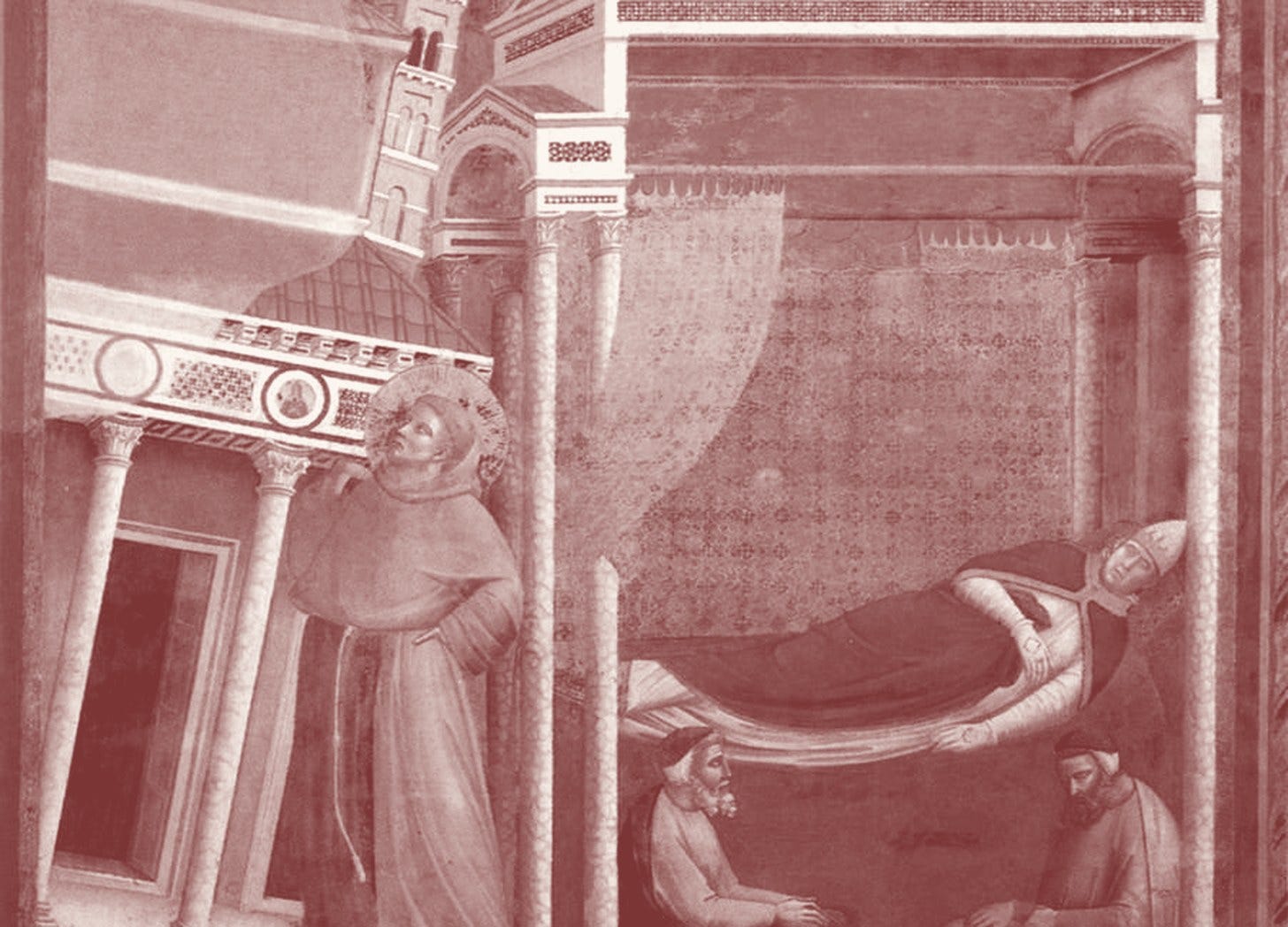
Of this movement the classical expression is St. Francis of Assisi, the moral and social reformer, whom Pope Innocent III. saw in vision upholding the tottering walls of the Church. And the interest aroused in the history of the movement has resulted in a vast quantity of literature dealing with the life of the saint and his influence on his contemporaries. Not the least valuable result of this literary activity has been the republishing of the ancient “legends” or memoirs of St. Francis, written by his own friends and companions. For centuries these precious documents, unique in the history of Catholic literature, were hidden away and almost forgotten. About half a century after the death of St. Francis discussions arose among the members of his order as to the interpretation of the rule which he had given them. The more zealous members appealed to the “legends” in support of their contention against those who were anxious for relaxation. The authorities in the order desired to put an end to division by compromise; but this the “zealots,” as the upholders of the primitive austerity were called, would not hear of. In order to overcome their opposition it was decreed that the “legends” should be destroyed—a drastic measure which it is difficult to condone. Fortunately some copies were preserved. The most ancient of the “legends”—the “First Legend by Thomas of Celano”—was published by the Bollandists, as was also a fragment of the “Legend by the Three Companions,” which is a compilation of personal recollections by the saint’s three most intimate friends. In 1806 the “Second Legend by Thomas of Celano,” a supplement to the “First Legend,” was again given to the world by a learned Franciscan friar.
This “Second Legend” threw light upon several doubtful points in the received “lives” of the saint and gave rise to a more critical study of the sources already recovered. But it was reserved for the last two or three decades of years to see the outburst of a worldwide interest in the study of early Franciscan literature. As already noticed the impetus to this study came in great measure from outside the Church, and it is only just to acknowledge the debt we Catholics owe to non-Catholic efforts. And to no one is greater praise due than to M. Paul Sabatier, whose “Life of St. Francis of Assisi,” published in 1894 and translated into most European languages, has done much to make the saint and the mediæval revival connected with his name known to the world. M. Sabatier’s work had many defects arising from a somewhat distorted view of the action of the Papacy in regard to the Franciscan movement; but he was able to make St. Francis live in the imagination. He did still better work in editing the long-lost “Mirror of Perfection: The Blessed Francis,” the greater portion of which was written by Fra Leone, the saint’s most cherished companion. M. Sabatier is now engaged in preparing other primitive Franciscan documents for publication. Not less valuable have been the labors of two friars of the order, Padre Marcellino da Civezza and Padre Teofilo Domenichelli, who lately edited the entire text of the “Legend by the Three Companions,” the most delightful of all the “legends.”
The value of these discoveries in confirming the popular cultus of the saint cannot be exaggerated. We can now see Francis as he appeared to those who knew him most intimately, and the result of this increased knowledge is to deepen our reverence and love for his name. “Those that loved him before may love him better now. We knew him saintly and human. We find him more human and saintly than we knew. The more clearly we see his features, the more clearly may we trace their likeness to those of the Man of Sorrows. It is the likeness of close kindred, the mystic likeness that once seemed a peril and has always been a glory to the Church of Christ.”[1] Yes, in these original documents Francis stands out with a glory brighter than ever. His features, faithfully limned by his own companions and personal disciples, are more Christlike than we find them in any of the later biographies. These have generally drawn the saint as they conceived he should have lived: by deepening the shadows here and heightening the colors there, they have often caricatured and even falsified the saint’s true features. The Francis of the later biographies is like an ancient masterpiece of art restored by inferior hands. But in the primitive “legends” we have the real Francis. To be sure, he is ever the hero and the saint and no common man in the mind of the writers; but then he really was a hero and a saint. With charming simplicity they relate what they heard and saw. There is no attempt to criticize, for they are disciples of a great master and they write with the candor of faith. They do not think to hide his human infirmities or temptations; these do not detract from his moral grandeur. They evidently do not think him the less a saint because he was more a man. To them he was verily a prophet sent by God to form a “chosen people” whom God had called out of the midst of religious laxity and degeneration, to bear witness to the true character of the Gospel; another Abraham, father of a mighty spiritual race that should endure unto the end of time. No less than prophet and patriarch was Francis to them, and with delightful simplicity they found parallels in Scripture to apply to the saint and his religious family. The Chapel of the Portiuncula is another Jacob’s stone; the promise of God to Abraham is repeated to Francis; the followers of Francis are the new Israel. But in Francis the Old Law is transfigured and becomes the New. He bears the character not of Abraham nor of Moses, but of Christ. Assisi is as Bethlehem, Alverna as Calvary, Umbria as Galilee. In the company of Francis they seemed to themselves to walk with Jesus in the far-off Holy Land.
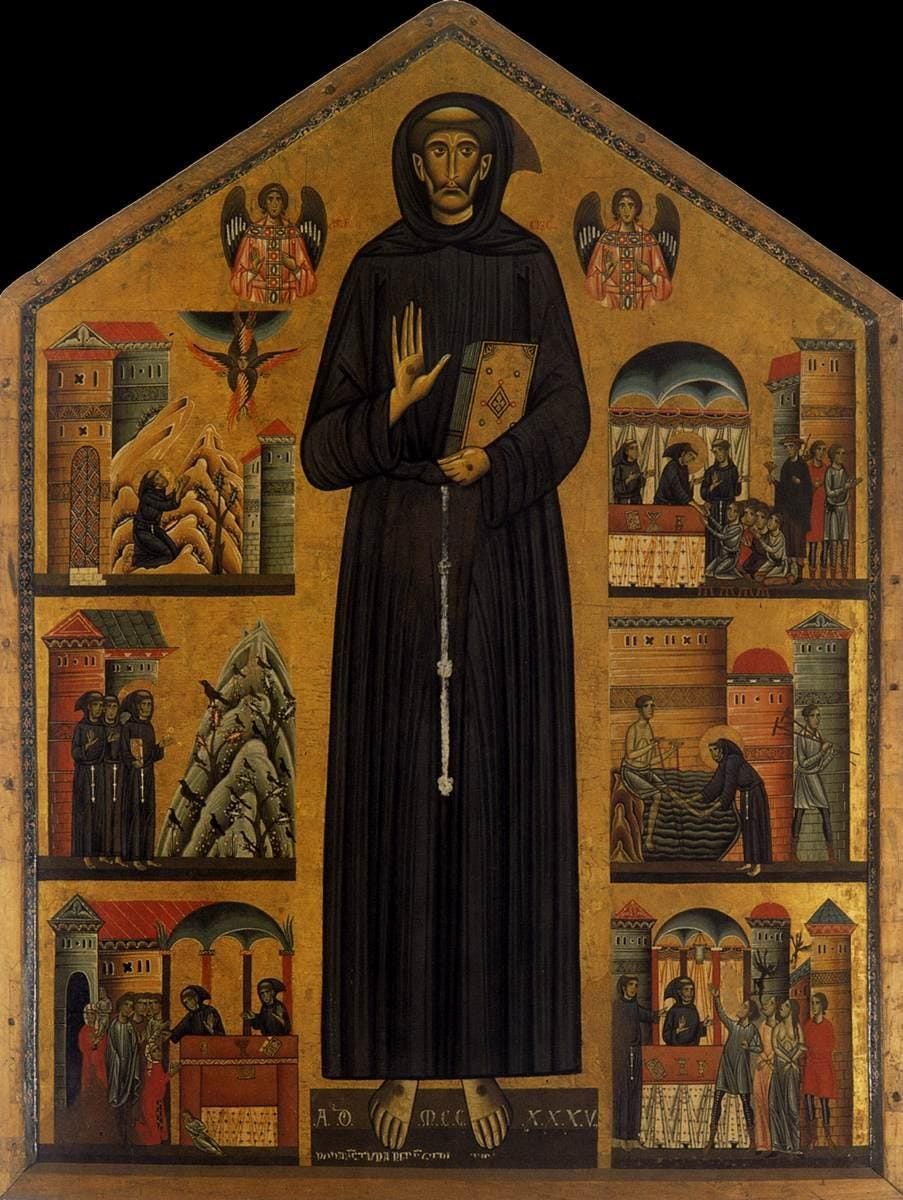
How all this worked out in daily life may be read in the “Legend by the Three Companions,” of which the following extracts are a specimen:
“The Blessed Francis, being already filled with the grace of the Holy Spirit, called unto him his six brethren (this was, of course, in the very earliest years of the movement) and spoke to them of the things that would happen to them, saying: ‘Let us consider, my brothers, our calling, wherein God has mercifully called us, not for our own salvation only, but for the salvation of many others; that going forth into the world we may exhort other men, more by example than by word, to do penance for their sins and be mindful of the commandments of God. Fear not because you seem weak and foolish, but without faltering preach simply penance, and put your trust in God Who conquers the world, because by His Spirit He speaks in you and through you, for the exhortation of all men, that they may be converted unto Him and observe His commandments. And you will find some men believing, gentle and kind, who will with joy receive both you and your words. But many others you will find unbelieving, proud, and blasphemous, who will resist you contumeliously, both you and the words you will speak to them. Therefore lay it up in your hearts to bear all things humbly and with patience.’ Now when the brothers had heard these words they began to fear. To whom the saint said: ‘Fear not, for after no long while many will come to you, learned and noble, and with you they will preach to kings and princes and many peoples, and many will be converted to the Lord Who will multiply and increase His family throughout the world.’ And when he had said these things and blessed them, the men of God devoutly went forth, observing what he had taught them.”
This was the first missionary journey of Francis’ disciples. They went two and two, after the fashion of the Gospel, in various directions; nor were they long in experiencing the various receptions foretold by the saint. Some received them with the reverence and affection due to holy men; others took them to be tramps and assaulted them, pelting them with mud and even stripping their clothes from their backs. Such treatment must have been peculiarly trying to men of sensitive temperament like Fra Bernardo, the saint’s first disciple. But they bore all patiently, “according to the Gospel, praying fervently and solicitously for their persecutors.” At the end of their missionary period they all returned to Portiuncula, outside Assisi, and says the Legend: “No sooner did they meet each other again than they were filled with such joy and sweetness as to forget altogether the injuries of perverse men.” The Legend then gives us a glimpse of what we may call the friars’ home-life.
“Every day they gave themselves to prayer and manual labour that they might altogether flee idleness, the enemy of the soul.[2] They rose in the middle of the night and prayed most devoutly with sighs and tears. They loved each other with an intimate affection, and each served the other and cared for him as a mother loves and cares for her only son. So great was the charity which burned in their hearts that each one would have deemed it an easy thing to give his life, not only for the love of Christ, but for the salvation of the soul of his brother, and even to save his body. Thus it happened one day, when two of the brethren went out, that a madman met them and began to throw stones at them. Whereupon one brother, seeing that the stones were hitting the other, at once threw himself in the way, willing that he himself should be hit rather than the other, so great was their mutual love. Thus were they prepared to give their very lives for each other.
“So grounded were they in humility and charity that each reverenced the other as his father and lord, and those who were superiors or who were in any way distinguished above the others, appeared only the more humble and unassuming. Moreover, they were all anxious to obey, and were so ready to carry out the will of him who commanded that they never thought to distinguish between just and unjust precepts; because whatever was commanded they took to be in accordance with the will of God. Hence it was easy and sweet for them to obey. They put from them all carnal desires. They judged themselves without indulgence, and especially did they beware lest they should in any way offend each other. And if it happened at any time that one said anything which hurt another, he was seized with remorse and could not rest till he had acknowledged his fault. . . . No one of them considered anything as his own; their books and whatever else they had were for common use, according to the tradition handed down from the apostles. But, although they themselves were truly poor, yet out of the things God had given them they liberally and ungrudgingly, for the love of God, gave to others, especially the poor who sought an alms. Sometimes when they were traveling and met beggars, having nothing else to give, they would share with them their garments, sometimes giving away their hood, sometimes tearing off a sleeve: that so they might fulfil the Gospel which says, Give to them that ask.
“When the rich ones of this world came to them, the brethren received them readily and with kindness, being anxious to draw them from evil and lead them to penance. They were anxious not to be sent to their native places, in order to be free from the company and conversation of their relatives; thus observing the prophet’s words: ‘I am become a stranger to my brethren and as an alien to the sons of my mother.’ Thus did they rejoice much in their poverty, . . . and they were joyful in the Lord at all times because among themselves there was no cause for sadness.”[3]
No wonder that Jacques de Vitry, traveling through Italy in A.D. 1216, in the early days of the Franciscan movement, was struck with astonishment at this new body of men and women whose life recalled to him “the manner of life of the Primitive Church, concerning which it is written: ‘The multitude of them that believed had but one heart and one soul.’”[4]
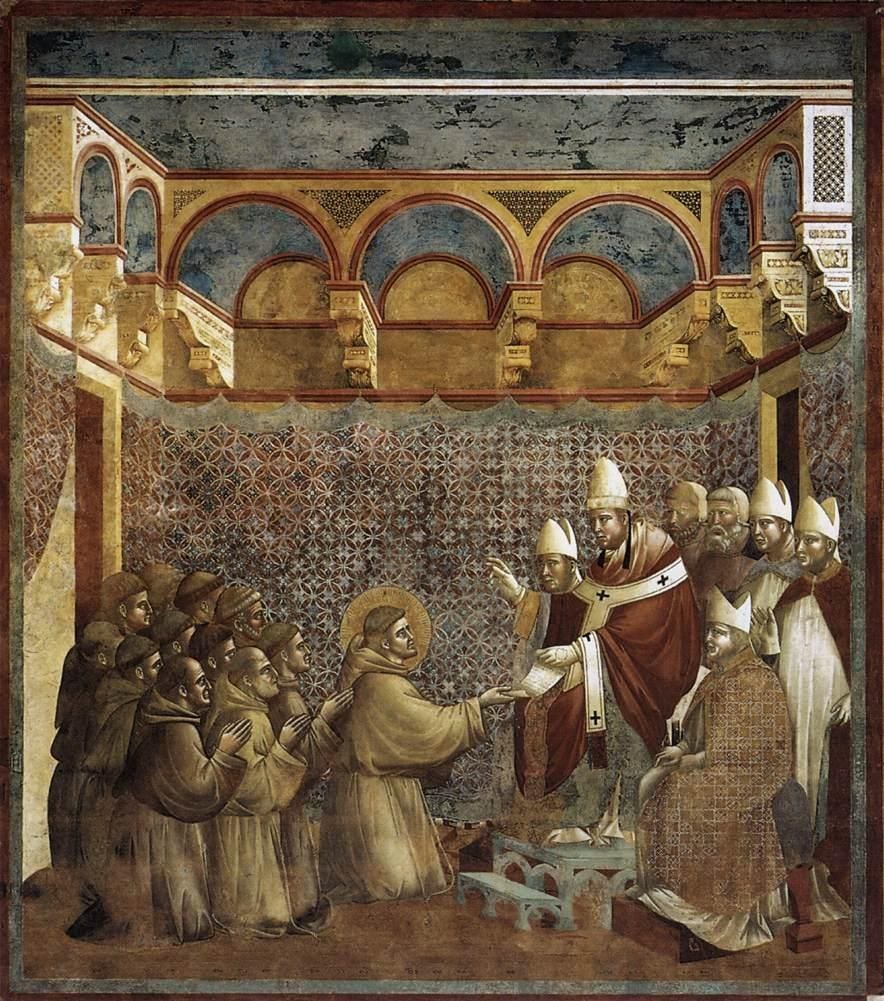
Surely in the whole history of Christendom since the days of the Apostles themselves, there has been no such another evangelical movement as this. Never has the world seen such another dramatic setting of the Gospel, played with such fidelity in the minute details of daily life. It was too sublime really for general acceptance. As the number of Francis’ disciples increased (and they increased with surprising rapidity) the first high fervor waned. There were still some who walked on the high road of Francis’ heaven; but the majority could not attain thereto. Historians lament the decline of the movement. Need we be surprised? The life of Francis and his early disciples was an inspiration rather than a set rule of life. Other men of less spirituality came after them, who aspired to walk in their footsteps. Most frequently they followed only at a distance; yet the world has been the better even for such a following as theirs. The humblest follower of Christ is still a witness to the Christ, even though he point to the Christ from afar off, and were he to disappear the world would oftentimes be lost in utter spiritual darkness. We must be grateful when Providence sends us the greater lights of religion; but let us not despise the lesser lights who are more constantly with us.
Besides these humbler, but honest, disciples of Francis, there were others who called themselves disciples—and they were not a few—who seemed destined to subvert, if it could have been subverted, the noble ideal of Francis’ life. They saddened the saint’s last years; after his death they well nigh brought the Franciscan movement into contempt. They gathered round Francis like moths around a lamp. They were not of his; they only usurped his name. We may therefore leave them to their fate in the contempt of history, and fix our gaze upon the pure and heroic figure of the saint himself. For by doing so we shall be able most surely to understand the spiritual motive which lay at the back of that wonderful religious revival of the later middle ages.
Notes
[1] Preface to the Mirror of Perfection, by Sebastian Evans.
[2] This phrase, “idleness, the enemy of the soul,” was frequently on the lips of St. Francis, and occurs several times in his Rule and Last Testament.
[3] “Legend by the Three Companions,” chaps. x. and xi.
[4] This letter of Jacques de Vitry is most valuable to the student of the early Franciscan movement. But its significance will easily be exaggerated unless we bear in mind that it is the letter of a traveler giving his impressions. M. Sabatier has, it seems to me, done violence to the text when he draws the conclusion that the religious Sisters of the order were “sœurs hospitalières,” and not contemplatives, because Jacques says: “They dwell together in various hospices; they receive nothing, but live by the labour of their hands.” But this is quite consistent with the contemplative life. Francis did eventually enlarge the scope of his order, so as to include women devoted to a more active life.
From the American Catholic Quarterly Review, vol. 25, no. 100 (October 1900), pp. 657–674. Part II follows tomorrow.