


St. Francis of Assisi
from the Catholic World, April 1877
by Maurice Francis Egan
From the Editor
Today is the feast of St. Francis, eight hundred years after his passing. It is also the Lord’s Day, on which the Review does not ordinarily publish; we make an exception for the great saint.
We offer a poem, “St. Francis of Assisi,” which appeared, unsigned, in the Catholic World in April 1877 and is attributed to Maurice Francis Egan, the subject of Joshua C. Benson’s essay on Friday, “Everybody’s Francis.” Egan was then twenty-four. He went on to teach English at Notre Dame and at The Catholic University of America, and to serve as Theodore Roosevelt’s minister to Denmark.
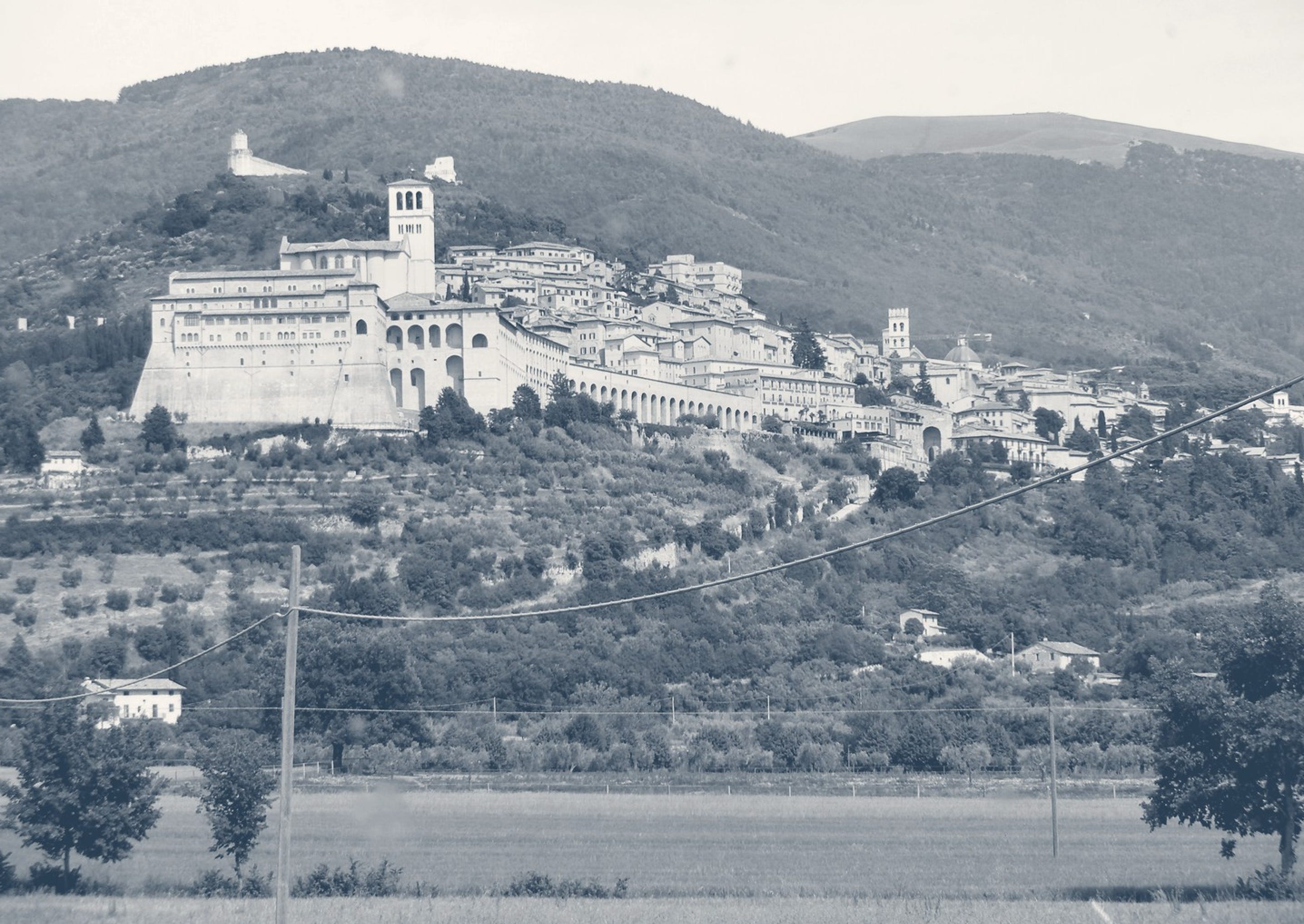
It is a poem about missing Assisi. A husband and wife spent a summer in Umbria with the town in sight across the valley, but they never made the short journey. The conceit is not plausible, and so it invites interpretation. In the first four stanzas she voices the regret; in the rest he consoles her. The saint, he says, is not confined to his town: he is found in his poverty, his wounds, his creatures, and his Canticle, which the poem paraphrases in its ninth and tenth stanzas.
Those of us blessed to have visited Assisi may nonetheless ponder this lesson with profit.
The last stanza turns to Dante, who sets the praise of Francis in the fourth heaven of Paradise, the heaven of the Sun, and who says that Assisi ought rather to be called the East, because a sun rose there. That is the sense of Egan’s closing line.
Michael Pakaluk
O Love! you lay the volume by
That held you like a holy chime—
Life of St. Francis—with a sigh
Which says: “That was a pleasant time
In old Perugia’s mountain-town
On the Umbrian valley looking down—
Flushed like an Eden in sublime
Environment of mountains vast;
And do not you, as I, recall
What, morn and even, and first and last,
Attracted most of all?
“The peaks of Apennine we knew
By heart—the many-citied land
Where-through the infant Tiber drew
A thousand streams in silver band,
Filled with the murmur of the pines
That told the olives and the vines
They heard the sea on either hand.
But, kindled on its lofty cape,
A light-tower to that inland coast
O’er waves of greenwood, corn, and grape,
What object charmed us most?
“Assisi seated in the sun!
All round from Monte Sole’s height
The insistent fascination
Of its white walls enthralled our sight.
And moon and starlight on its slope
Showed but a dimmer heliotrope.
We watched it many a mellow night:
Once when a warrior comet came,
And flashed, in high heaven opposite,
A sheathless sword of pallid flame,
Drawn from out the infinite.
“To sweet St. Francis’ native town,
Alas! we made no pilgrimage;
Nor to St. Mary’s, lower down,
His Portiuncula hermitage.
We knew but by its star-like shine
The splendors of Assisi’s shrine,
In mystic triple stage on stage.
It only asked one summer’s day—
How strange it seems in you and me!—
That narrow vale of Umbria
Made severance like the sea.”
O gentle wife! I cannot tell
To wistful eyes of retrospect
What dolce far niente’s spell,
In that midsummer, caused neglect;
What imp, procrastination hight,
Seduced us when we meant no slight.
In life, all paradox and defect,
Easy is difficult—the friend
Next door to visit—duties small,
To be done any day, that end
In not being done at all.
“How can this trite philosophy
Console me in my great regret?”
Nay, love, look not so tearfully,
And we will find some comfort yet.
What figure, think you, in those streets
The gentle, loving youth repeats,
Singing his gay French canzonet?
Doth either temple’s sumptuous pride
Suit stone and crust for bed and board,
And bridegroom joyful in his bride—
The poverty of our Lord?
O brown serge holier than the cope!
Was mystery veiled in long-sleeved gown?
And awful was his girdle-rope?
Were skirts that swept his ankles brown?
Bore he, in hands and feet and side,
The five wounds of the Crucified?
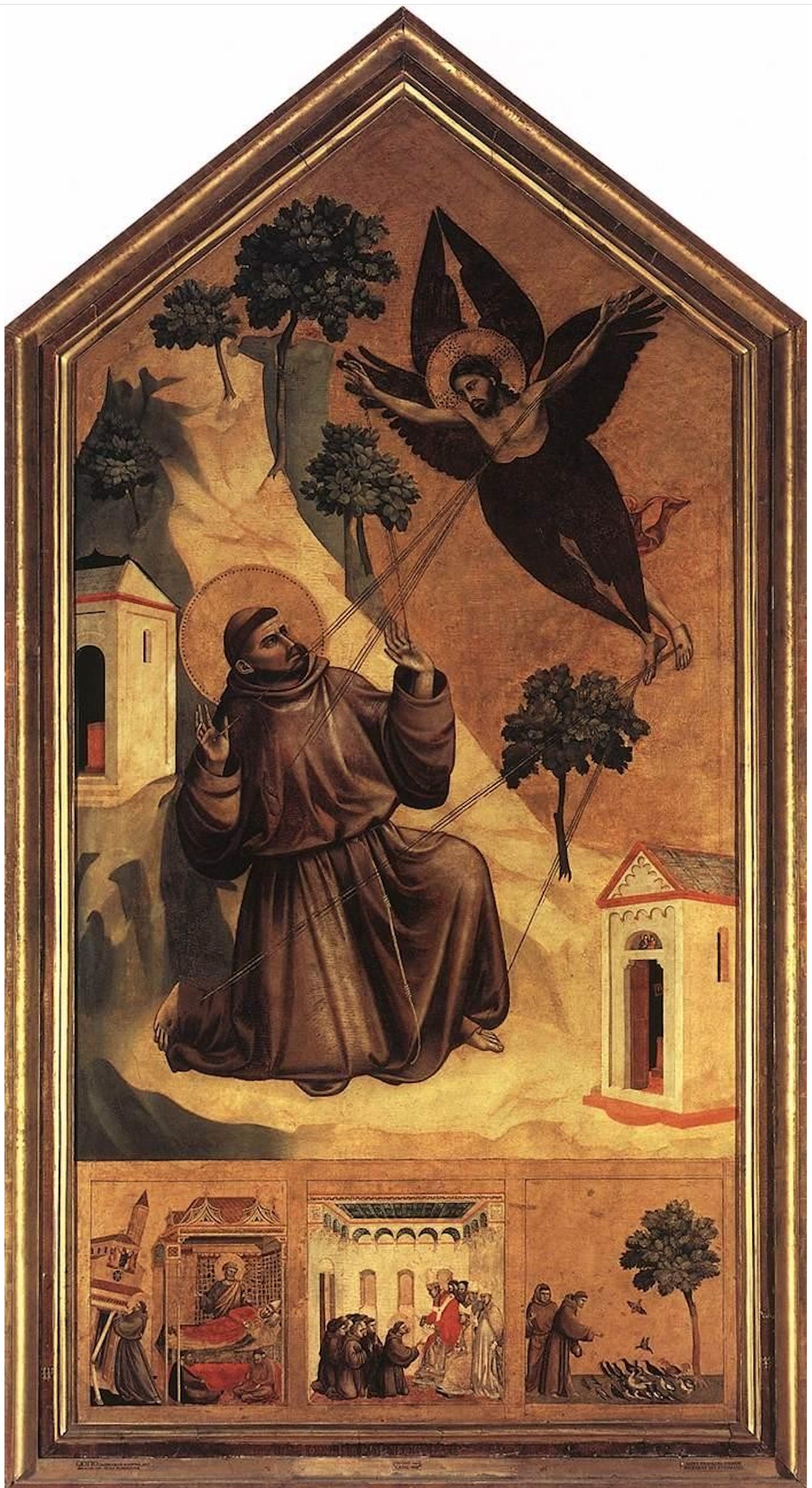
Did high God send his seraph down,
On the lone mount, to imprint such sign?
His brethren wondered, overawed;
Yet not even this made more divine
That sweet-souled man of God!
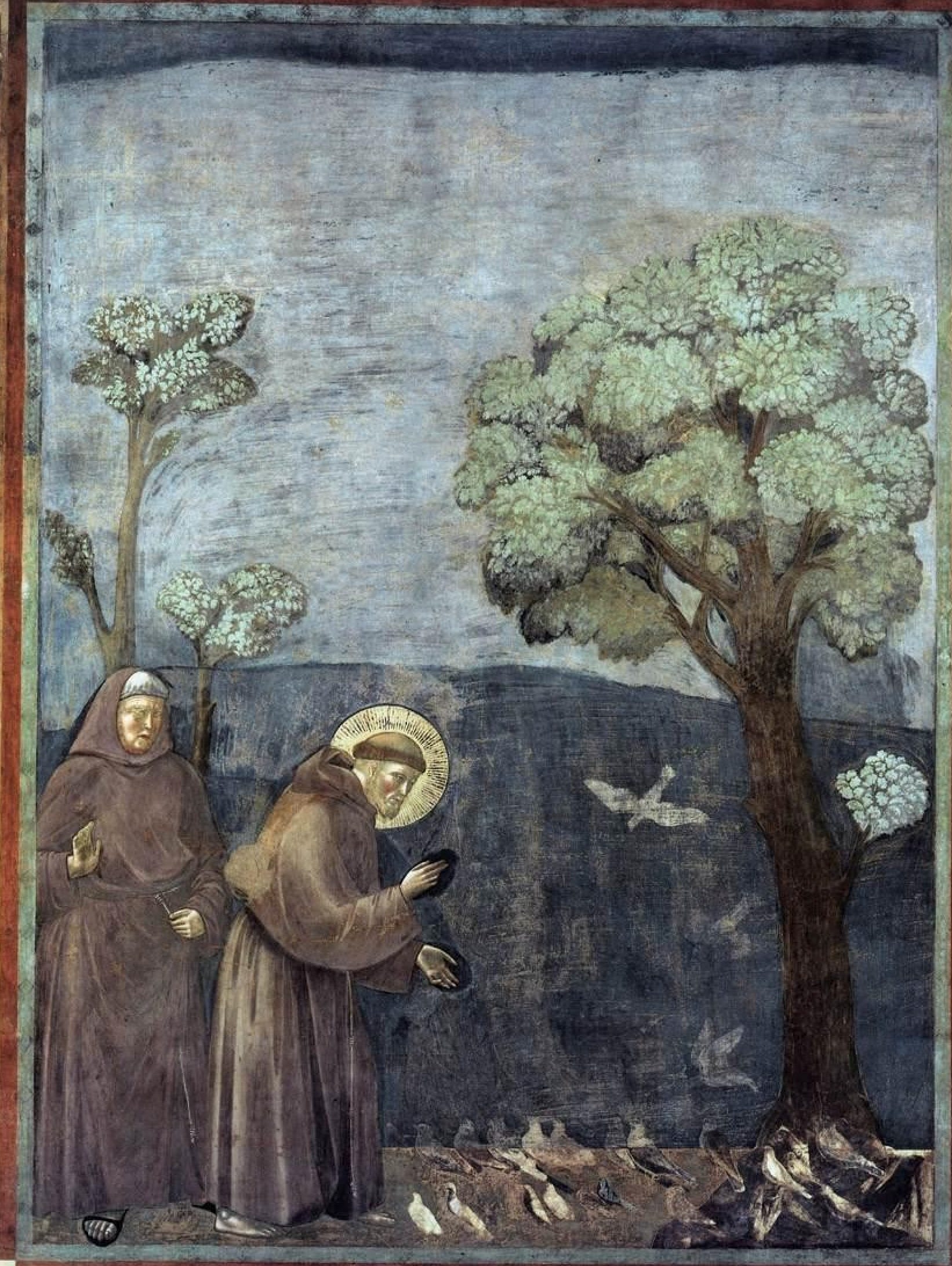
O happy swallows! circling skim
And twitter o’er the gray church-towers.
He called you sisters; ye with him
Chirped sweetly when he sang the Hours.
And ye, his brothers innocent,
With whom he talked where’er he went,
Play, lamb and leveret, in the flowers!
Wise foolishness and melting ruth—
That move deep chords, O love! in you—
Born of child-instincts, or a truth
He and the angels knew!
“O Sun, my brother above all!
Stars, Sister Moon, in praise accord.
Chaste, humble, useful, precious, full,
O Sister Water, freely poured!
Robust and jocund, strong and bright,
O Brother Fire! illume the night.
Live tongues of beauty, praise the Lord!
O Brother Wind! thy wonders weave
In clouds and the blue sky above,
Wherefrom all creatures life receive,
And weave them all of love.
“Confess the Lord, O Mother Earth!
Through whom so beautiful thou art.
To herb, fruit, flower, he giveth birth
And color from Love’s eyes and heart.
Serve God!” he sang. His sermons good,
Dear to shy creatures of the wood,
Could even to bole and branch impart
Their glowing sense: a conscious soul
Kin to his own in all things moved.
His monument is grand—the whole
Creation that he loved.
O Life, that sought to imitate
The one pure type, its perfect Chief,
By its own purity separate
As is the dew-drop on a leaf,
Which yet doth from its luminous veil
A glory to the flower exhale!
Close sympathy with no touch of grief!
Let fair Assisi on its slope,
An unremote yet reachless star,
Lend to our hearts another trope,
So near and yet so far.
O Poet, who in faltering rhyme
First wove the Tuscan into song!
O poem and miracle sublime,
Thyself, in Dante sweet and strong!
To his fourth circle of Paradise,
To the King-splendor of the skies,
Dost thou, the elder seer, belong.
Thee “Sister Death” hath glorified;
And what an image we have won:
Through kindled mists of mountain-side,
Assisi in the sun!
From the Catholic World 25, no. 145 (April 1877): 11–14. Obvious misprints have been corrected and the spacing of punctuation modernized. Cover: Assisi from the plain, photograph by Gunnar Bach Pedersen (public domain), via Wikimedia Commons.