


From the Editor
The beatification Mass for Archbishop Fulton J. Sheen will be held this week on Thursday, September 24, 2026, at 2:00 p.m. Central Time, at The Dome at America’s Center in St. Louis, Missouri, presided over by Cardinal Luis Antonio Tagle as the Papal Representative.
To celebrate the event, this week the American Catholic Quarterly Review is devoted to Sheen, particularly his 1938 proposal to reform Catholic higher education in response to the crises of the times, through an “Institute of Catholic Culture.”
We will publish that seven-page proposal in its entirety on Wednesday. You will not want to miss it.
As a lead-up, we begin today and tomorrow with two essays by Jonathan A. Buttaci, Associate Editor and Gibbons Institute Senior Fellow.
Enjoy, and celebrate with us!
—Michael Pakaluk
“Someday You Will Be Just as I Am”
On Sheen, Spalding, and the Teaching of Divine Providence
(the first in a two-part series)
by Jonathan A. Buttaci
For here the saying holds true, “One sows and another reaps.”
I sent you to reap that for which you did not labor;
others have labored, and you have entered into their labor.
The Venerable Fulton Sheen, to be beatified later this week, often reminds us to look for the work of Providence in all things. The more we do this, he recommends, the more joyful and peaceful we become; the less we do this, he warns, the more upset we are likely to be, even at the pettiest annoyances and disappointments of life.[1] In this counsel he joins many others among the blessed; like theirs, his life bears witness to its truth. Indeed, as a preacher he seldom let pass an opportunity to tell a charmingly self-deprecating story that revealed his own struggles with humility, trust, and peace of soul amid the trials and disappointments of his life.
Sheen served for twenty-four years on the ecclesiastical faculties at the Catholic University of America. The young priest-philosopher took teaching quite seriously and actively worked with the students on campus. Already in his first year he was invited to preach the Mass of St. Thomas Aquinas in March of 1927.[2] He was always seeking fresh ways to engage with students and the wider culture.[3]
Even so, biographers (and Sheen himself) report that he sometimes found other aspects of academic life a source of frustration.[4] Often his “Christian impatience”—a striking term that he would later use to close the cover letter to his 1938 proposal—resulted directly from his commitment to excellence in education and his insight into what its achievement would require. Despite the occasional difficulty or even conflict at the university, Professor Sheen was afforded many opportunities to pursue his work as an educator with countless young people, thinking life through with them and cheerfully answering their questions, while also preparing for the larger audiences that were already beginning to hear his voice.
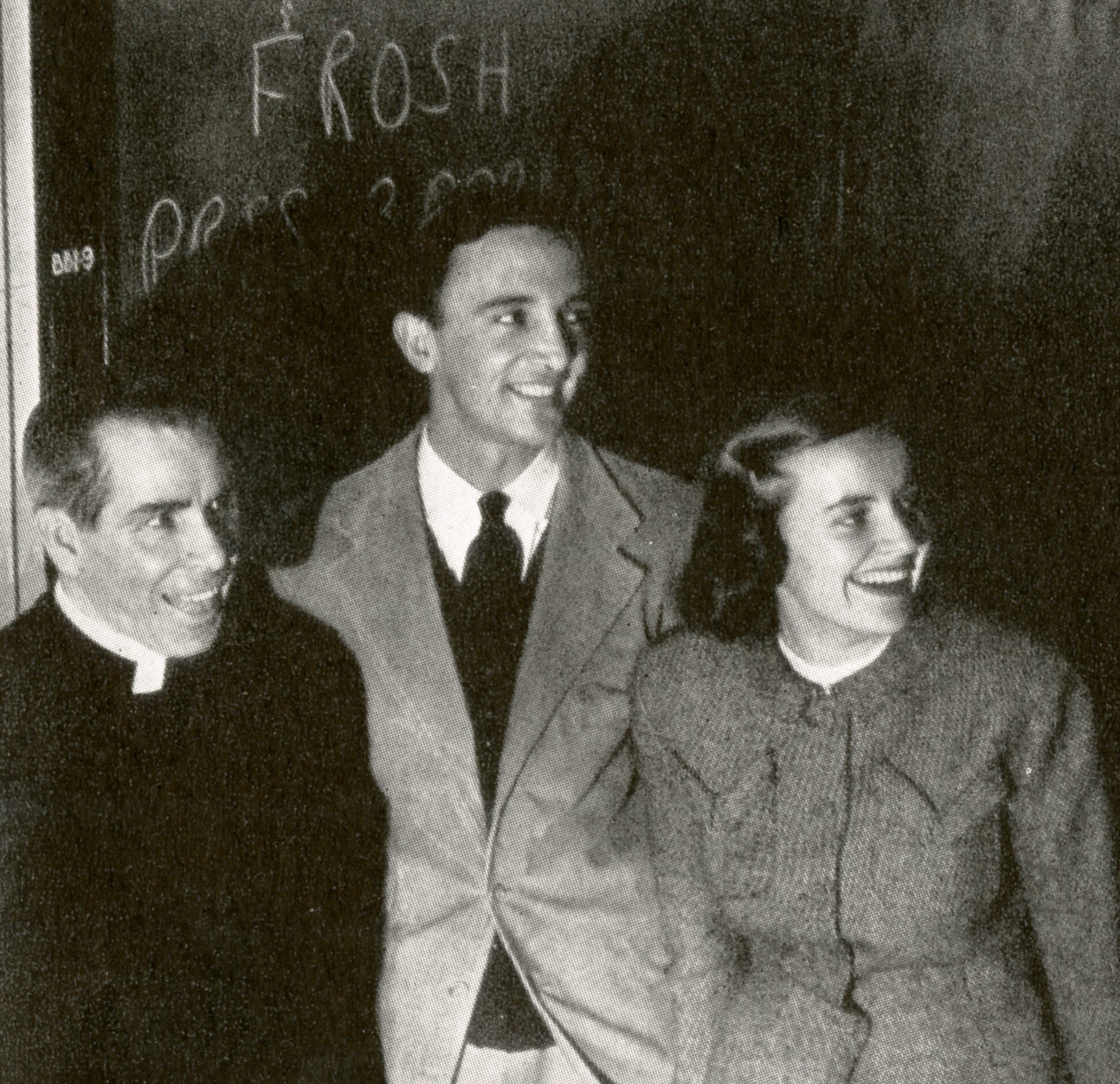
Sheen’s university years were, in short, both intellectually and socially formative. It is therefore striking that he should be beatified a century after joining the faculty of Catholic University, a hundred years almost to the day since fall classes began in late September 1926; the Mass inaugurating that academic year was offered on Sunday, September 26.
This fact invites our reflection on his time at the university and his place in its early history. We can be confident that Sheen now clearly appreciates the providential contours of his life, including his time as a professor, with both its tears of sowing and its joys of reaping, all punctuated by the energy and occasional excesses of youth. Perhaps we too might catch a glimpse of his position in the providential course of things and thereby come to have greater trust and peace of heart regarding our own. Here a very large subject opens up to which I can only allude in the most oblique way (see John Henry Newman, “Wisdom and Innocence,” in Sermons Bearing on Subjects of the Day).
---
The Catholic University of America claims Pope Leo XIII as its founder, who formally approved its statutes in 1889. Its founding was, of course, the work of many American clerics, scholars, and benefactors over several decades. Though the general idea was conceived much earlier, the first formal proposal seems to have been made at the Second Plenary Council of Baltimore in 1866, with Archbishop Martin Spalding presiding. The resolution was both brief and indeterminate: “A desire is expressed to have a Catholic university in the United States.”
Although the idea continued to be discussed by Catholic authors, work did not begin in earnest until almost twenty years later, after the Third Plenary Council of Baltimore in 1884. It was, in fact, Archbishop Martin Spalding’s nephew, John Lancaster Spalding, whose clear vision and singularly persuasive efforts led to the university’s eventual founding in the late 1880s. All great works take time.
Cardinal Gibbons said of this younger Spalding, in his address on the university’s Silver Jubilee:
All great works have their inception in the brain of some great thinker. God gave such a brain, such a man, in Bishop Spalding. With his wonderful intuitionary power, he took in all the meaning of the present and the future Church in America. If the Catholic University is today an accomplished fact, we are indebted for its existence in our generation, in no small measure, to the persuasive eloquence and convincing arguments of the Bishop of Peoria.
The Bishop of Peoria! It is yet another curious accident of history, if not a wondrous sign of Divine Providence, that the same Spalding—that “great thinker” and towering figure of Catholic education in America, whom one might regard as an unofficial founder of the Catholic University of America—should also have been the first bishop of Peoria, Illinois.
Peoria is, of course, where Fulton Sheen grew up. As a boy he attended Mass at St. Mary’s Cathedral. In his autobiography, Treasure in Clay, Sheen recounts an episode in which he dropped a wine cruet while serving Mass for “the great Bishop John L. Spalding”:
There is no atomic explosion that can equal in intensity of decibels the noise and explosive force of a wine cruet falling on the marble floor of a cathedral in the presence of a bishop. I was frightened to death. What would the bishop say?
After Mass, the bishop comforted the understandably distraught lad. Ever the educator, he then inquired about Sheen’s plans for higher studies, “when you get big.” Spalding reportedly told him that he ought to study at Louvain in Belgium, where Spalding himself had earned his degree, adding that “someday you will be just as I am.”
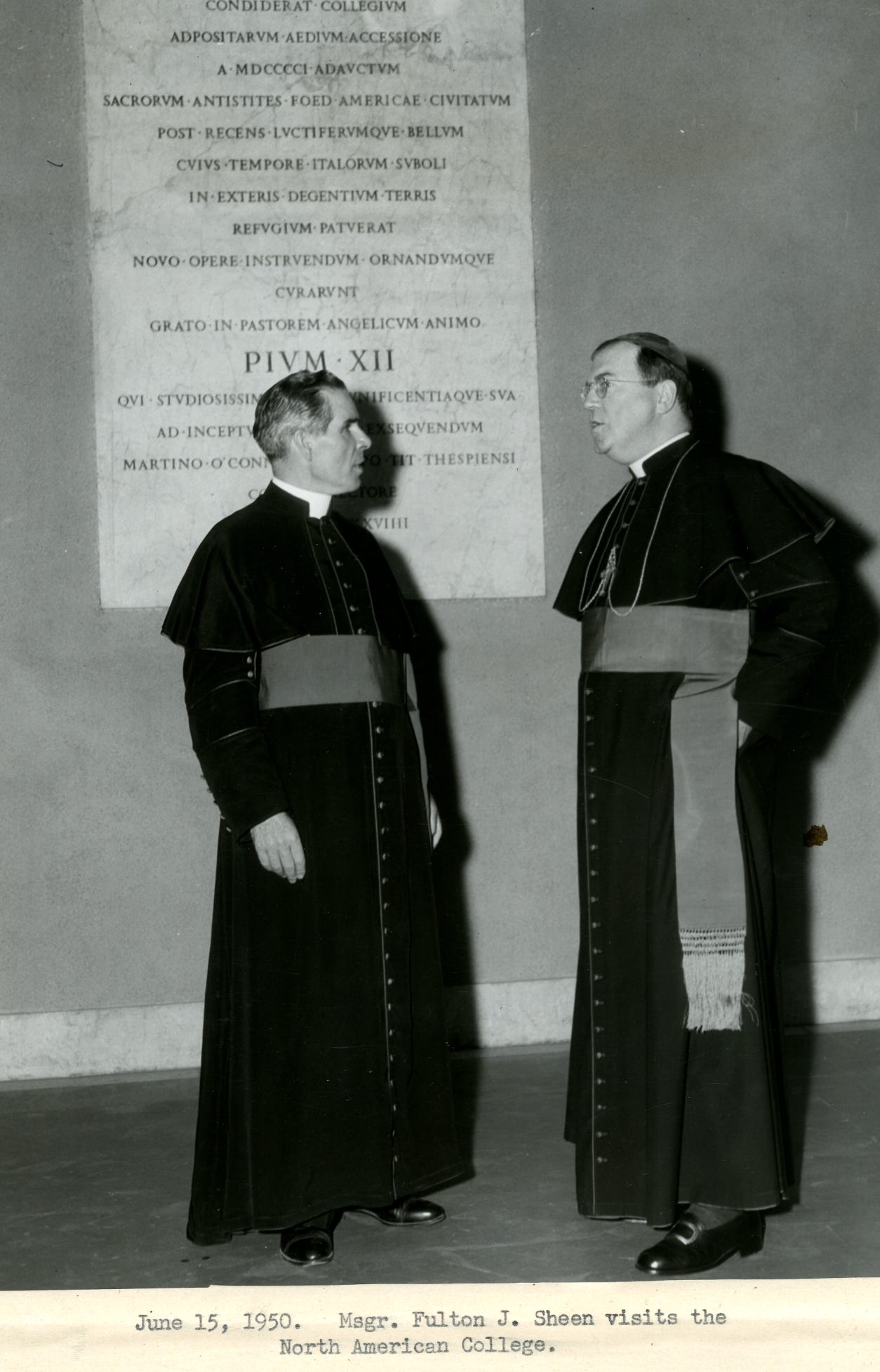
This story is familiar to many devotees of Sheen, especially the near-prophetic suggestion that he would someday join Spalding in the episcopal rank. Sheen himself reports forgetting about the conversation until his arrival at Louvain as a young priest in 1921. There he earned a doctorate in philosophy before returning to the United States, soon to teach at the very university Spalding helped to found, which by then had surely become “an accomplished fact.”
Doctoral robes and episcopal rings did not exhaust the likenesses foreseen by Spalding. This week the Review will be highlighting some of the insights of Sheen’s university years, especially in view of intellectual culture at large. Of chief interest will be his 1938 proposal for an Institute of Catholic Culture. In it, Sheen sought to “meet the new situation” in which the American Church found herself, thereby reiterating Catholic University’s original mandate some fifty years after its founding.
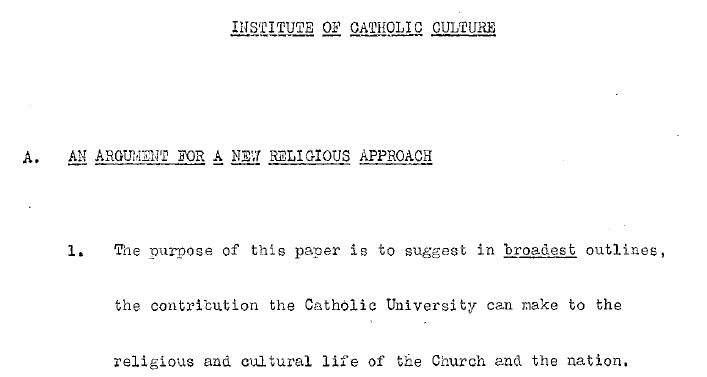
Sheen, then, came to be very much like the bishop of his childhood cathedral in Peoria, who, as Gibbons attested, “took in all the meaning of the present and the future Church in America.”
But in today’s essay I wish to recall a more general likeness between these two great American Catholic teachers and their “wonderful intuitionary power.” Although both men worked tirelessly to develop concrete proposals to “meet the changed conditions” of the surrounding culture, neither lost sight of the higher aim of teaching: it is essentially a spiritual transformation, which equips us for living a “higher life.” Such a transformation is not merely a matter of learning various disciplines: it must be realized in “the remarriage of thought and action,” as Sheen puts it in his proposal.
In order to affirm and realize this high educational vision—especially in view of the frustrations, challenges, and conflicts of the modern world—both men often reminded their audiences that life is worth living because a providential and loving God directs the course of our lives. The truth that life is worth living so animated Sheen’s teaching that it became the name of his television program.
Spalding chose to begin an important address about university education in precisely the same way:
Life, more life, ever-increasing life, is the aim and end of all we think and do. To inquire whether life is worth living is absurd, for life loves itself, and love originates all worth. Misconduct or misfortune may in individual instances enfeeble or even destroy the will to live, but the love of life—and therefore the belief in life’s goodness—is indestructible. … Wherever we are, however surrounded and attended, we cannot live except in our minds and hearts. If all is well there, the rest need give us little concern. Let us learn to trust the Power by which we live, and to place less reliance on what is adventitious.[5]
Despite the occasional disappointments and frustrations of his university years, then—indeed, perhaps precisely because of them—Sheen gradually came to realize this “Teaching of Divine Providence” in his life, having himself learned to trust and be untroubled by “what is adventitious.” Nearly ninety years on, though he did not himself see his proposed Institute come to be, we can see many such endeavors committed to similar principles and methods, including the Gibbons Institute at the Catholic University of America.
For here too the saying holds, “One sows and another reaps.”
Sheen’s beatification proposes that we too should work to learn this Teaching of Divine Providence, even in the most intense, frightening, or disappointing episodes of our lives, whether they be a delayed academic proposal, a discouraging faculty meeting, or even a fallen cruet. With Sheen and Spalding as our teachers, “let us learn to trust the Power by which we live,” the One Who both gives the growth and makes all life fruitful and worth living.
[1] See, for example, Fulton J. Sheen, Treasure in Clay (1980), 314 and 344. See also the preface to the revised edition of The Life of Christ (1977). For the latter reference I am grateful to Peter Ulrickson.
[2] The Tower, Vol. 5, Issue 20 (March 9, 1927).
[3] He would give special lectures about the Catholic intellectual tradition in relation to the modern world that seem to have garnered student interest (see, e.g., The Tower, Vol. 7, Issue 3 (October 17, 1928)). He was also actively involved in extracurricular student groups like the Abbey Club (see, e.g., The Tower, Vol. 7, Issue 7 (November 14, 1928)).
[4] See, e.g., Thomas C. Reeves, America’s Bishop (2001), especially Ch. 3. See also, again, Treasure in Clay, especially Ch. 5.
[5] “The University: A Nursery of the Higher Life,” in Opportunity (1903), 69, 77–78.
Photos courtesy of The American Catholic History Research Center and University Archives (ACUA), The Catholic University of America, Washington, DC.