



INSTITUTE OF CATHOLIC CULTURE
A. AN ARGUMENT FOR A NEW RELIGIOUS APPROACH
1. The purpose of this paper is to suggest in broadest outlines, the contribution the Catholic University can make to the religious and cultural life of the Church and the nation.
2. The peculiar contribution which the University can make will naturally depend upon the philosophy, the temper and the spirit of the times in which we live. The plan herein suggested assumes that since the Church is living in an order and world-spirit radically different from the past, it must change its method of approach to meet the new situation. The religious affirmations of the Church depend in part on negations by the world, as infallible decisions of the Church are motivated in part by the nature of the environment at any given time.
3. The proof of a new world spirit is apparent as one contrasts old and new ideas in philosophy, politics, economics and religion.
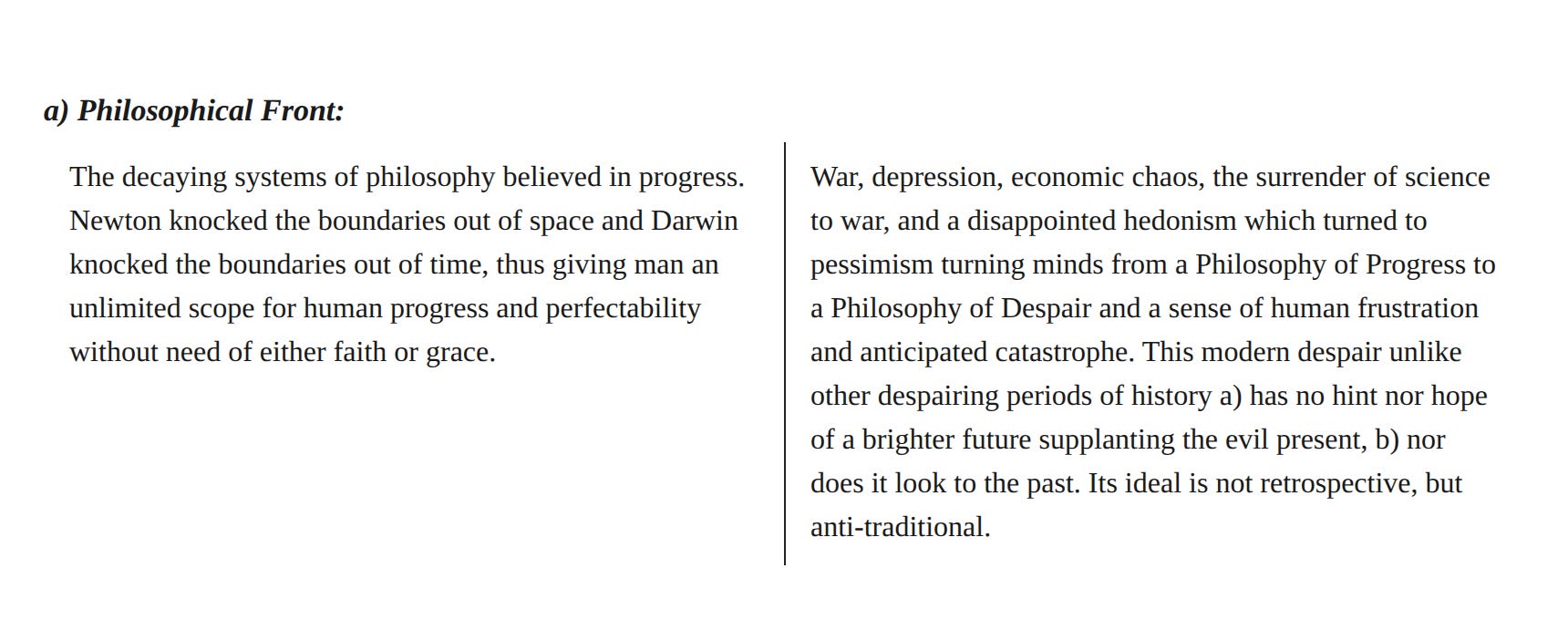
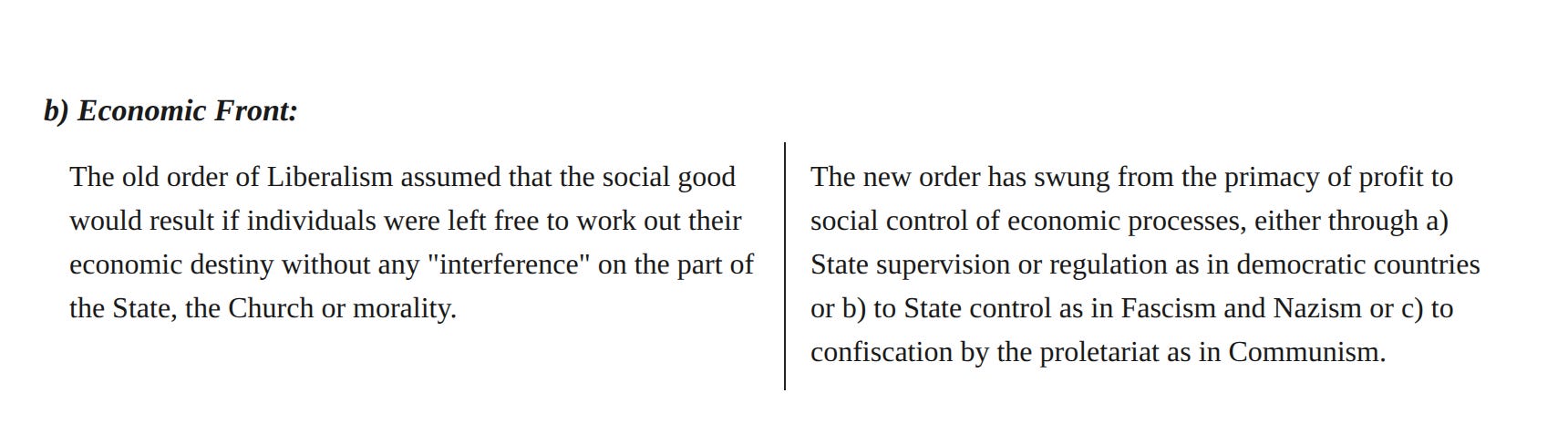
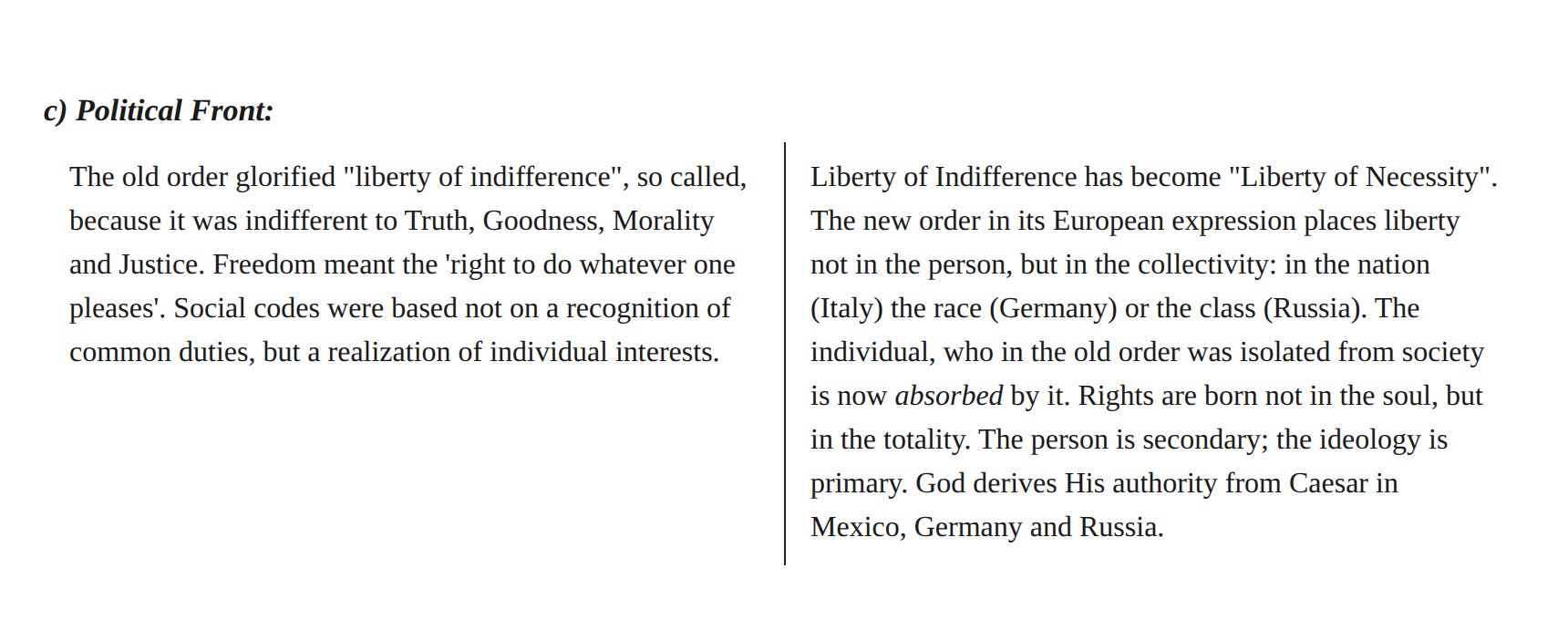
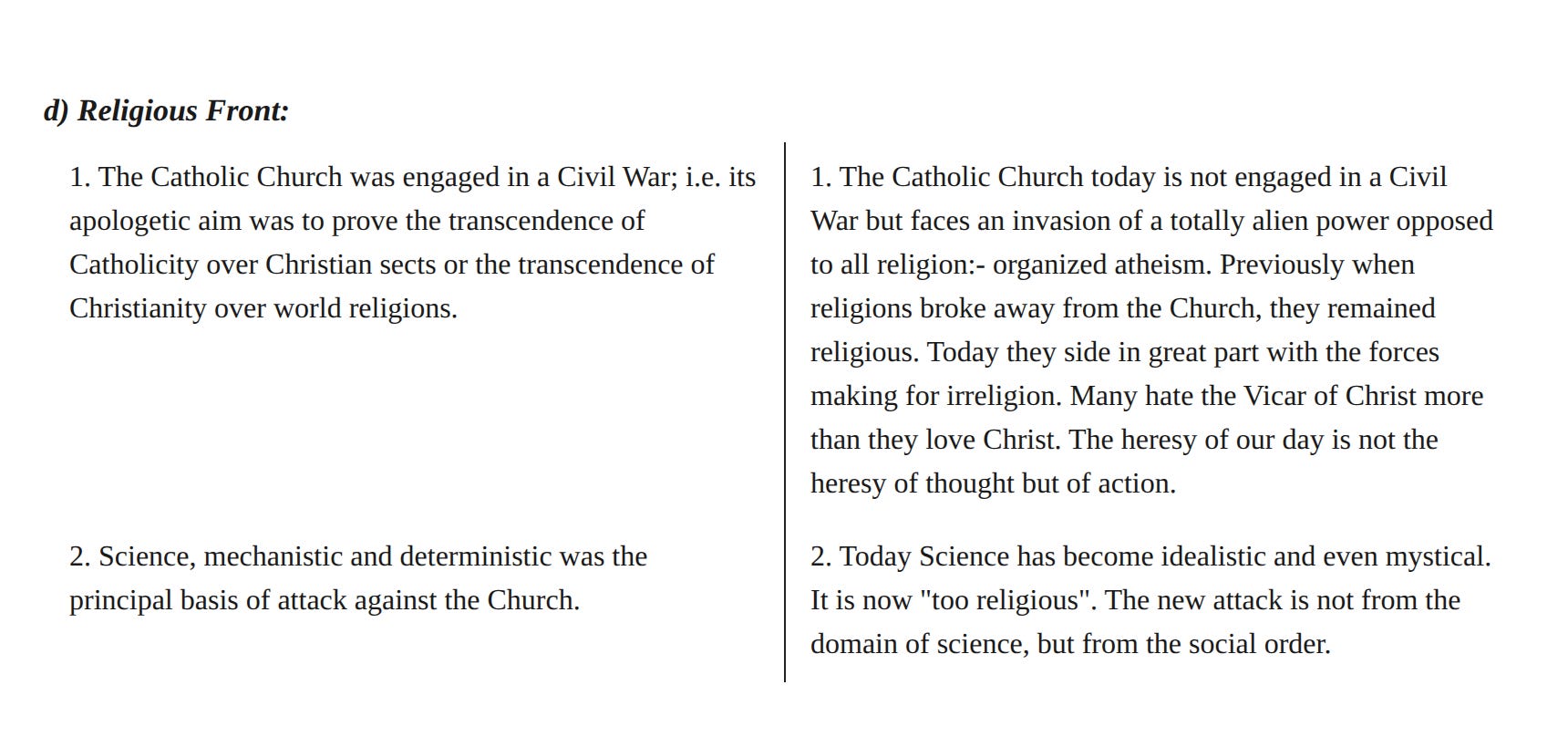
4. Conclusion: The Church is no longer homogeneous with the world but heterogeneous to it. Its principles were once ignored; now they are to a great extent in some countries repudiated and repressed. Since then the religious program of the Church in relation to the world must take cognizance of the errors of the time, and since the new errors are quite radically different from the past, it follows that the Church must present its eternal verities with a new emphasis.
B. THE BASIC PROBLEM OF A NEW PROGRAM
1. The nature of the new approach will depend upon the fundamental and basic problem which underlies all other problems. It is the position of this paper that the basic problem is:-
MAN.
a) The authority of the Church supports this view, for the Holy Father in his encyclicals: Quadragesimo Anno, Divini Redemptoris, Divini Illius Magistri and Mit brennender Sorge begins a discussion of the social order, Communism and education with “the fundamental doctrine of man”.
b) The best of contemporary thinkers, Dawson, Jerrold, Berdyaev, Hoffman, Madariaga, Maritain, summarize the modern errors as “the dehumanization of man”.
c) All social, political and economic problems are resolvable to the problem of man, e.g. Political Liberalism which isolated man from social responsibilities and Totalitarianism which absorbs man into the collectivity are both errors concerning man, who from the Catholic point of view is above the State because he is a person and yet subject to it because he is also social by nature. The Capitalist contention that capital is entitled to all the profits and the Communistic solution that labor is entitled to all the profits are each exaggerations and defects of the Catholic doctrine which holds that since human labor is both individual and social, therefore both Capital and Labor should share to some extent. Birth control, living wage, family rights, sex, public morals, Totalitarianism, class conflict, racial snobbery are all so many problems issuing from the value of a human person which St. Thomas has called “id quod est perfectissimum in tota natura” (Summa 1 q. 29 a. 3)
C. NEGATIVE SIDE OF THE NEW PROGRAM
1. The abandonment of Apologetics as the cornerstone of the religious approach because:
a) It is too negative and defensive
b) It was shaped to answer the objections of theological Protestantism which are no longer urged.
c) It was adapted to answer a world which had religious difficulties but not a world which is irreligious.
d) The Catholic presentation of motives of credibility was in a large part determined by the positions taken by the enemy, instead of by ourselves.
2. The abandonment of an approach which takes its form and content from the error to be answered rather than from the truth to be presented. For example, ethics as a branch of philosophy is philosophy’s answer to Deism and Naturalism. But a philosophical ethics however valid it be is not the Catholic solution to all the problems discussed.
3. The relegation of apologetics as a genus in the hierarchy of sciences to that of a species, i.e. it should be one among other sciences treating the problem of man. Such is the mind of the Church as revealed in the “Letter of the Sacred Congregation of Seminaries and Universities to the Rectors of Universities and Seminaries” (May 1938) which ranks apologetics as one of a body of sciences, to wit, “biology, history, philosophy, apologetics, the juridical and moral sciences.”
D. POSITIVE SIDE OF THE NEW PROGRAM
1. The new program should take account of integral man, i.e. as natural and supernatural, personal and social. a) Hence it should include the theological, philosophical and the scientific study of man, and b) it should embrace social and juridical sciences as well as courses touching the individual such as psychology and theodicy.
2. It should integrate Catholicity (not merely the philosophy of man) with every sphere of human activity: political, economic, social, juridical, scientific, historical, etc., thus breaking down the assumption that religion is a department of life distinct from and often unrelated to other departments, valid only in its own sphere and with a principle of operations different from those in the secular sphere. As St. Thomas put it: “All human activities are at the service of Divine Truth.”
3. This integration would imply a scheme of courses built not as so many distinct compartments, but as a hierarchy or pyramid. At the peak would be the principales or superior sciences of theology and philosophy stating the basic principles concerning the nature, destiny and value of man as supernatural, personal and social.
Next in order would follow a group of courses called the auxiliares which would apply the above principles to economics, politics, law, social work, etc. For example, why does the Catholic social program insist on a living wage, the right to organize, a share in profits, right to property, its social use, the transcendence of person to State, the subjection of citizen to common good? Both Catholic and non-Catholic programs share some of these positions in common, but the Catholic reason for any of them is different than the secular. The Catholic reason for a living wage is not “the abundant life” but in order that man, dispensed from economic worry, may be free to save his soul. Hence the necessity of courses applying the Catholic doctrine of man to man in the concrete, historical and social order.
Finally, there would be a group of courses entitled the speciales. These courses would not be constituted by the application of Catholic principles of man to the social and economic order (auxiliares) for there is a group of sciences which derive but little illumination from superior sciences, e.g. the empirical sciences, anthropology, statistics, psychology of conversion, etc. These and similar sciences have their own methods of investigation and their own distinct formal and material objects. Catholic theology and philosophy would not impose their principles on these sciences but rather utilize their findings, for both the deductive and inductive sciences are derived from and serve the common cause of God’s truth.
4. The general name for a school teaching such a group of courses might be “The Institute of Catholic Culture”. The word ‘cultivation’ in relation to nature means inciting nature by human labor to produce fruits which nature of and by itself is incapable of producing. Applied to man, culture means the unfolding of human possibilities through reason and grace, or the rational and spiritual development of the whole man. Civilization is the effect of this culture in the domain of the civil, the political, the scientific and the artistic.
E. GENERAL EFFECT OF SUCH AN “INSTITUTE OF CATHOLIC CULTURE”
1. Socially:
It would break down the enforced isolation of Catholicity from the secular.
In order to understand this statement recall that religion in general purchased its freedom for the last three hundred years on the assumption that it would not interfere with the secular order. To call any activity “business” or “politics” was to throw a cloak of immunity about it and to justify the exclusion of religion and morality in either of these domains. The secular order said to religion: ‘we will not interfere with you if you do not interfere with us.’ Three disastrous effects followed:
a) Religion became a circumscribed area of life, water-tight in its influences and insulated from all contacts with the political or the economic.
b) While religion was tending to its own business, irreligion preempted the social order.
c) Religion discovered too late that though it left politics and economics alone, politics and economics did not leave it alone, but began to include Divine religion under a State-religion and to regard the Church as “counter-revolutionary”.
By reaffirming that Catholic truth is organic with all truth, the Church will challenge the world’s assumption that the spiritual is an affair of individual morality. It will re-emphasize with Pius XI that “economic reconstruction is conditioned upon spiritual regeneration” and thus restore the relevance of God to the secular order, by the new policy of initiative as against abstention and by forming a civilization instead of being formed by it. The greatest social effect on such an Institute would be to place the Church ahead of movements for social and political betterment rather than behind them.
2. Nationally:
The contributions of such an Institute would be:
a) The protection of democracy against the invasion of all “isms” which impose a false ideology upon man, claiming him as its own as regards both body and soul.
b) The restoration of the lost virtue of Patriotism as a form of Pietas or a corollary of love of God and love of neighbor. This does not mean the imposition of religion on the State, but it does mean effectively laying the resources of religion at the service of the State.
3. Educationally:
Such an Institute would be a kind of university within a university in the sense that it would give a complete philosophy and theology of man as a person, a citizen, a rational animal, a social animal, a creature of God and a child of the Heavenly Father. Its claim to autonomous existence is that:
a) There is not only much truth yet to be learned, but there is also much more acquired and revealed truth which has yet to be applied. Catholic education is not merely an exhortation to extend the frontiers of truth; it must also be primarily the announcement of salvation, not only for the individual soul but for society as well.
b) It would break down the assumption that religion is a department of life and restore its dignity as the soul of life. The present teaching of religion is that it is something to be learned; the Institute would add that it is something to be realized for Catholic Action is nothing but Catholic realism, or the remarriage of thought and action.
Publication of this proposal is courtesy of The American Catholic History Research Center and University Archives (ACUA), The Catholic University of America, Washington, DC.