


Today and tomorrow, we republish the Salutatory from the founding issue of the American Catholic Quarterly Review in January 1876. A first interesting question is whether we—you and I who read this and who perhaps see the need for a similar project—can affirm what they affirmed, and, if not, is that because our judgment is better and our conviction is sounder, or because we fall short of something we see in them.
Some observations:
Compare what they say about philosophy of history in the first paragraph with what Jim Hankins and Allen Guelzo just posted on their Substack, The Golden Thread:

Then look at their assessment of Europe: “it is simply the moral power of her presence that prevents European society from taking the final plunge into the anarchy and barbarism, for which three centuries have been striving to prepare it.” This was written forty years before World War I, the outbreak of which, in Europe—you will remember—was greeted with shouts of jubilation. This was written two years before the election of Leo XIII and his first encyclical in 1878, Inscrutabili Dei Consilio, which has the following memorable line, but which is in general alignment with the diagnosis of Europe found here: “ It is perfectly clear and evident, venerable brothers, that the very notion of civilization is a fiction of the brain if it rest not on the abiding principles of truth and the unchanging laws of virtue and justice, and if unfeigned love knit not together the wills of men, and gently control the interchange and the character of their mutual service.”
Notice how, remarkably, in an American context, they regard Public Opinion as an authority which makes claims of absoluteness and which would usurp the rule of God. Lincoln saw the problem: in his September 16, 1859 speech in Columbus, Ohio, he famously said:
“Public opinion in this country is everything.”
And in his 1858 debates:
“In this age, and in this country, public sentiment is everything. With it, nothing can fail; against it, nothing can succeed.”

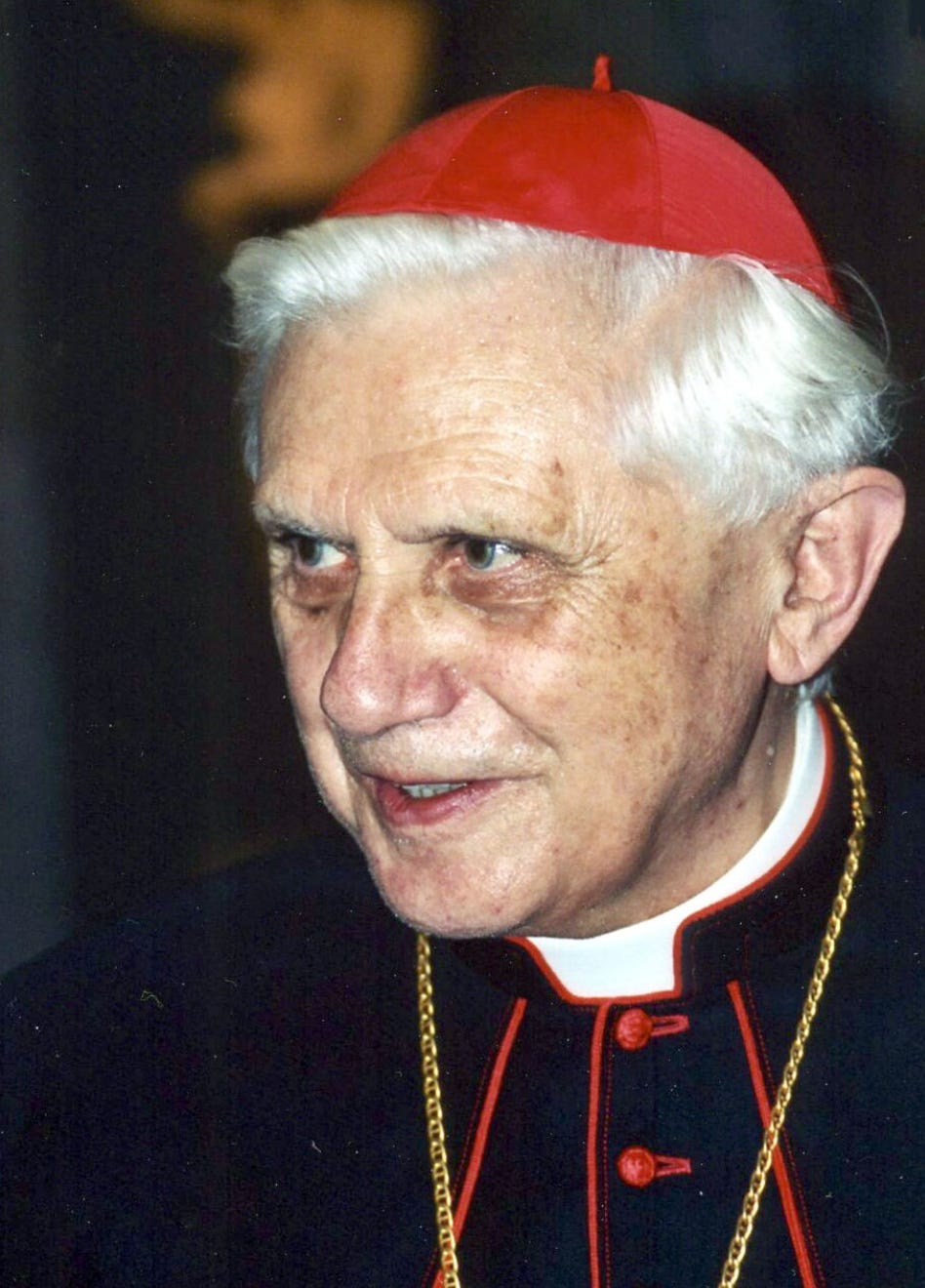
Abraham Lincoln Although he spoke with softer articulations, Cardinal Joseph Ratzinger expressed a similar view about philosophy in his Missa pro eligendo Romano Pontifice, delivered April 18, 2005, the day before he was elected Pope Benedict XVI:

“How many winds of doctrine have we known in recent decades, how many ideological currents, how many ways of thinking. The small boat of the thought of many Christians has often been tossed about by these waves — thrown from one extreme to another: from Marxism to liberalism, even to libertinism; from collectivism to radical individualism; from atheism to a vague religious mysticism; from agnosticism to syncretism and so forth.”
“We are building a dictatorship of relativism that does not recognize anything as definitive and whose ultimate goal consists solely of one’s own ego and desires.”
This document appeals to “the infallible Church of God” six years after the definition of papal infallibility by the First Vatican Council in 1870. The phrase is helpful for understanding how papal infallibility was understood then. It was not understood as a free-standing power but as a protection which must in some circumstances fall upon the chief authority of a community, if that community is preserved in truth. This was Newman’s argument: if some disputes risk dividing the Church, and if the last word is held by Peter, and if the Church remains in the truth assuredly, then Peter must remain in the truth assuredly, in those circumstances in which he speaks that last word—but then (Newman’s important hedge in his letter to the Duke of Norfolk) not elsewhere, except when speaking with the Church.
When you read language like “how different is the base counterfeit of the same, wickedly forged to our discredit by some,” keep in mind that Catholics in the United States, especially recent immigrants, commonly suffered persecution. This statement was written barely two decades after the peak of the Know Nothing movement. Overt anti-Catholic nativism was still well within their living memory
I won’t use block quotation for the text.
SALUTATORY
OUR REVIEW, as its name points out, is to be Catholic and American. Its aim, therefore, will be to explain and defend the Catholic theory of revealed Truth, moral and dogmatic, as it really is, as it has been left us by the Apostles and defined by the Church; and to let men see how different is the base counterfeit of the same, wickedly forged to our discredit by some, and received in good faith as our doctrine by many others outside of our communion. It shall be our endeavor also to show the practical development and working of Catholic principle in the history of the world, in the lives of great and good men, and in the destinies of nations. In the history of mankind before and after the establishment of God’s Church on earth, we recognize no chaotic mass of events huddled together like Lucretian atoms by blind chance, or produced merely by the caprices and passions of men. We look upon it as a great book in which the true philosopher as well as the devout Christian may trace on every page the finger of Divine Providence. In it we find, as all must who study and reflect dispassionately, the perpetual presence and action of God, who moulds men and things at His will; calls into being, guides, preserves or destroys kingdoms and peoples for His own wise purposes; in a word, makes of nations, as well as of individuals, either trophies of His mercy, or standing memorials of His avenging justice.
In the days of old, when God was known only in Judah, and His name was not great outside of Israel, He abode quietly in Salem; and the Church of Sion was simply the depository of His revelation, the treasure-house in which were silently laid up the hopes of humanity. But the Church of the New Law has a more active mission; and hence in the history of the world, since the days of Christ, she is seen perpetually foremost as God’s visible agent in bringing peoples to the knowledge of divine truth; in renewing, or to speak more correctly, creating afresh their moral life; in educating and civilizing them, in improving and bettering their condition in all that concerns their intellectual and moral welfare. Whatever there yet remains of good and creditable in the civilization of Europe is the work of her hands, the legacy she has bequeathed to ungrateful states and kingdoms. Even now, buffeted and persecuted as she is in Europe, stripped of all earthly influence and humbled to the very dust by infidel statesmen — it is simply the moral power of her presence that prevents European society from taking the final plunge into the anarchy and barbarism, for which three centuries have been striving to prepare it. And in spite of many, who may be disposed to deny or doubt or sneer at our conviction, we feel assured, and have no hesitation in saying that our own country — if it is to be saved from the deluge of irreligion and immorality that is gradually threatening to submerge people and government — can only be saved by the influence of Christianity, as it is preached by the True Church of Christ. No paltry sects, born of human caprice, and, true to their origin, bending with all the whims and changes of human opinion, can ever succeed in drawing back our people from the abyss to which they are hurrying. Nothing can save us but the true Christian Creed, the only one in the world which has the boldness to teach our countrymen, in word and deed, that we are freemen not in name only, but that the freedom given us by Christ is our inalienable heritage with which we must not part; that neither the State nor Public Opinion is our lord and master, nor has either a right to command us in the moral, any more than in the intellectual sphere; that it is as unlawful for them to usurp power not their own, as it was for George III. and his Parliament; in short, that neither the State nor Public Opinion is the God of the true Christian, but that if either sets itself up against God and His Christ — as every modern State and the Public Opinion of our day seems mostly disposed to do — it becomes simply an engine of Satan for the destruction of souls, and the ruin of the commonwealth.
Some portion of our pages will be devoted to philosophy and science. True philosophy is, in some sense, the creation of Christianity. Nothing else could have purified the old Greek philosophy of its dross, superstition and skepticism, and confirmed by a divine unerring standard the old truths that primitive tradition had transmitted more or less distinctly to successive ages. All right-minded men may see what philosophy has become, ever since it shook off the guardianship of True Religion. From Bacon and Descartes there has been a logical succession of false teachers down to Kant, Fichte and Schelling, to whom we may add those boldfaced dogmatists, Büchner, Tyndall, Huxley, Darwin, etc. The road is easy enough from mild skepticism down to Pantheism, Atheism and Nihilism.
Science has ever been, when not lifted out of its proper sphere, the willing handmaid of religion; and this for the simple, evident reason that truth being one can never contradict herself. Just before the outbreak of the so-called Reformation, the Catholic Church condemned the assertion that anything can be true in theology, which is false in philosophy. And to that teaching she still adheres. The sects may go down and perish before the advances of science “falsely so called.” They have this much in common, that both are born of private judgment, the fallibility of which is made a boast of by sectarians. But the infallible Church of God, besides her consciousness of divine origin, knows too that her Author is the same who gave laws to nature — “qui omnia in mensura et numero et pondere disposuit“ (Wisdom xi. 21 [“who has ordered all things in measure, number, and weight”]), and that His undivided sway rules all worlds, material and spiritual. Hence she looks undismayed upon the pretended science, born of heresy, that, while scouting her claims, pretends likewise to dethrone her Divine Founder. She may well afford to laugh at their pretensions, when she remembers that whatever constitutes the foundation of European science is due to her own fostering care; and that to her children the world owes all the important discoveries that have been made, from the starry pathways of heaven down to that dread amalgam, in which “villainous saltpetre” holds no little part, and which forms one of the chief elements of our boasted modern civilization.
[Text continues on the following page. To be republished tomorrow.]