


Today is the launch of “For the Most Part,” a forum in which the new ACQR’s Editor-in-Chief will offer occasional reflections related to the essays in the Review.
We conceive of it as the analogue in this review of Fr. Neuhaus’s old Public Square.
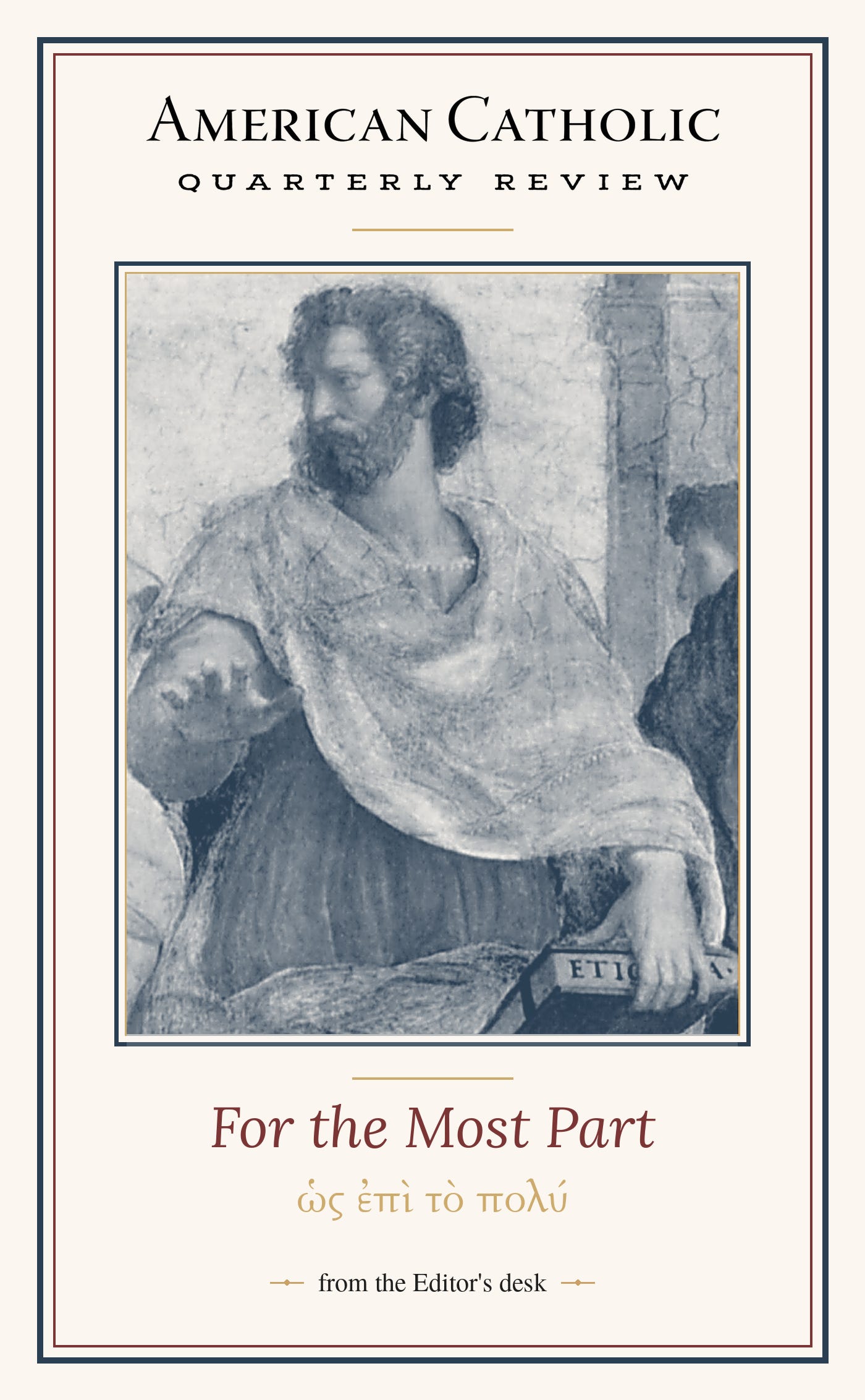
We represent this new forum with Raphael’s image of Aristotle, who in the fresco (“The School of Athens”) in contraposition to Plato gestures towards the ground, that is, he recommends turning to ordinary human experience and human nature.
The phrase, “for the most part” (Greek: ὡς ἐπὶ τὸ πολύ, transliterated hōs epi to polu, pronounced hōss eh-PEE tǒh pǒh-LU), means that which is found to be true not as an absolute or necessary general law, but as typically so, as if the object of a natural propensity.
What is by nature, for instance, is what proves to be so “for the most part.” To say, for instance, that a human being is by nature an animal fit to live in a city is not to exclude the existence of sociopaths, inveterate hermits, or (as Aristotle notes) god-like and beastial exceptions.
Many of the best quotations were never said by the person to whom they are attributed, or by anyone at all. Someone makes them up, or gets something wrong, or misremembers, but because some famous person “ought” to have said that, or “could only” have said it, the made-up “quotation” lives on. (Someone ought to compile a book: Pakaluk’s Book of Famous Non-Quotations.)
For instance, you’ve heard it said that G.K. Chesterton once wisely observed, “When people cease to believe in God, they do not then believe in nothing, but in anything.” At least Malcolm Muggeridge said that he said this. But it’s easy to scan Chesterton’s writings today and discover that he never actually said that.
The Chesterton Society, after following the sleuth work of various investigators, concludes that the language originated in a biography of Chesterton by Emile Cammaerts, called The Laughing Prophet: “The first effect of not believing in God is to believe in anything.”
Here’s the full context. Cammaerts is talking about a shift in the Father Brown stories. He begins as follows:
There is an aspect of Chesterton’s courage which must be noticed here. He had an instinct for the supernatural and felt intensely the presence of a good or a bad spiritual influence. Of the former he tells us very little ; it is a side of his life which he hides from the world through shyness or, more probably, through sheer humility. But of the latter we hear a great deal. We find in many of his stories an eerie touch, bringing us back to the legends and fairy-tales which he defended so brilliantly against the attacks of a narrow rationalism. He was a master at creating atmosphere, although he found a special delight in dispelling it with the wind of laughter or the light of logic. He frequently dwelt on the importance given by the Gospel to exorcism, and his Father Brown devotes most of his time and power to exorcizing evil spirits — the evil spirits of superstition.
The shift is this: in the early stories, the good Father is mainly defending the supernaturalism of Christianity against the scientific naturalists; but in the later stories, the Father finds himself needing to defend Christian rationalism against the superstition of the spiritualists:
When the little priest first appeared in his works, in 1911, Chesterton was still engaged in fighting materialism and scepticism, and he provided his hero with a series of adventures which showed that the materialist’s reason could not reach the truth because it left out of account the imponderable, and was blinded by concrete evidence. But when the last stories were written, a considerable change had occurred. The religious instinct, long placed under restraint, had reasserted itself in a thousand directions. People who had refused to believe in Orthodoxy, because it was supernatural, were now disinclined to believe in it because it was not supernatural enough. They had rejected the miracles, they now rejected the reason and the common sense which justified the miracles.
The collection called The Incredulity of Father Brown, for example, has a story, “The Oracle of the Dog,” where the murderer’s pursuers are thrown off track because they superstitiously interpret the howling of a dog as an evil omen. Only Father Brown with his hard-headed reasonability sees that the dog howled because it was deprived of its toy, a swordstick, the murder weapon, which had been thrown into the sea. Superstition blinded the others from seeing the truth.
Cammaerts explains, quoting Father Brown in the story:
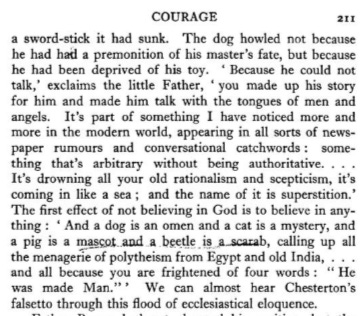
‘Because he [the dog] could not talk, exclaims the little Father, ‘ you made up his story for him and made him talk with the tongues of men and angels. It’s part of something I have noticed more and more in the modern world, appearing in all sorts of newspaper rumours and conversational catchwords : something that’s arbitrary without being authoritative. . . . It’s drowning all your old rationalism and scepticism, it’s coming in like a sea ; and the name of it is superstition.’ The first effect of not believing in God is to believe in anything : ‘And a dog is an omen and a cat is a mystery, and a pig is a mascot and a beetle is a scarab, calling up all the menagerie of polytheism from Egypt and old India, . . . and all because you are frightened of four words : “He was made Man.” ’ We can almost hear Chesterton’s falsetto through this flood of ecclesiastical eloquence.
And you can see that the important line, “The first effect of not believing in God is to believe in anything” contains the words of Cammaerts, not Father Brown or Chesterton.
Would it be a misguided patriotism for you and me to say that that distinctively American sage and proto-Chesterton, Orestes A. Brownson, should get some credit as well? After all, he quotes Clement of Alexandria:
The world outside of the Church may be credulous and superstitious, able, as Clemens of Alexandria said to the Greeks, ‘to believe anything and every thing except the truth’...
And, just like Father Brown, he traces modern superstition, and indeed all heresy, to the rejection of Verbum caro factum est:
The Incarnation is the key to all the Creator’s works, and we have not mastered theology or the philosophy of the supernatural, till we are able to say that the denial of any one item in those works involves the denial of the Incarnation, or the Word made flesh.
We might keep in mind these wise words of Brownson and Chesterton when we hear people lamenting today the “loss of enchantment,” while dwelling sometimes a little too much on demons and exorcisms, and furthermore might, when Christmas approaches, think that this holiday of the Incarnation contains all the wonder we need, and all that God in his wisdom has apportioned to us.
That Muggeridge’s quotation is from Chesterton?
True for the most part. But change it from “when people cease to believe in God” to “when Christians cease to believe in the Incarnation,” to be accurate.