



Vincent L. Strand, S.J.
A Sower Went Out to Sow
Exiit qui seminat seminare
From the Editor
We are pleased to announce today a new series in the American Catholic Quarterly Review, a forum for the publication of thoughtful contemporary homilies from around the country. We have taken its title from Our Lord’s words, “A Sower Went Out to Sow” (Exiit qui seminat seminare).
By establishing this forum we revive an old practice in the Church. Most of what we have of St. Augustine’s preaching survives because stenographers sat in his congregation and took down his words as he spoke. Newman’s Parochial and Plain Sermons, preached to an Oxford congregation, has become one of the lasting works of English Christian thought. In both cases a homily preached to particular persons on a particular day was preserved, and, insofar as it found rich soil, it bore a harvest far beyond its moment.
We look for homilies that are excellent and sound. They need not be original contributions, and the homilists need not have conceived them as such. We will keep our editing light, enough to convey the voice of the men who preached them. Readers who hear a homily they think worth keeping are invited to tell us about it.
The series begins with a homily by Fr. Vincent L. Strand, S.J., preached at St. Jerome Catholic Church in Hyattsville, Maryland, on the Twenty-Ninth Sunday in Ordinary Time, on Christ’s words “Repay to Caesar what belongs to Caesar and to God what belongs to God.” Fr. Strand’s argument, that nothing belongs to Caesar that does not also belong to God, fittingly opens a series built on the conviction that no word truly spoken about God is merely of its day.
— Michael Pakaluk
Preached at St. Jerome Catholic Church, Hyattsville, Maryland, on the Twenty-Ninth Sunday in Ordinary Time (Year A), October 18, 2026. Readings: Isaiah 45:1, 4–6; Psalm 96; 1 Thessalonians 1:1–5b; Matthew 22:15–21.
“I am the Lord and there is no other, there is no God besides me” (Isaiah 45:5)
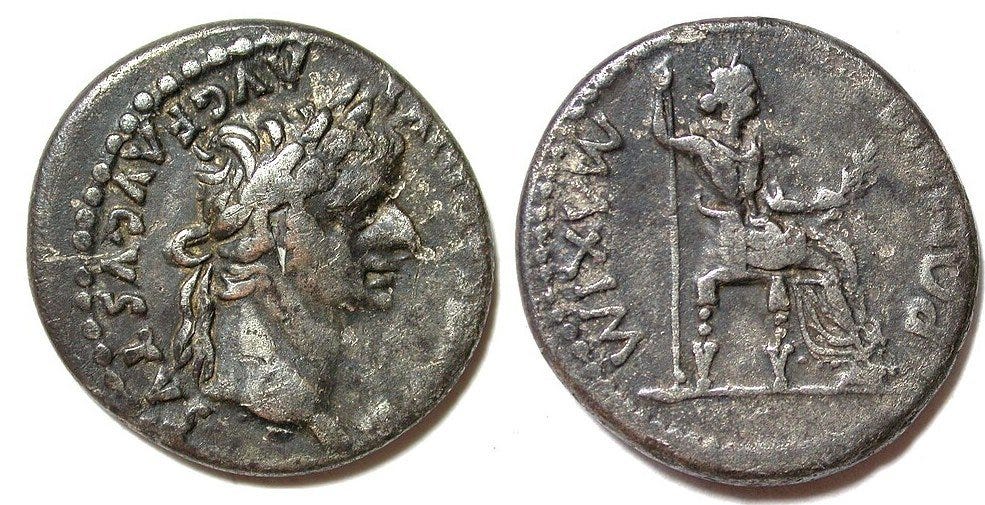
In today’s gospel, the Pharisees engage Jesus with bad intentions. They send some of their disciples, along with some Herodians, to Jesus to entrap him and bring about his downfall. The snare is set with a question about the census tax. After the establishment of Roman rule in the province of Judea, every Jew had to pay a tax to live at peace as a subject of Rome. The tax was a denarius, which amounted to a laborer’s full day’s wage, and it had to be rendered in Roman currency. In Jesus’s time, the common denarius coin was stamped with an image of the emperor Tiberius and the Latin inscription Tiberius Caesar Divi Augusti Filius Augustus (“Tiberius Caesar Augustus, son of the divine Augustus”) on one side and Pontifex Maximus (“High Priest”) on the other.
The Jews were not of one accord in their attitude toward the Roman tax. The Herodians were in power because they had Roman backing; it is no surprise that they favored the tax. Certain Jewish nationalist groups, in contrast, were of a more revolutionary mindset and opposed paying taxes to the Romans. Some had even been put to death by the Romans for refusing to pay the census tax. The Pharisees, therefore, think they have Jesus cornered: whether he answers yes or no, he will take a wrong step.
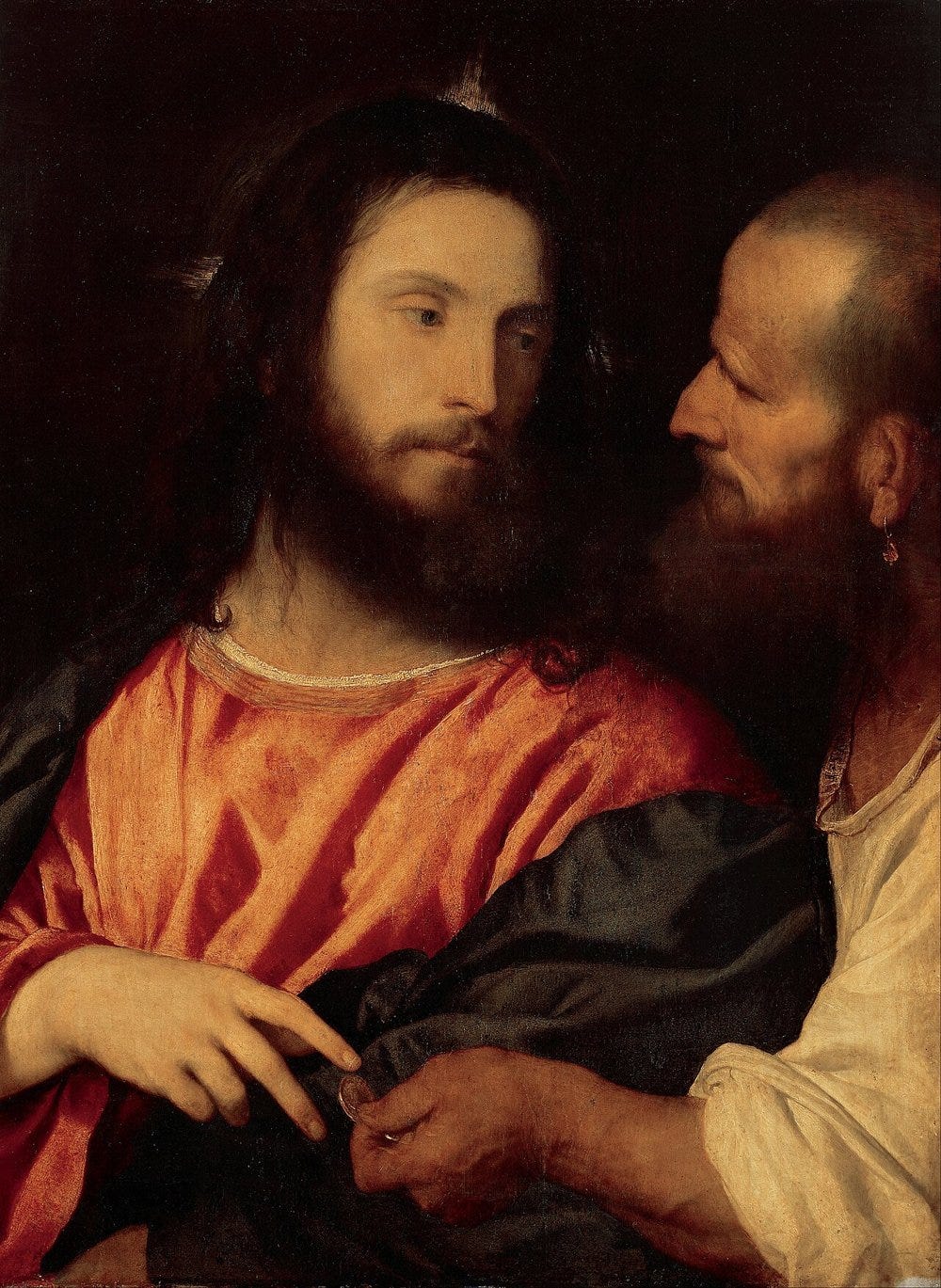
Jesus exposes the Pharisees’ hypocrisy and demands to see a coin. Coin in hand, he asks whose image it bears. When he is told, “Caesar’s,” he utters his famous words, “Then repay to Caesar what belongs to Caesar and to God what belongs to God” (Matthew 22:21).
On an immediate level, Jesus’s response allows him to evade the snare set for him; upon hearing his reply, the Pharisees’ disciples and the Herodians marvel and depart. Yet our Lord’s words contain much more, layers of meaning waiting to be unearthed. We must examine them carefully, in light of the whole of our Christian faith, because it is easy to misinterpret them.
A false interpretation would take the symmetry of the grammatical structure of Jesus’s teaching as a basis for thinking that Caesar and God are in symmetry—that is, as if God and Caesar could be placed alongside each other, on the same plane, each having his proper sphere that is independent of the other. If this were so, then we could set up a realm of Caesar and claim that it should be free from God’s influence; from there, we could construct political theories that would bar Christianity from the public sphere and relegate it to a curtailed private realm.
Scripture, and the Christian metaphysics that arises from it, gainsay this view. The opening chapters of the Book of Genesis teach us that God is the creator of all that is. Nothing exists that is not God’s; everything is under his power and governance. The New Testament reveals to us that all things are created through God’s Word, the eternal Son of the Father, who is the incarnate Lord Jesus Christ: “All things came to be through him, and without him nothing came to be” (John 1:3). We learn from St. Paul’s Letter to the Colossians that all things were made not only through the Son but also for him: “in him were created all things in heaven and on earth, the visible and the invisible, whether thrones or dominions or principalities or powers; all things were created through him and for him” (Colossians 1:16). All worldly power is ultimately under the authority of Christ, who is the beginning and the end, the Alpha and the Omega (Revelation 22:13). Jesus Christ is the King of the Universe—as we will celebrate in a few weeks on the last Sunday of Ordinary Time.
Thus, there are things that belong to God that do not belong to Caesar, but nothing that belongs to Caesar that does not also belong to God. This truth is demonstrated in today’s first reading from the Book of the Prophet Isaiah. Cyrus of Persia has come to power and defeated the Babylonians. It was the Babylonians, we may recall, who had previously destroyed Jerusalem and forced the Jews into exile. After his victory, Cyrus permits the Jews to return to their homeland. He even finances the rebuilding of their Temple. Isaiah interprets these actions through the eyes of God’s providence: though Cyrus does not know the Lord, Cyrus belongs to God, and it is the Lord who has acted through him. For, as God says through the prophet, “I am the Lord and there is no other, there is no God besides me.” The Book of Isaiah goes so far as to call Cyrus the Lord’s “anointed”—that is, the Messiah or the Christ. Cyrus was the most powerful man of his time. Yet all that belonged to Cyrus also belonged to God, for Cyrus himself belonged to God.
The ramifications of these truths for Christianity’s place in the political order are extensive. On a basic level, they show that Caesar is not God, whatever the inscription on the coin might say. We Christians must reject any attempt to find in the state our ultimate telos and meaning; we must oppose any attempt to divinize the state or a ruler.
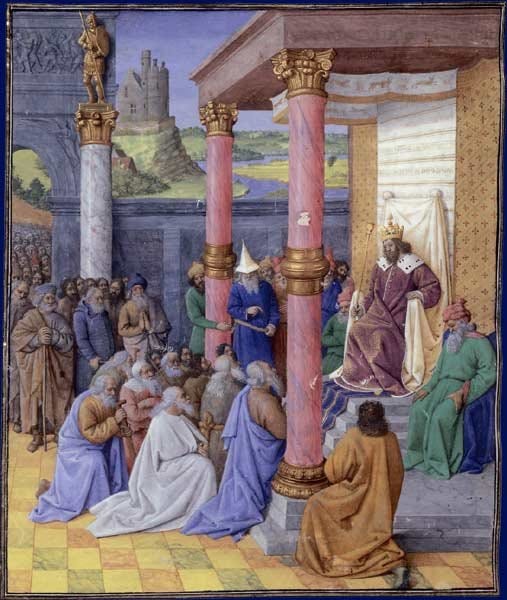
But if we stop there, we don’t go far enough. For, as we have seen, Caesar is not God, but he is God’s. Temporal rulers have real authority. But this authority does not come from themselves, nor ultimately from those whom they govern. It comes from God. Pope Leo XIII—from whose Catholic social and political doctrine we still have much to learn—explained this point lucidly, above all in his 1881 encyclical Diuturnum illud. As was recognized throughout Christendom in the long tradition of anointing the king or emperor, which was regarded as a quasi-sacramental rite, temporal authority is mediated from above.
There is much more one could say about the political consequences of all this. Instead of examining this further, however, I’d like to consider briefly what Jesus’s teaching means for our spiritual lives. A first point is that no part of our lives is “ours” in such a way that it is not God’s—as if I could set up certain domains of my life where I rule as an almighty Caesar and God is to have no place. Everything I am and possess comes from God and is to be put at the service of God. This also means that all those dark and broken corners of my life are not beyond God’s purview. He desires to enter with his light and healing into the back rooms I try to keep locked from him because of shame, embarrassment, or pain.
A second point is that if all reality belongs to God, the place in our lives where the Evil Spirit chiefly works is in those regions that do not have being—that is, in the domain of fantasy. This is an implication of the classical Christian idea that evil is a privation of the good. All being is good because all being belongs to God. The Evil Spirit, therefore, tries to take us away from reality into the realm of non-being, into a land of counterfactuals, what we can call “the Realm of the If.” We start thinking about how things could have been otherwise: If only that thing had not happened to me . . . If only I were smarter, richer, more beautiful . . . If only I did not have this illness . . . If only I had gotten that job . . . If only I had not made that mistake . . . If only this relationship were better . . . When we find ourselves spinning our wheels, stuck in the Realm of the If, wasting our precious energies and bending ourselves out of shape, let us ask for God’s help, make a small act of faith, and come back to reality. For all reality—no matter how mysterious and even painful it may seem to us—is God’s. Nothing has happened that God has not willed or permitted. All things, ultimately, are in his loving hand. For he is the Lord and there is no other, there is no God besides him.
Rev. Vincent L. Strand, S.J., is Assistant Professor in the School of Theology and Religious Studies at The Catholic University of America and Fellow of the Gibbons Institute.
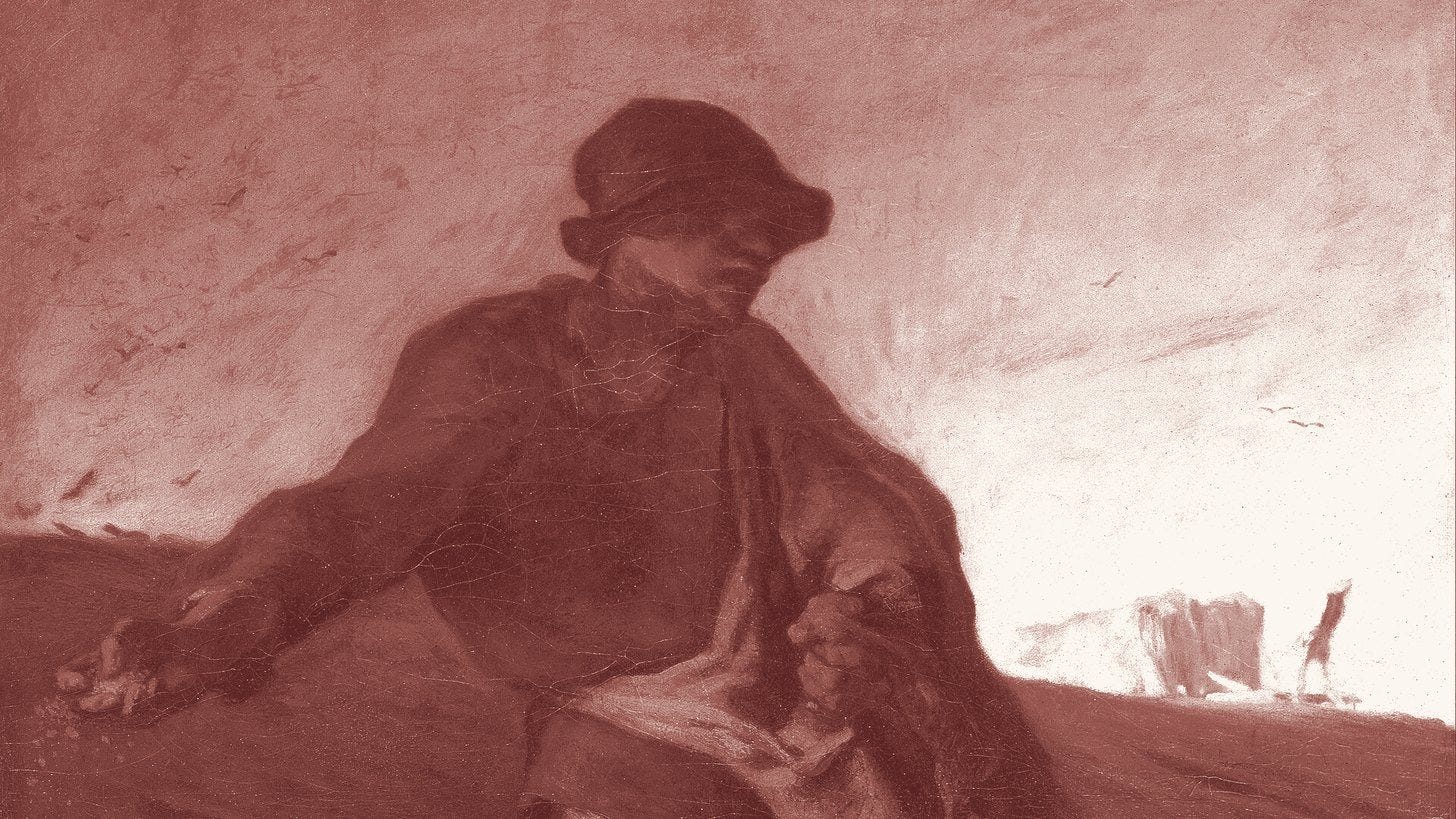
Cover: Jean-François Millet, The Sower (detail), 1850, Museum of Fine Arts, Boston; Wikimedia Commons.