



From the Editor
On the evening of October 3, 1226, as the light was leaving the Umbrian hills, Francis of Assisi died at the Portiuncula, the little chapel below the town that he counted his only home on earth.
The American Catholic Quarterly Review will mark the eight hundredth anniversary of his death with a week of writing on St. Francis, beginning today and running through Saturday, October 10—the eve of a second anniversary, which I will leave to a mathematician to explain on Monday.
The Review has done this before. When Leo XIII kept the seventh centenary of the saint’s birth with the encyclical Auspicato Concessum in September 1882, the Review answered in its next number, in January 1883, with a long essay on what Francis had done for the arts. We will republish that essay this week.
We begin with a genial essay by one of our associate editors, Joshua C. Benson, on Maurice Francis Egan’s Everybody’s St. Francis (1912), a life of the saint written before the garden statue and the “Peace Prayer” settled our picture of him.
Michael Pakaluk
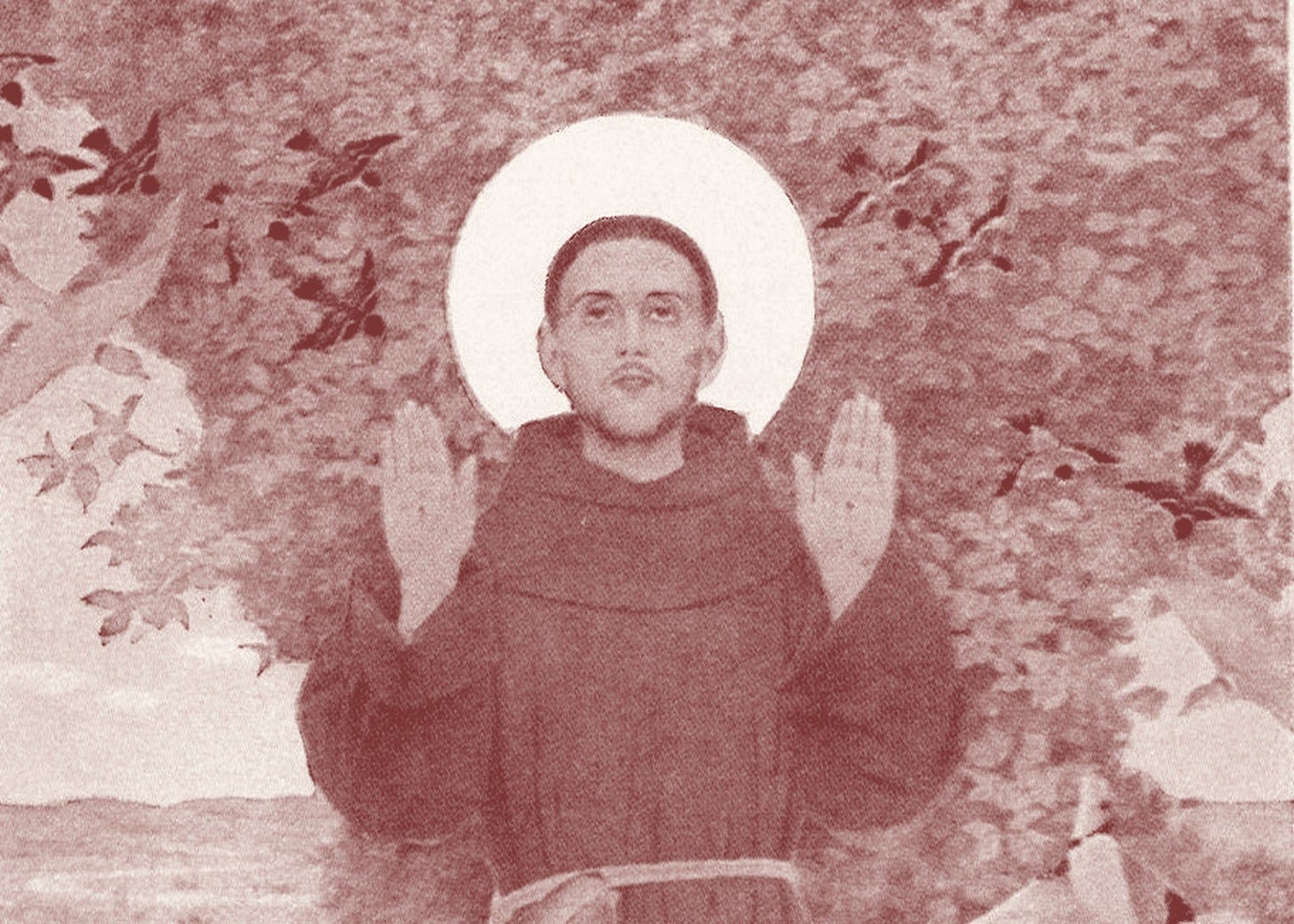
Everybody’s Francis
Maurice Francis Egan’s life of the saint, written before the garden statue and the “Peace Prayer”
Joshua C. Benson
As we approach the 800th anniversary of St. Francis of Assisi’s death—strictly the evening of October 3, but observed traditionally on October 4, on the principle that the next day began at sunset—it is right for this Review to pay tribute to Everybody’s St. Francis, a remarkable life of the saint by Maurice Francis Egan published in 1912. Though Egan’s name is little known today, he was an important American Catholic literary voice of the late nineteenth and early twentieth centuries, the very period when the ACQR flourished.
A gifted editor, prolific writer, and professor of English at Notre Dame and The Catholic University of America, Egan was also a close friend of Theodore Roosevelt and an accomplished statesman. As U.S. minister to Denmark (his title was “Envoy Extraordinary and Minister Plenipotentiary”), he helped broker the deal that made the Danish West Indies the United States Virgin Islands.¹
Egan was born in Philadelphia on May 24, 1852, to parents who prized education. They planted him in a world of letters and art at a young age, a world which became the rich soil for a life that would bear much fruit. Egan attended La Salle College and Georgetown. A sharp student, he studied law as a young man with his boyhood friend James Gibbons Huneker, who himself became one of the most important cultural critics of the early twentieth century.² In the 1870s and 1880s, he became a widely published Catholic author across a variety of venues. This led Egan into editorial work culminating in the editorship of the New York Freeman’s Journal, which he assumed on the death of its principal editor, the convert James A. McMaster.³
In 1888, the very year the cornerstone of Caldwell Hall was laid at Catholic University, Egan began his appointment at Notre Dame. Seven years later, in 1895, CUA, looking to bolster its offerings in English, wooed Egan away from South Bend. Egan taught at CUA until May 22, 1907, when he accepted Roosevelt’s offer to become minister to Denmark. While in that distinguished position, Egan, a longtime devotee of the Poor Man of Assisi, wrote in serialized form for the magazine Century the pages that would become Everybody’s St. Francis.
Egan’s fascination with Francis must have originated in his youth. In 1877 he published a poem in the Catholic World dedicated to Francis, which anticipates some of the themes of his later book, above all love: in Egan’s rendering, Francis’s Canticle bids the wind weave all creatures “of love.”⁴
O Love! you lay the volume by
That held you like a holy chime—
Life of St. Francis—with a sigh
Which says: “That was a pleasant time
In old Perugia’s mountain-town
On the Umbrian valley looking down—
Flushed like an Eden in sublime
Environment of mountains vast;
And do not you, as I, recall
What, morn and even, and first and last,
Attracted most of all?
The poem also shows that Dante influenced Egan’s approach to Francis. Indeed, he views Dante and Francis as the first two poets of the Italian tongue, as evidenced by the last stanza of the poem:
O Poet, who in faltering rhyme
First wove the Tuscan into song!
O poem and miracle sublime,
Thyself, in Dante sweet and strong!
To his fourth circle of Paradise,
To the King-splendor of the skies,
Dost thou, the elder seer, belong.
Thee “Sister Death” hath glorified;
And what an image we have won:
Through kindled mists of mountain-side,
Assisi in the sun!⁵
In a letter of 1892, cited by Brother Raymond Weitekamp, Egan reveals more about how he would later approach Francis.⁶ “The Lives of the Saints should be rewritten,” Egan explained, “because young people do not understand the blundering, cumbersome, foreign way in which they are generally presented. They lack ‘style,’ and no writer can teach young Americans in print without a knowledge of the art of the modern way of putting things.” He then noted that while a life of St. Francis published in 1870 by Margaret Oliphant may excel in its style, it “fails in an understanding of the mystical character of the saint. Francis d’Assisi was a poet, a man of genius, a hero and he did far more for the world than Columbus or George Washington.” One might imagine that Egan hoped to correct these perceived failings and even improve upon Oliphant’s modern style in his later work. The passage also makes clear that Egan was concerned that good literature on the saints be provided to Catholic youth.
Everybody’s St. Francis was clearly written for a more general audience, as its length and style show. This was a wise decision on Egan’s part, since two much larger works on Francis preceded his own. Paul Sabatier’s landmark study of Francis, first published in 1894, set a new standard for the discussion of St. Francis and began paving the way for what has since become known as the “Franciscan Question,” which has dominated scholarship since that time: How can a scholar access the historical Francis, who has been transmitted to us through so many different sources?⁷ Moreover, just as Egan was publishing his own work, Johannes Jørgensen’s Saint Francis of Assisi: A Biography was translated into English from Danish. Everybody’s St. Francis is not like either of these works, nor is it like Oliphant’s, which drew Egan’s criticism. Egan sought to write more simply, more briefly, and yet with clear attention to history and scholarship. Egan’s volume also distinguished itself from all other Francis texts before or since because it included tender, colorful illustrations by Louis-Maurice Boutet de Monvel, whose cycle of paintings on Joan of Arc is still displayed today at the National Gallery of Art.
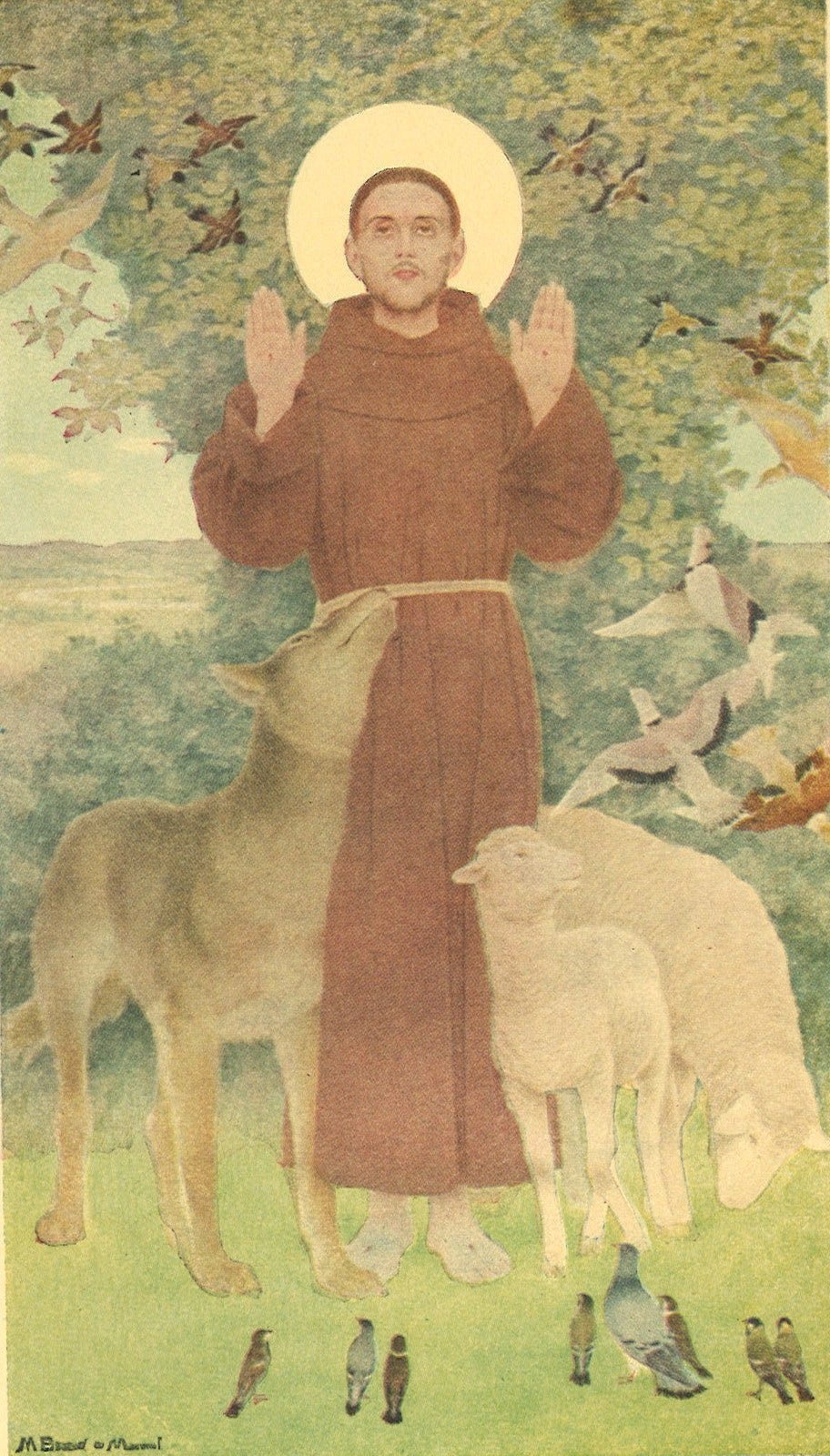
Egan, then, had to contend with earlier lives of Francis in order to make room for Everybody’s St. Francis. The precise moment of his composition also preceded significant developments that affect our own perception of Francis, though they did not influence his own perceptions or those of his readers. While Francis’s love of nature has always been lauded, our contemporary memory of Francis has certainly been shaped by St. Francis garden statues. These quaint renderings often depict Francis not merely as a serene contemplative to be lodged in our garden but also as a functional birdbath to cleanse its avian visitors. These statues started appearing in the 1920s, according to historian Patricia Appelbaum, but only reached mass-production levels a decade later.⁸ At about the same time, near the last centenary of Francis’s death, in 1926, the now much-loved “Peace Prayer” first appeared in English, having been published in a French magazine, La Clochette, in 1912.⁹ This prayer, which does so much to shape our thoughts about Francis, exists in no medieval manuscript or early printed edition. It is not an authentic text of the saint but an invention of the twentieth century. Along with the mass-produced garden statue, the prayer has contributed to the image of Francis the proto-hippie: tree-hugging and peace-loving. Franco Zeffirelli’s 1972 film Brother Sun, Sister Moon helped to cement that image, portraying Francis as a starry-eyed youth gazing longingly at fields of flowers and speaking breathlessly, sometimes to no one in particular.
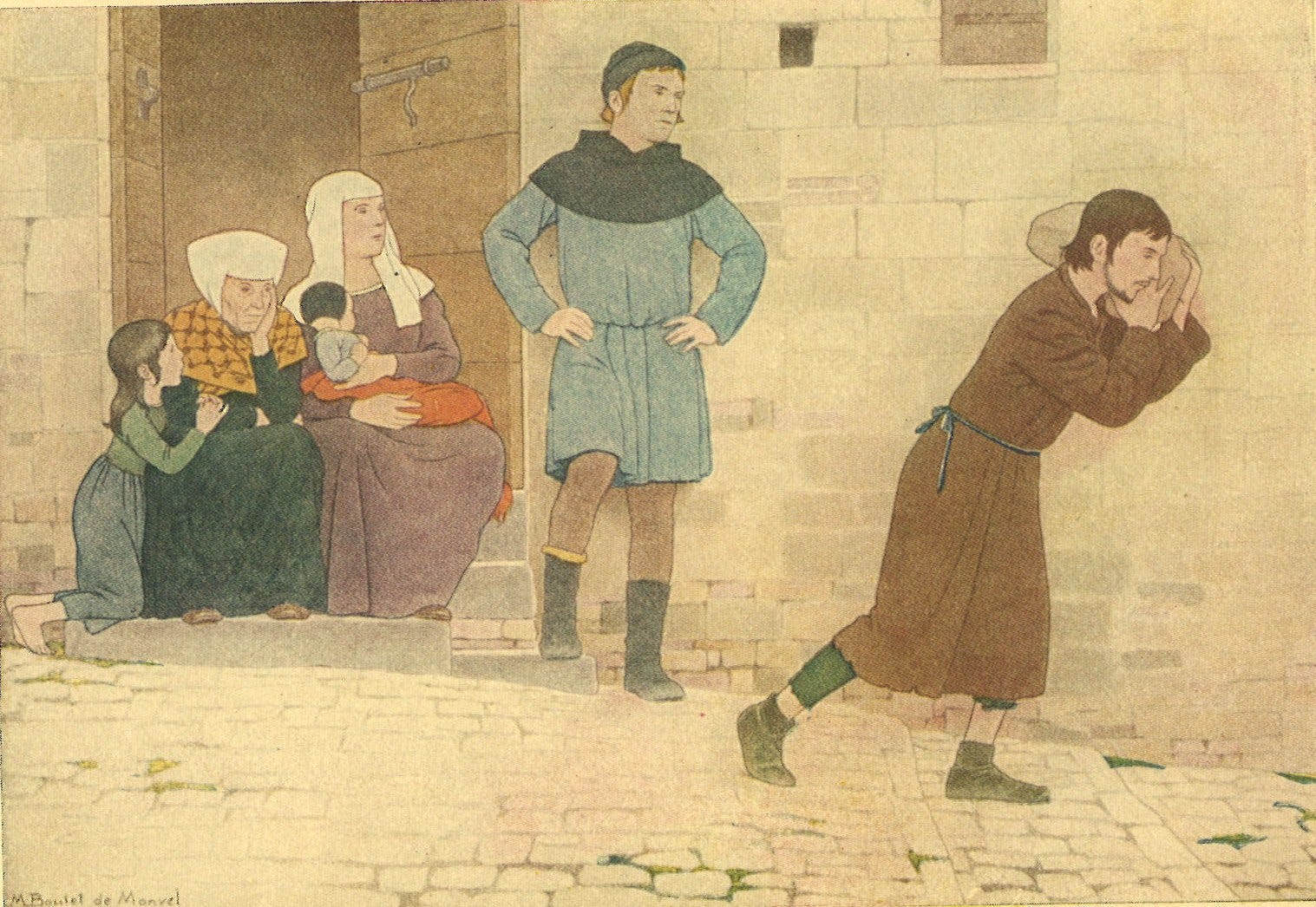
Egan writes in a world before any of this became the popular perception of the little poor man. His own portrayal begins with love, and love remains his consistent theme. At first glance one might suppose that such a Francis is but a variant of the proto-hippie. But the “Summer of Love” is not easily fitted to the love Egan describes in Francis. “The power of St. Francis of Assisi . . . over the Western world of his time, and over our hearts in our time, has been explained in many ways,” Egan writes in his opening paragraph. “But it has only one source and that is love. Love made him a poet; love made him a saint; love gave him life and fire and understanding and all the things that were added to him. Let us see if this is not true.”¹⁰
As his portrayal moves forward, Egan focuses on Francis’s specific love of poverty, a theme he could have absorbed from Dante (see Paradiso, Canto 11). In fact, Egan holds that we will find it hard to understand Francis’s commitment to poverty “unless we have something in our hearts that yearns to love as he loved.”¹¹ It is only our love of the same things that Francis loved that will enable us to understand the depth of Francis’s commitment to poverty. Egan even ties Francis’s love of nature to his love of poverty, for it is in having nothing that Francis can concentrate on the created world. Thus, not possessing books, he can tell his brothers “that created things were the best of all books.”¹² Egan concludes on the same page, “They [i.e., the brothers] must always be in sympathy with nature as well as with poverty.”
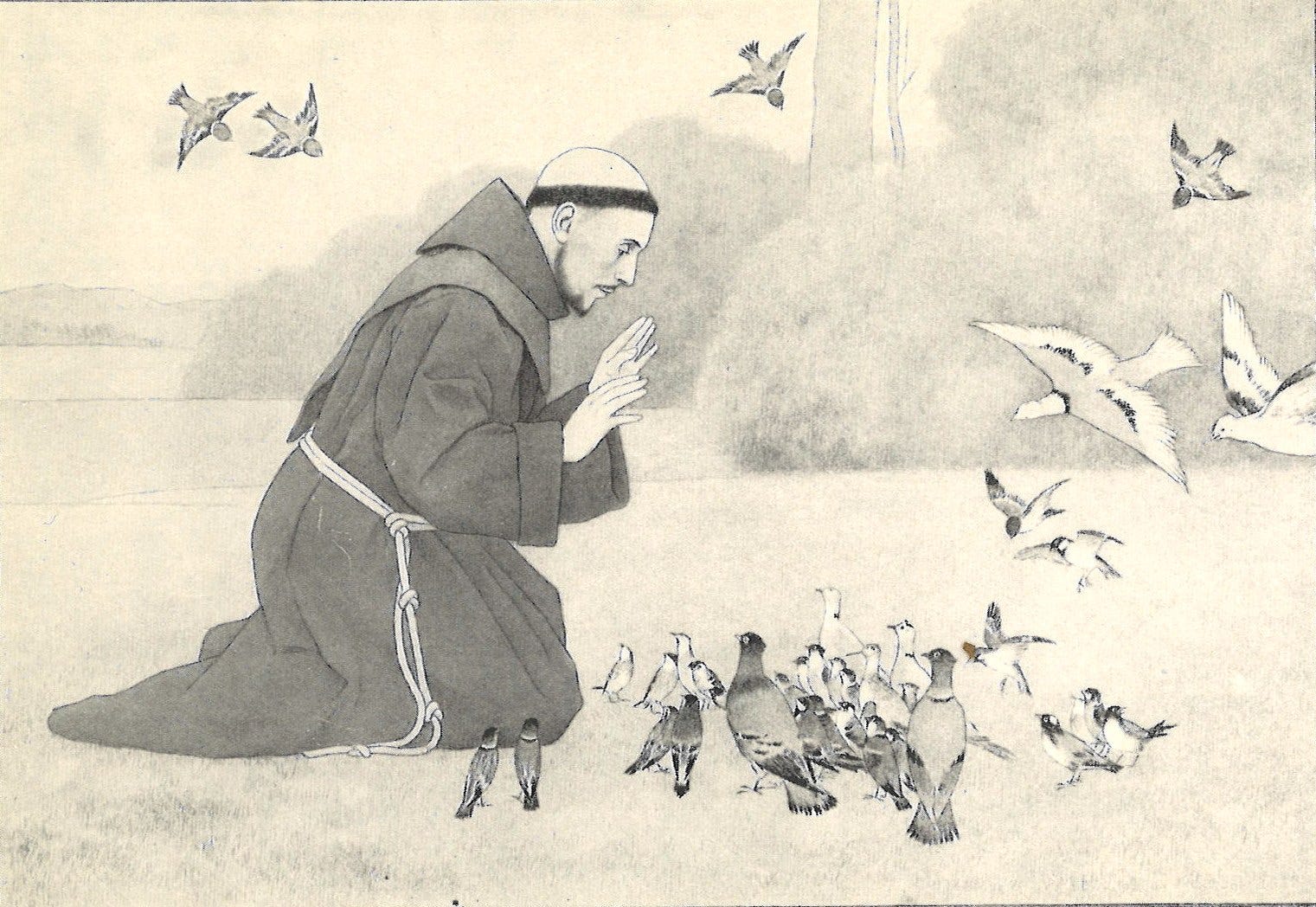
Egan links Francis’s miraculous hold over birds, other natural things, and even human hearts to his great love: “The mighty love in the heart of Francis drew all pure-hearted things to him . . . no sinner was hopeless in his eyes, and there was no sinner who might not be called brother.”¹³ His power was perhaps greatest, for Egan, over the heart of St. Clare, whose story he tells at length in connection with Francis. When Egan comes to the great miracle of the stigmata, he yields to the pens of Thomas of Celano and St. Bonaventure, but still he does not hold back his own judgment, that the stigmata flowed from Francis’s greatest love: his desire for union with Christ and his constant contemplation of Christ’s own wounds, which Christ himself “endured for love.”¹⁴
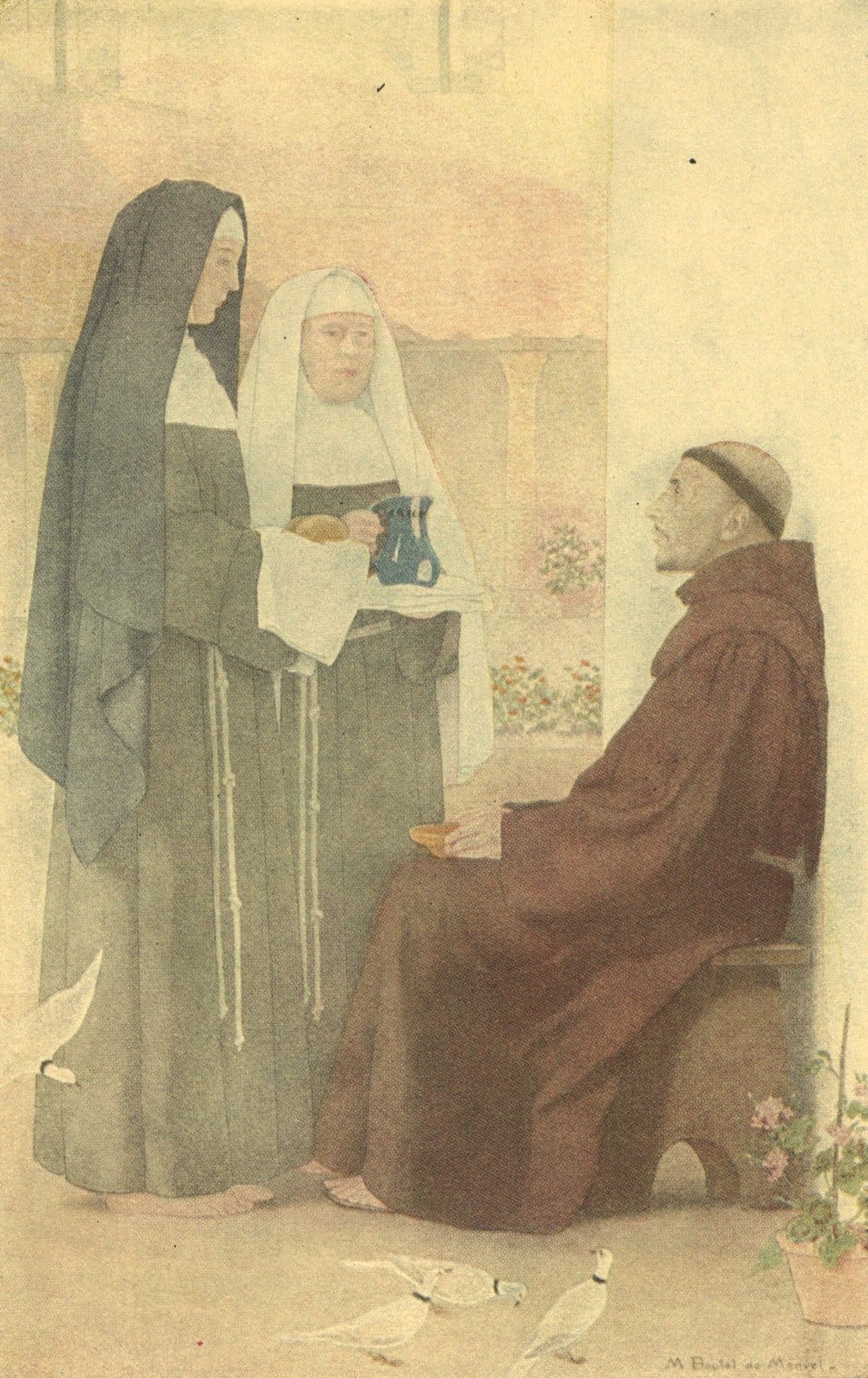
Egan’s life of Francis is well informed, its themes well chosen, its illustrations lovely, and its prose clear. Unfortunately for the legacy of Egan’s work, G. K. Chesterton would publish his own St. Francis of Assisi little more than a decade later, in 1923. The 114 years since the publication of Everybody’s St. Francis have also seen an explosion of research on “Il Poverello.” But none of this makes Egan’s work inadequate. To be sure, his text is a product of his moment. But each age since Francis’s death has rightly felt the pressing need to tell his story.
I myself have felt this need and have added to the vast sea of literature on this great saint.¹⁵ In part, this is because the telling of the lives of the saints is as important as Egan believed it was. Telling the stories of the saints reminds us that the Gospel can be followed, that God’s grace can and will come to us in wonderful, unexpected ways, because the Holy Spirit is at work in time. We must keep writing about the saints: I mean, not simply biographies, stories that tell the facts of their lives. No, we must learn again to write genuine hagiographies—stories that show the saints themselves as living exegeses of the sacred page, and that invite us to assume the risk of the Gospel with them. Maurice Francis Egan understood this need in his own way.
There is an interesting symmetry between Egan’s portrayal of Francis and his comments about his own life in his memoir, Recollections of a Happy Life. At the book’s end (p. 367), Egan reflects in these words:
If I had my life to go over again, I should never worry about anything that might happen—during my long life the things that I worried about never happened, and the things to which I gave no unhappy thought always happened. I should like to say, too, for the benefit of the young, that when one is old, one regrets not the sins one has committed so much as the good deeds one might have performed. As a Christian, I trust that I can leave my sins to Christ, who is more merciful than man; but I can never forgive myself for not having been keener to discover means of helping others. It may be considered sentimental to say or to repeat what is often said—that the only treasure for the old is the love of one’s family and one’s friends . . . I still feel that it is love which gives me the will to live and the will to live really means living.
Egan, writing in 1924 as an aging man, had absorbed the lessons of the two Italian poets he had praised in 1877. All his work and his high thoughts had come to completion, his will and desires turned by the Love that moves the sun and the other stars (Dante, Paradiso, 33.142–145). We remember him now with gratitude, understanding his zeal, because we love too the saint whom he loved.
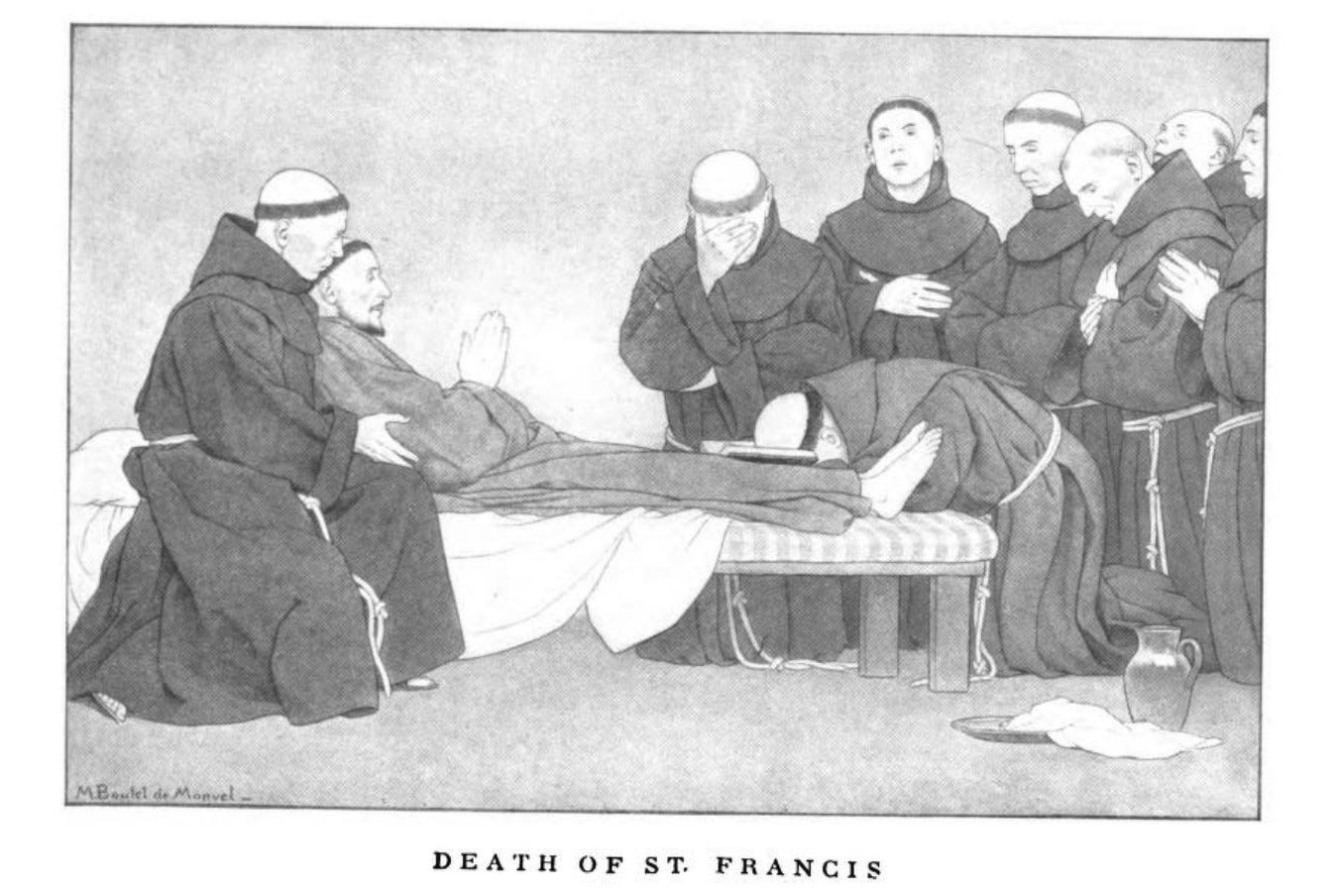
Egan’s poem “St. Francis of Assisi” will appear in full in a companion post on Sunday.
Notes
1. On Egan, see his own Recollections of a Happy Life (New York: George H. Doran Company, 1924). For a biography of Egan, see the dissertation of Brother Raymond Weitekamp, F.S.C., “Maurice Francis Egan: Writer, Teacher, and Diplomat 1852–1924,” The Catholic University of America, 1962. More briefly, see David Jayne Hill, “Commemorative Tribute to Maurice Francis Egan,” American Academy of Arts and Letters, 1924.
2. On Huneker, see Arnold T. Schwab, James Gibbons Huneker: Critic of the Seven Arts (Stanford: Stanford University Press, 1963). Huneker’s name is no accident—his mother was related to James Cardinal Gibbons. He largely left Catholicism behind in later life, but it was the soil out of which he grew with Egan.
3. On McMaster, one could consult another CUA dissertation, this one published by the press. See Sister Mary Augustine Kwitchen, O.S.F., James Alphonsus McMaster: A Study in American Thought (Washington, D.C.: The Catholic University of America Press, 1949).
4. Weitekamp notes the poem (p. 5). The poem may be found in Catholic World 25 (April 1877): 11–14. Weitekamp seems to report that the poem in the Catholic World was a translation of, perhaps, the Canticle of the Creatures. In fact, the poem is an original work of Egan, as Weitekamp acknowledges in the bibliography to his dissertation (p. 354).
5. “St. Francis of Assisi,” 14.
6. Weitekamp (p. 37). I have not been able to access the full letter.
7. On this see Augustine Thompson, Francis of Assisi: A New Biography (Ithaca: Cornell University Press, 2012), “On the ‘Franciscan Question,’” 153–170.
8. Patricia Appelbaum, St. Francis of America: How a Thirteenth-Century Friar Became America’s Most Popular Saint (Chapel Hill: University of North Carolina Press, 2015), 78–88.
9. Appelbaum, 70–72.
10. Egan, 3.
11. Egan, 96.
12. Egan, 97.
13. Egan, 109.
14. Egan, 127, 176.
15. Joshua C. Benson, Francis of Assisi: A Meditation on His Life and Writings (New York: Paulist, 2024).
Joshua C. Benson, an associate editor of the American Catholic Quarterly Review, teaches in the School of Theology and Religious Studies at The Catholic University of America. He is the author of Francis of Assisi: A Meditation on His Life and Writings (Paulist, 2024).