


By Michael Lucchese
“Many of our men of speculation, instead of exploding general prejudices, employ their sagacity to discover the latent wisdom which prevails in them.” — Edmund Burke, Reflections on the Revolution in France (1790)
John Locke has sometimes been revered as “America’s philosopher.” Widely read among our Founders, the seventeenth-century Englishman’s ideas about human nature, society, and government were in the air during the Revolution. His fingerprints, it is thought, may be detected in the Declaration of Independence itself, especially the ringing phrases about “life, liberty, and the pursuit of happiness.” The rousing assertion that “all men are created equal” has even become a slogan for a host of egalitarian political movements, successors in one way or another to the liberal ideology Locke, in some sense, founded.
And yet, even in this semiquincentennial celebration of our national independence, the Lockean account of the Founding leaves many dissatisfied. Rather than find the Declaration’s call to equality inspiring, critics of the Republic find the idea that American liberalism somehow “lowered the aims” of political life unsettling. Our social contract lies in tatters; rank individualism has led to an epidemic of loneliness; Americans’ faith in government institutions is at an all-time low. It is perhaps understandable why some have come to believe that liberalism has failed and the American Republic is in need of “regime change.”
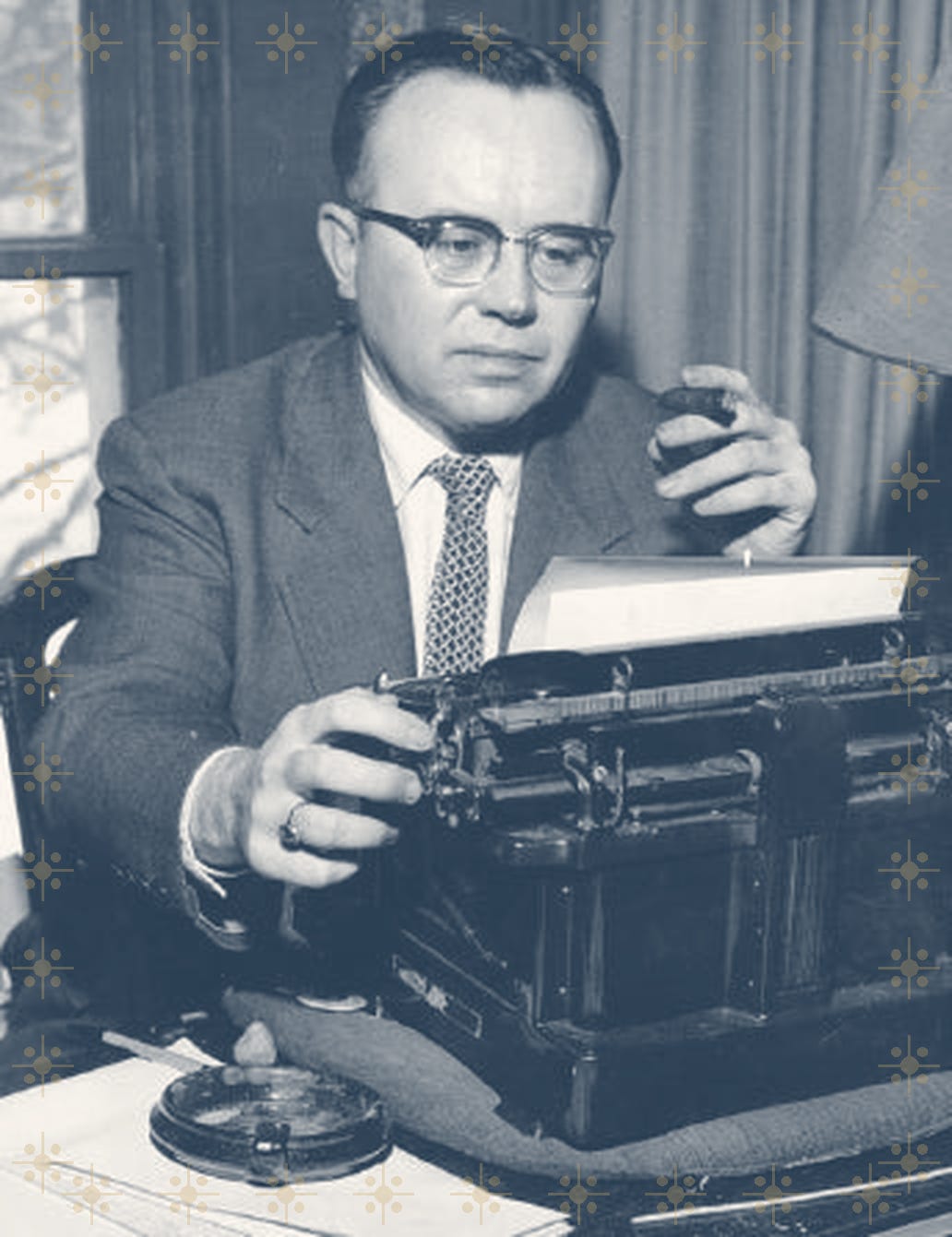
One figure who would counsel against this despair is Orestes Brownson, among the nineteenth century’s greatest American men of letters. Rather than identifying the American Founding with a morally vacuous liberal ideology, he sought to uncover the deeper roots of our republican institutions and articulate an unwritten constitution supporting our political tradition. Especially in his 1865 magnum opus, The American Republic, Brownson demonstrated that the Union was something more than a Lockean social contract — he believed that Americans were blessed by what he called a “providential constitution.” Recovering Brownson’s wisdom will not only provide a patriotic answer to those discontented with liberalism, but also help us understand the true meaning of the American political tradition.
It is true that one must caution against overstating Locke’s influence on the Founding. As Russell Kirk put it in The Roots of American Order, “Locke has an eminent part in the American political mind, true, but he is no monarch in that realm.” Other historians, such as Donald Lutz and Forrest McDonald, have demonstrated that the Founders may have taken a rhetoric of revolution from his Second Treatise, but they looked to other sources of inspiration for actually constituting the American Republic. References to the Baron de Montesquieu, common law, and even the Bible came to the Framers’ lips far more readily than to Locke. Neither the Continental Congress nor the Philadelphia Convention acted as though the Second Treatise was a roadmap for creating a republic; other luminaries lit the way for them.
All the same, it is important to understand just how radical Locke’s ideas were — and how those who embraced them sapped away strength from the tradition upon which the Founders drew. In his 1953 book Natural Right and History, Leo Strauss uncovered how “his whole political philosophy” is “revolutionary not only with regard to the biblical tradition but with regard to the philosophic tradition as well.” Whereas the foundational figures of Western civilization, from Cicero to Richard Hooker, defended natural law and mankind’s duties, Locke embraced a modern shift away from this tradition. “Through the shift of emphasis from natural duties or obligations to natural rights, the individual, the ego, had become the center and origin of the moral world,” Strauss wrote, “since man — as distinguished from man’s end — had become that center or origin.” Motives which the ancients considered vicious, like greed and self-interest, were recast in liberal ideology as natural to us and even good.
Nowhere is this radicalism more apparent than in Locke’s description of political community as a “social contract.” In The Roots of American Order, Kirk contrasted his theory with the account found in biblical texts. “Locke’s emphasis upon primitive freedom endangers that spiritual continuity which we call human society,” he wrote. “There is no warmth in Locke, and no sense of consecration … Utility, not love, is the motive of Locke’s individualism. Locke’s isolated individual, a kind of social atom, has the possibility of life, of liberty, of property. But what sort of life, and liberty for what?” As Strauss put it earlier, Lockean liberalism and the vicious acquisitiveness it unleashed reduced “Life [to] the joyless quest for joy.” Untethered from tradition, the subjects of liberalism are cast out into the waste land to seek meaning for themselves.
In the nineteenth century, Orestes Brownson felt the pain of this situation deeply. Born to a Calvinist family in Vermont, Brownson was left profoundly unsettled by the intellectual and religious ferment of antebellum New England. Filled with inner doubts, Brownson would leap between religious traditions and political ideologies, adopting more and more radical positions, including Universalism and Transcendentalism. By the mid-1840s, however, he converted and regarded himself as settled within the Roman Catholic Church. Even if Brownson’s mature Catholicism was paired with a sometimes-intense sectarianism, not unusual for strong-minded converts, which conservatives might be wary of imitating today, one can still admire his search for a fundamental source of authority and stability, which he believed the American Republic required.

Like today’s critics of liberalism, Brownson always attributed his spiritual unease to the climate caused by ideology. “The great misfortune of modern liberalism is,” he wrote in an 1864 essay, “that it was begotten of impatience and born of a reaction against the tyranny and oppression, the licentiousness and despotism of governments and the governing classes; and it is more disposed to hate than to love, and is abler to destroy than to build up.” For Brownson, individualistic, revolutionary liberalism was a kind of political madness because it undermined the moral core of a just society. As an ideological habit of mind, liberalism discouraged citizens from understanding the common good in light of the highest good — communion with God — thereby “taking from law its sacredness, and authority its inviolability.”
It is important to note, though, that Brownson did not view liberal ideology as an inevitable consequence of the American political tradition. In the introduction to his splendid anthology of his writings, Richard Reinsch has observed that “The trajectory of Brownson’s mind, in many respects, had always been a rejection of modern political notions of self-interest, individualism, the social contract, and the belief that theory or reason operating apart from history, tradition, settlement, religion, and language, among other particulars would found an enduring polity.” Rather, as R.A. Herrera points out in his own biography of the man, “Brownson aspired to emulate the Founding Fathers” and saw their republicanism as a rejection of modern liberal speculation. “The statesmen of 1787 did not attempt to destroy or deface the work of Providence, but accepted it, and went on to organize the government in harmony with the real order,” according to Brownson — he understood that they were realists, not theorists.
Brownson therefore did not call for “regime change” to remake the American Republic according to Catholic political principles. Instead, he set it as his task to articulate the true meaning of the Founders’ Constitution, shorn of liberal ideology. “Of all conceivable states, the American state is the most complex, the most mysterious, and demands the most intelligence, the most study, the most thorough mental discipline for its scientific understanding,” he wrote in one essay. “No people ever had greater need than we of the profoundest political philosophy.” As a public writer, Brownson’s aim was to help the American people see beyond what he called “mere abstractions.” “A state, a real state, is a mysterious existence,” he wrote in the aforementioned essay. “It is not a voluntary association, a collection, or an aggregation of individuals, with no existence, no life, no activity, except what it derives from them.”
Brownson’s chief contribution to that political philosophy was his American Republic. Written in the wake of the Civil War — in which he tragically lost two of his sons — the treatise was an attempt to express the genius of the American Founding and defend the true basis of the Union for which so much had been sacrificed. Although the text is somewhat obscure today, it is a ringing achievement and a bracing tonic for those discontented with the simplifications of liberalism.
In the early chapters of the book, Brownson addressed several major theories about the origins of government, including the Lockean notion of the social contract. While he acknowledged that many of the West’s thinkers spoke of some kind of social compact, he denied that they “ever held that government has only a conventional origin or authority.” The analogy was only meant to clarify “the reciprocal rights and duties of governors and the governed.” Social contract theorists such as Locke, as well as his predecessor Thomas Hobbes and his successor Jean-Jacques Rousseau, “have abused the phrase,” stripping it of its moral content.
The most absurd element of social contract theory was the antecedent idea of the “state of nature.” Liberal theorists, he argued, “deceive themselves by transporting into their imaginary state of nature the views, habits, and capacities of the civilized man.” The Lockean myth has no correspondence with the actual history of humanity. “Man in civil society is not out of nature, but is in it — is in his most natural state; for society is natural to him, and government is natural to society, and in some form inseparable from it,” Brownson held. “The state of nature under the natural law is not, as a separate state, an actual state, and never was.”
Yet his rejecting the social contract theorists’ mythological origins of government did not mean Brownson rejected the Declaration of Independence’s principle of equality, nor the concept of universal rights. Instead, he asserted that the vision of equality at the heart of the Founding was derived from an honest appraisal of the human condition. “Man is not God, independent, self-existing, and self-sufficing. He is dependent not only on his Maker, but on his fellow-men, on society, and even on nature, or the material world,” Brownson wrote. “The right of that on which man depends, and by communion with which he lives, limits his own right over himself.”
Brownson went on to articulate an alternative theory of the social contract and popular sovereignty, rooted not in the speculations of seventeenth- and eighteenth-century liberals, but in the reasoning of the Church Fathers:
“The people, holding their authority from God, hold it not as an inherent right, but as a trust from Him, and are accountable to Him for it. It is not their own. If it were their own they might do with it as they pleased, and no one would have any right to call them to an account; but holding it as a trust from God, they are under his law, and bound to exercise it as that law prescribes. Civil rulers, holding their authority from God through the people, are accountable for it both to Him and to them. If they abuse it they are justiciable by the people and punishable by God himself.”
By placing the republic “under God,” as it were, Brownson found a more secure guarantee against oppression than the centralizing tendencies of liberal ideology. “Religion is brought to the aid of the state, not indeed as a foreign auxiliary,” he wrote, “but as integral in the political order itself.” Where liberals sought to tear them asunder, Brownson sought to unite Christian faith and republican liberty, because he understood that among the best guards against unlimited power is religious belief.
That notion of course had many precedents in the American political tradition. In Federalist 48, for example, Publius notes that “a mere demarkation on parchment of the constitutional limits of the several departments, is not a sufficient guard against those encroachments which lead to a tyrannical concentration of all the powers of government in the same hands.” And in his Farewell Address, coauthored with the minds behind The Federalist, George Washington famously observed that “Of all the dispositions and habits which lead to political prosperity, religion and morality are indispensable supports.” Brownson agreed completely: though he loved the written US Constitution, he also wrote of the need to acknowledge the unwritten or “providential” constitution of society as a moral check against centralizing power. He defined this providential constitution as “the source of the vitality of the state, that which controls or governs its action, and determines its destiny,” bound up with the religious and cultural assumptions undergirding republican liberty.
Brownson, of course, was drawing on the Founders’ own insights about the providential character of the American constitution. In Federalist 2, for instance, Publius takes notice of the ways “that Providence has been pleased to give this one connected country, to one united people … an inheritance so proper and convenient for a band of brethren, united to each other by the strongest ties, should never be split into a number of unsocial, jealous and alien sovereignties.” And in Federalist 37, he even claims to perceive, with “astonishment,” in the deliberations of the Constitutional Convention “a finger of that Almighty Hand, which has been so frequently and signally extended to our relief in the critical stages of the revolution.” An “ingenious theorist” may have derived a more abstractly perfect constitution “in his closet, or in his imagination,” and yet the Convention “surmounted” so many disagreements and difficulties with incredible unanimity to produce a functioning frame of government that could be ratified by the whole people.
Borrowing a phrase from the rising British statesman Benjamin Disraeli, and echoing Publius in the aforementioned papers, Brownson argued that the “providential constitution” could only be expressed in a “territorial democracy.” Unlike the social contract of Locke, in which natural rights are an abstraction or even a fiction, a “territorial democracy” roots authority and liberty in a real people and a real place. Richard Reinsch and Peter Lawler summarized Brownson’s view nicely: “Citizens’ occupying a particular part of the world, joined together by borders, law, and defined accountability of rulers to ruled — this is what makes republican government possible.” Only by the light of the particular might we understand the universal.
For Brownson, then, these questions about the nature and meaning of republican liberty were anything but academic. The American Republic was written in the aftermath of a crisis — the bloodiest war in our nation’s history — which Brownson believed emerged because radicals embraced ideological theories at odds with the Constitution. As he put it in an 1873 essay:
“The people have forgotten its providential origin, treat it as their own creature, as a thing they have made, and may alter or unmake at their pleasure. It is not a law enjoined on them, and has no hold on their conscience. They give it a purely democratic interpretation. Men talk of loyalty, but men cannot be loyal to what is below them and dependent on their breath; and, therefore, they violate it without compunction, as often as prompted to do so by their interests or their passions.”
The cataclysm of secession came about because antebellum political radicalism — as expressed by both fire-eaters and abolitionists alike — sapped away the loyalty to America’s providential constitution necessary for our us, through our free institutions, to reach accord. Brownson maintained that slavery was a wicked contradiction of the Declaration of Independence’s principles. In the heat of the controversy over it, though, self-interested demagogues exploited political enthusiasm, and the nation itself was turned into a powder-keg. Rationalistic Lockean theory was by no means strong enough to rescue the country from this crisis.
Brownson had a complicated relationship with Abraham Lincoln, the man who arguably did the most to save the Union. He disagreed with his exercise of war powers and certain of his constitutional interpretations. But no statesman expressed the providential constitution of the American Republic so profoundly as Lincoln. Like Brownson, he ultimately found the cold theory of the social contract altogether insufficient. In its place, Lincoln asserted with Brownson that the true patriot’s loyalty must be placed in the eternal contract of society. As he put it at Gettysburg, we the living must “be dedicated here to the unfinished work which they who fought here have thus far so nobly advanced” and ensure “that this nation, under God, shall have a new birth of freedom — and that government of the people, by the people, for the people, shall not perish from the earth.”
The last full measure of devotion is owed by all true patriots, in one form or another, as Justice Thomas has recently observed, but no one gives up his life for a mere contract.

This essay was adapted from remarks delivered at the Catholic University of America’s “Orestes Brownson and the Mission of America” conference in the spring of 2026. Its author serves on the board of the Orestes Brownson Studies Foundation, which co-sponsored the event.
Michael Lucchese is the founder of Pipe Creek Consulting, an associate editor of Law & Liberty, and a contributing editor to Providence.
The Founding Fathers did reference John Locke as well as Algernon Sidney, and use Montesquieu's "The Spirit of Laws" as a handbook for government, but evidently through George Mason whom circumstantial evidence suggests was familiar with the writings of St. Robert Cardinal Bellarmine in response to King James's I assertion of Divine Right, also incorporated "Catholic" (i.e., Aristotelian-Thomist natural law) principles in the Declaration of Independence and Constitution. Brownson was clearly aware of this, and incorporated Bellarmine's theories in "The American Republic" although he made the same mistake Bellarmine did that was not corrected until the pontificate of Pius XI with the definition of a particular act of social justice, at which time Pius XI beatified Bellarmine, canonized him, and named him a Doctor of the Church, all within the space of a few years. (The error was to assert God grants certain rights to the collective, an abstraction created by man, which is impossible as God is omniscient and does not abstract; it would therefore be a contradiction — an imperfection in a Perfect Being — for God to grant rights to an abstract human creation.)