


by Peter Ulrickson
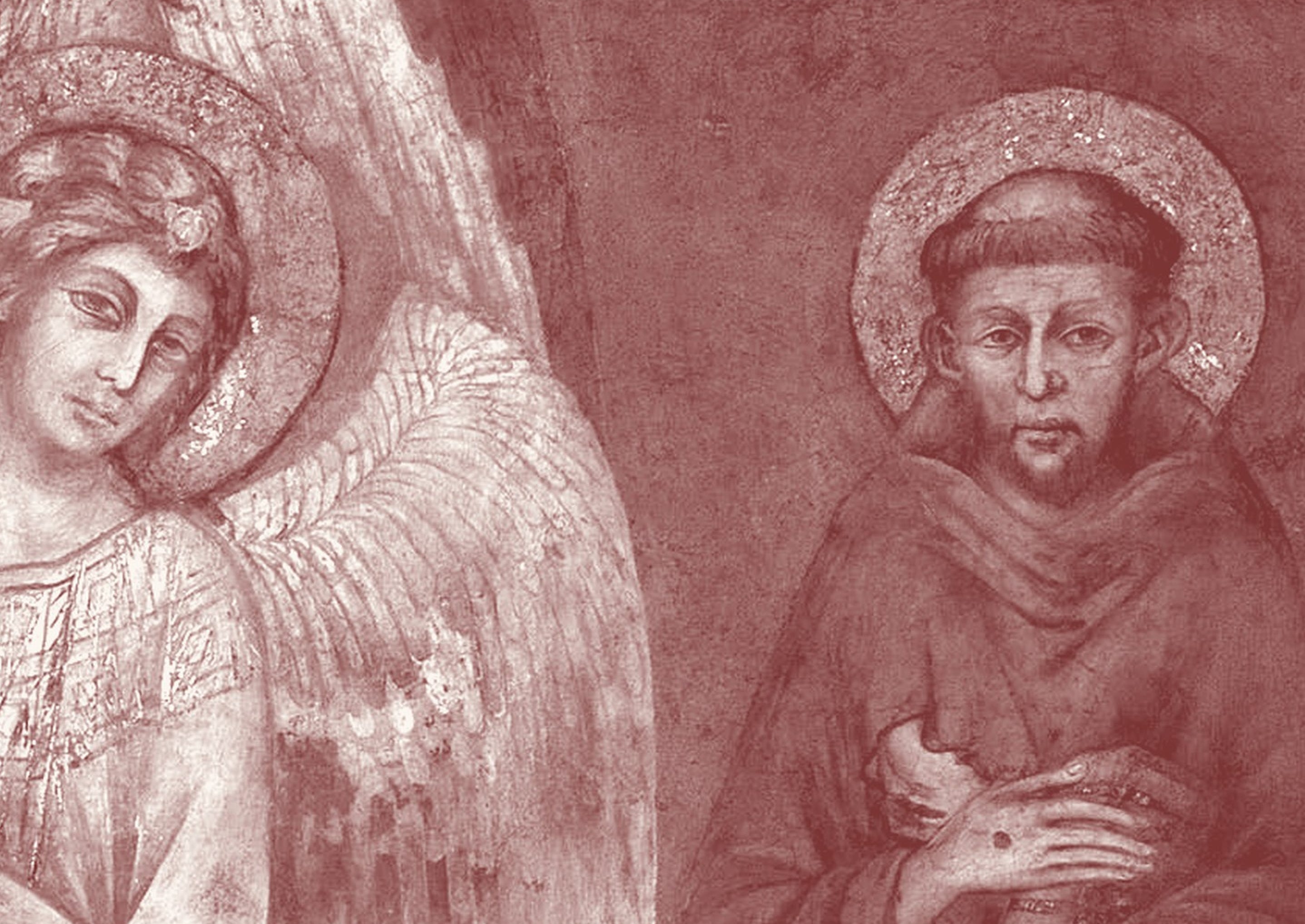
St. Francis has been celebrated in many ways over the last few years. In short succession, we have witnessed the anniversaries of the Nativity at Greccio, the reception of the Stigmata, and the composition of the Canticle of Creatures. Now, as summer turns to fall in the year of Our Lord 2026, there is one last Franciscan 800: the 800th anniversary of the passage of Francis into eternal life.
That passage was celebrated in many places, above all in Assisi, on October 4, the day before this publication appears. Despite the fact that October 4, 2026, already lies in the past, the 800th anniversary of Francis’s passing is still to come. In the perennial puzzle of being and seeming, this essay appears to be late, but is, naturally, still early.
William Henry Draper paraphrased the Canticle of Creatures for the English world in “All Creatures of Our God and King.” “Thou burning Sun,” he writes, “with golden beam… praise Him.” Without denigrating Draper’s work in any way, I would like to begin by drawing attention to the difference between his phrasing and St. Francis’s. For Draper, we speak to the Sun, exhorting it to praise a Divinity who stands at the grammatical remove of the third person. Francis, on the other hand, addresses himself directly to God.
When Francis, gazing on the heavens, praises God, he speaks of “messor lo frate Sole.” That “frate,” Brother Sun, is surely at the heart of the Francis of popular legend. Here is someone who sees Nature in warm and familiar terms. Due attention, however, should also be given to “messor,” an Umbrian cousin of the French “monsieur.” The Sun is not just Brother Sun but My Lord Brother Sun. Familiarity stands with respect.
Respect means looking again—re-spicere. A person worthy of our respect gets a second glance when entering the room. When we corral a gaggle of elementary schoolers, we hope even for a single look. We want to be respected: “Hey! Look at me.” Let us join Francis in considering the Sun as worthy of our respect, by looking again at the word “year,” for the true year is not the product of human conventions but rather the work of our Brother above.
You could stop here and look up a specific decimal number for the length of the year (more specifically, the “tropical year”) when measured in days.1 Let us ignore that number for a moment, though, and think simply about the things that we can see with our own eyes. In summer, the sun climbs high in the sky and the days are long. In winter, the midday sun is low, and evening falls too soon. When the cycle of seasons runs its course a single time, we say that a year has passed.
That coarse description lets us talk about “roughly a year.” In a very primitive society, it would be difficult to distinguish between 365, 365.2, 365.25, and 365.24 days as measures of the “true” length of the year. How do we get from “roughly” to “exactly”? The way to do this is to consider long periods of time, not single years but scores of them. Take a culture that is slightly more refined, and suppose that its members can do two things. One is to keep accurate records over a century, and the other is to pick out the day in the summer when the sun achieves its highest midday elevation. That is called the summer solstice.
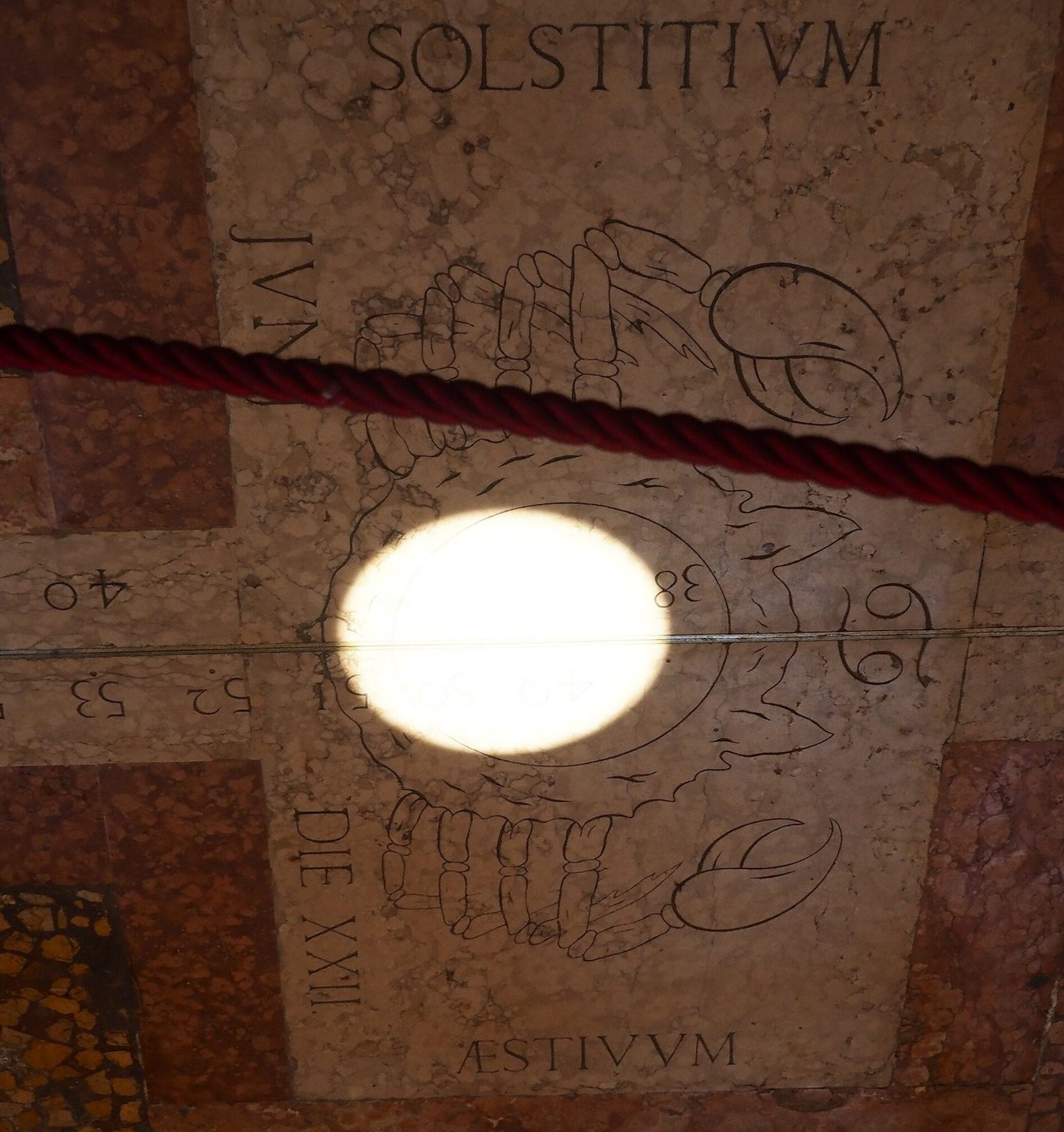
We can imagine recreating a society like that, even if all our technology were to crumble and accumulated scientific knowledge were to disappear. After a few generations, this society arrives at 100 years of keeping records. Its members find that a certain number of whole days have passed between one summer solstice and one 100 years later. That number is 36,524. It is important that this is a whole number. We are presuming the capacity to count days, but not supposing that we have accurate clocks, or indeed any clocks at all. And we are not supposing that we can track down the “exact” time of the solstice (which is a moment rather than a day) but just the day that it occurs.
By taking a long period of 100 years, we are able to overcome the poverty of our instrumentation. Little bits of uncertainty are rendered moot by a large denominator. We found that there were 36,524 days in 100 years, so dividing gives us 365.24 days in a single year.
Julius Caesar introduced a calendar in 45 BC, with leap years occurring every fourth year. This means that four consecutive calendar years have 365, 365, 365, and then 366 days, for a total of 1,461 days in 4 years. Dividing 1,461 by 4, we see that the Julian calendar approximates the true solar year as 365.25 days.
What happens when a calendar’s approximation of the solar year does not correspond exactly to the real thing? Here are two extreme cases that illustrate the results. Suppose that we chose to make a calendar of twelve 30-day months, so that there were 360 calendar days in one calendar year. If the summer solstice happened on June 20 one year, it would occur around June 25 the next year, since 5 days would remain in the solar year after the passage of a single calendar year. Suppose, on the other hand, that we make an overestimate, with a calendar containing twelve 31-day months. Then, by the time we get back to June 20 on the calendar, the solstice is already seven days (372 − 365) in the past.
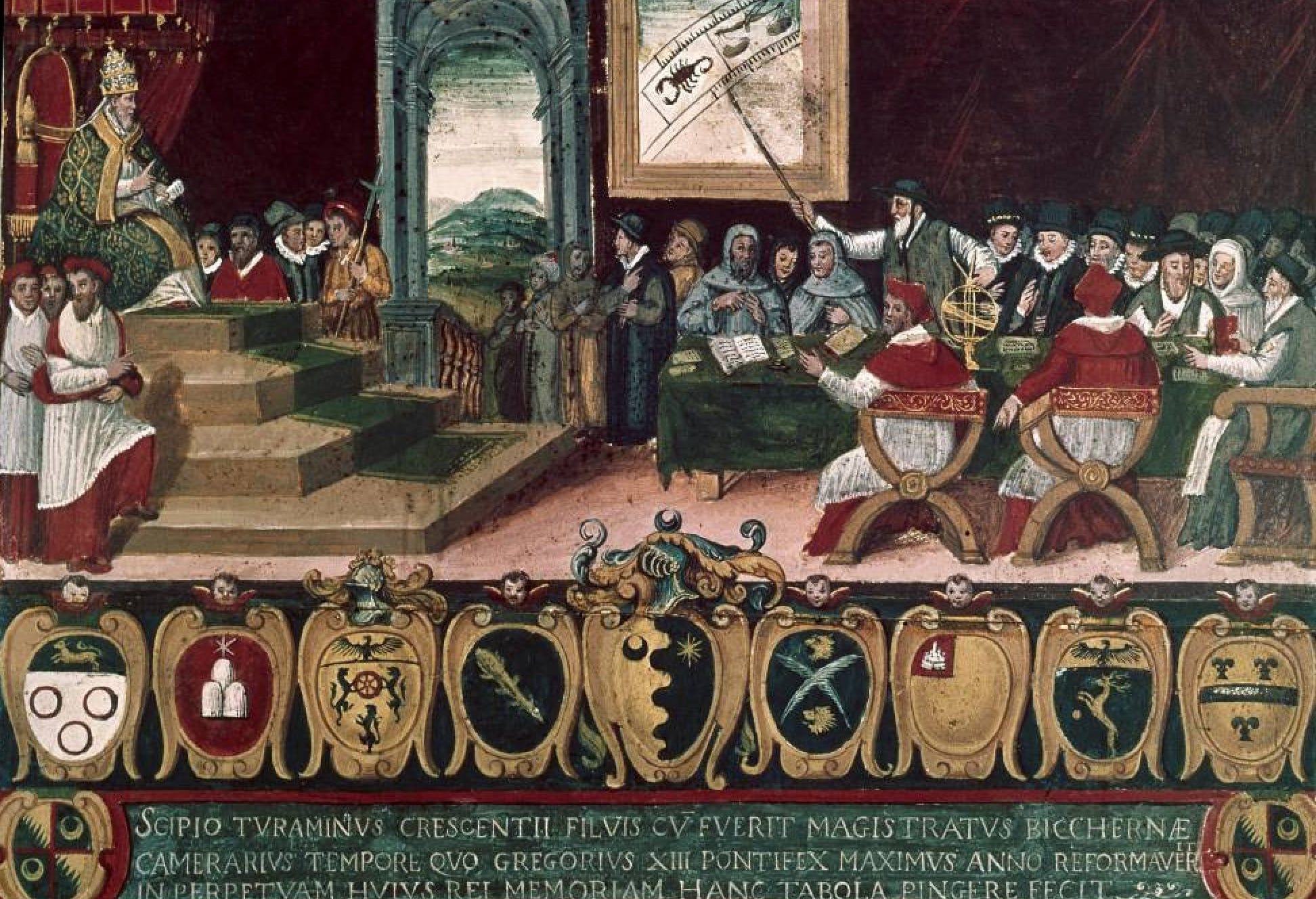
The inaccuracy in the Julian year, the difference between 0.24 and 0.25 days per year, is quite small when we limit our attention to the span of a single human life. Over centuries, though, the error accumulates. Season as marked by the sun decouples from season as marked by the calendar. This gap slowly became evident. In 1582, Pope Gregory XIII called for a new calendar, one that would give a better approximation. This correction removes three Julian leap years out of every 400 years. The Gregorian calendar, therefore, approximates the solar year as 365.2425 days.
When Gregory introduced his change, he did two things. One was to modify how leap years would be observed going forward. The other was to make a one-time adjustment to correct for the error accumulated since the Council of Nicaea. The Julian year is an overestimate. Recall from the 372-day example: this means that the solstice was occurring too early in the calendar year. To fix this, one needs to remove calendar days. Within the sphere of Roman influence, calendars skipped from October 4 (the Feast of St. Francis) to October 15, 1582.
Great Britain and the colonies waited to adopt the Gregorian calendar. They came around while George Washington was a young man, and September 2, 1752, was followed by September 14, 1752. In the future United States, then, the transformation of time was subtly marked by the sign of the Holy Cross (celebrated September 14).
Now we need to put all this together, finally getting to the real question. What does it mean to celebrate 800 years of Francis? Solstices and equinoxes are the way that the sun marks time. We need to ask, then: how long after the autumnal equinox did Francis die? Let us work our way backward. This year, the autumnal equinox was on September 22. The Gregorian/British deletion of days means that before 1752, the autumnal equinox occurred eleven days earlier, according to the calendar (i.e., around September 11). Going back further, we must note that Julian leap years were observed in 1700, 1500, 1400, and 1300, which shifts the equinox four days in the other direction, calendrically. The difference 11 − 4 gives 7. So we conclude that the equinox in 1226 occurred around September 15.
Sister Death embraced Francis sometime in autumn; to measure this moment according to Our Lord Brother Sun means forgetting about every human calendar. October 4, 1226, happened about 19 days after the autumnal equinox. Nineteen days after our autumnal equinox, this year, is… October 11. The celebration has not yet come to its natural end.
There are two points that I have overlooked but cannot omit any longer. One is that the Gregorian year, like the Julian, is only an approximation. The accumulated difference, over 800 years, is roughly a quarter day, so our calculations have not been too inaccurate. Another is that the Transitus of Francis and his liturgical feast are not wholly identical; it seems that he passed from this life after the sunset of October 3. Days can be reckoned from sunset instead of midnight, so his feast was established on the 4th. Some uncertainties will always remain, in this life.
In Bonaventure’s Itinerarium Mentis in Deum, the life and Stigmata of St. Francis are a jumping-off point for investigating how the human mind ascends through created things. I would like to offer a kind of mirror image of the Bonaventurian presentation. Having begun with the scientific work of the mind, let us conclude by turning to Francis. Here are three points about his life, in the light of our study of the measurement of time. The first concerns convention, the second lowliness, and the third beauty.
This essay has pointed out that a certain convention—October 4, according to calendars—is missing something. St. Francis is renowned, and perhaps beloved, because of his willingness to transgress convention. The calculations above showed us that it costs something to see the nature beyond convention. Authentic “transcendence” of the convention involves submission to an order even more rigid, austere, and demanding. We might pause, then, for self-examination before we undertake to overstep conventional bounds. St. Francis sold his father’s wares, but he also acquired something: the wounds of One Crucified.
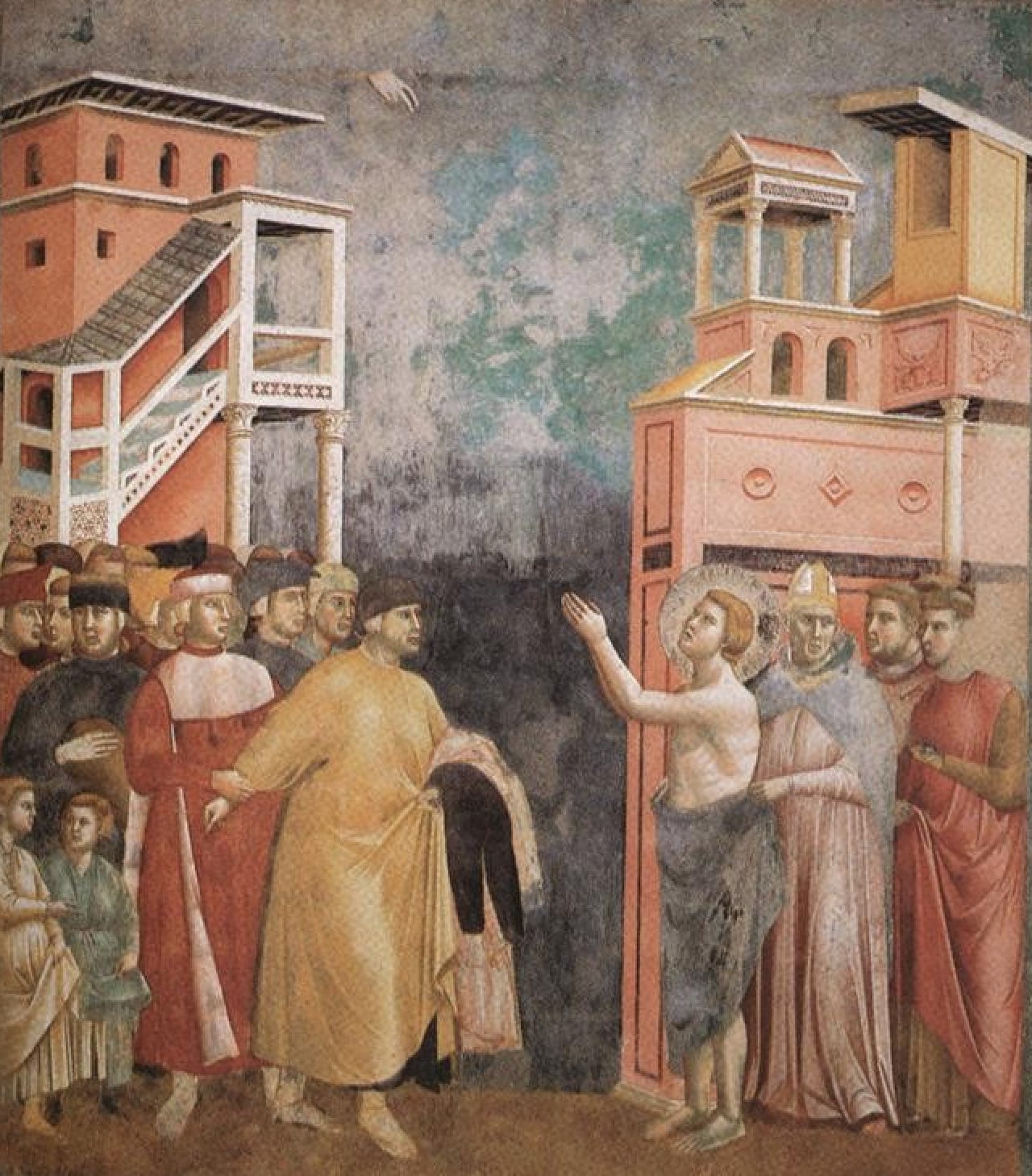
As his life drew to an end, Francis removed his clothes and lay upon the ground. He could not be lowly enough. The Franciscans who chose to expose Francis’s mortal remains for veneration this year drew inspiration from John 12: the seed must fall to the ground and die, lest it remain alone. In an age of dramatic scientific advances, we might hope to catch a glimpse of God in a new subatomic particle or in the latest galaxy revealed by a space telescope. I have no problem with new science, and I publish it myself. I hope, though, that we keep our eyes on lowly things, things like seeds and yeast and the familiar Sun. It seems that they have been imbued with a power to speak to us in every age.
Finally, what can the Christian believer call beautiful? Those of us with business in the world need to dress well and keep our lawns tidy. We want to offer pleasing fare when guests arrive. All of this is surely to the good. St. Augustine, like St. Bonaventure, was inspired by the perfection of the number six. In the Julian calendar, the residual part of the year has six hours, exactly. Sometimes the numbers seem so clean, so beautiful. St. Augustine took it as a sign.2 Sometimes, though, things do not work out. We are left with a mess, ever to be fiddled with, never to be fully grasped. Christians see beautiful things as beautiful. But they have learned of a more-than-mortal beauty. Francis speaks of it like this. “When I was yet in my sins, it seemed to me unbearably bitter to see lepers. And the Lord himself led me among them, and I showed kindness to them. And as I went away from them, that which had seemed bitter to me was now changed for me into sweetness of mind and body.”3
Notes
1. There are many subtleties in the definitions of years and days that will not be mentioned here. To explore these ideas, see the rich website of Dr. Irv Bromberg, https://kalendis.free.nf/seasons.htm#years, and the many beautiful graphs therein.
2. Augustine, De Trinitate IV.4.7–8.
3. Francis of Assisi, The Writings of St. Francis, trans. Ignatius Brady (Assisi: Edizioni Porziuncola, 1983), 143.
Cover: Cimabue, St. Francis, detail of the Maestà (c. 1285–88), Lower Basilica of San Francesco, Assisi, after the 2023 restoration. Public domain, via Wikimedia Commons.
Peter Ulrickson, a Fellow of the Gibbons Institute, is Associate Professor of Mathematics and Statistics at The Catholic University of America.